


Coin Metrics State of the Network is an unbiased, weekly view of the crypto market informed by our own network (on-chain) and market data.
Key Takeaways:
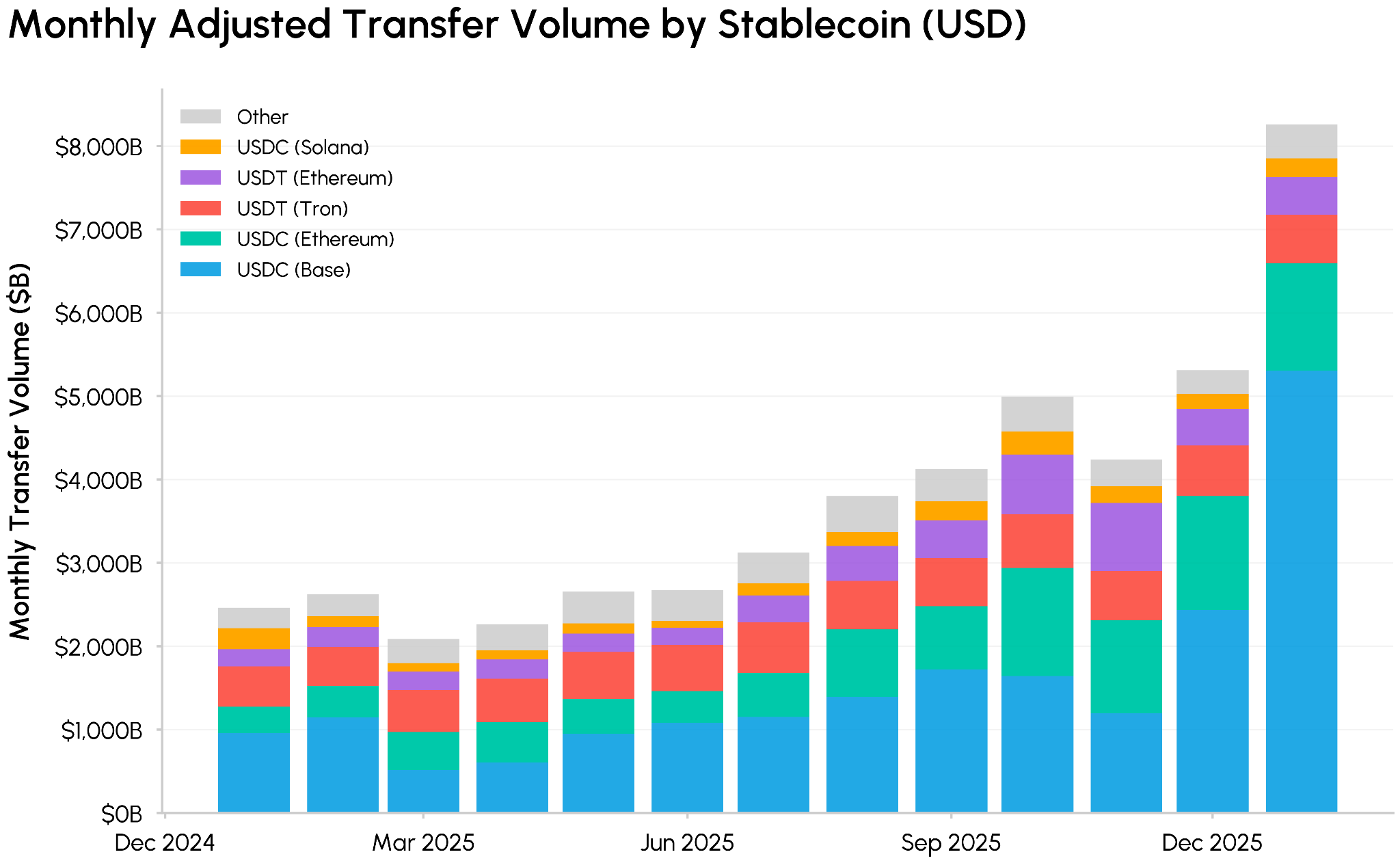
- In January 2026, adjusted stablecoin transfer volume hit a record $8T, with the majority of growth driven by USDC on Base.
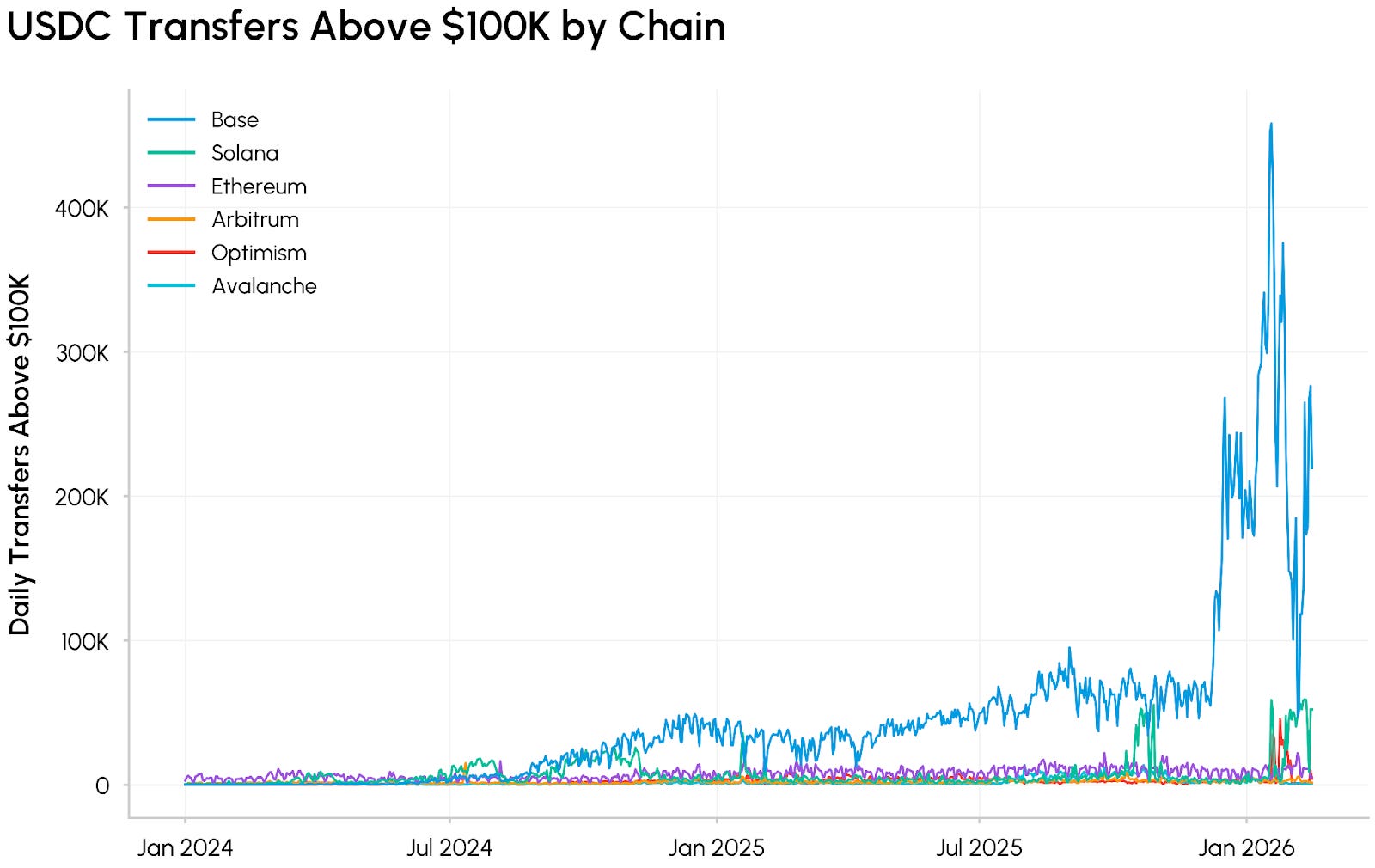
- The surge is driven by large transfers: daily USDC transfers above $100K on Base grew from under 50,000 to over 450,000 in January 2026, dwarfing all other chains.
- About half of this volume traces to DeFi infrastructure activity on Aerodrome liquidity pools and Morpho, rather than payments or settlement.
- The growth in stablecoin usage is real, but headline transfer volume can conflate fundamentally different economic activities, pointing toward a need for more granular classification of onchain activity.
Introduction
In January 2026, adjusted stablecoin transfer volume surged to a record $8T, eclipsing prior monthly averages.
As the supply of stablecoins expands onchain, they continue to gain attention as the rails for trading, decentralized finance (DeFi), settlement and increasingly, a range of global, programmable payments use-cases, including payroll, remittances and B2B payments. As a result, a key question for market participants is: what scale of economic activity are stablecoins facilitating, and how are they being used?
Source: Coin Metrics Network Data Pro
A closer look at transfer volumes reveals that a majority of January’s growth traces back to a single asset on a single chain: USDC on Base (in blue above). With ~$4.1B in supply, USDC on Base saw $5.3T in January 2026 transaction volume, generating unusually high velocity relative to other chains. However, does this represent a genuine surge in payments activity, or is something else at play?
In this issue of State of the Network, we dig into the drivers behind the surge in stablecoin transfer volume, zooming into the addresses and types of activity behind the headline numbers, and what it tells us about the evolving composition of stablecoin usage onchain.
A Surge in Large Transfers on Base
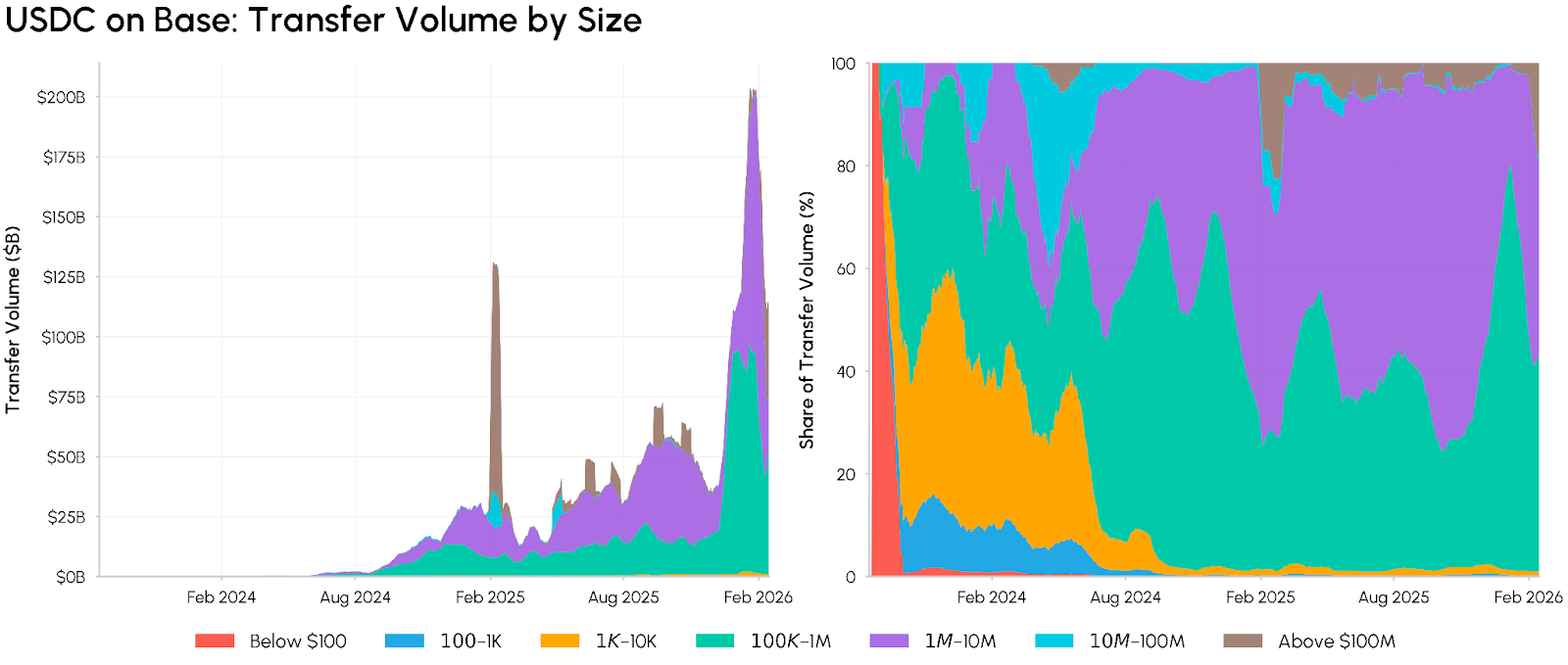
Looking at transaction sizes for USDC on Base, the growth comes overwhelmingly from large value transfers.
Source: Coin Metrics Network Data Pro
Daily USDC transfers above $100K exploded from under 50,000 per day in mid-2025 to peaks exceeding 450,000 in January 2026, dwarfing every other chain. Breaking down USDC transfer volume on Base by transaction size bands confirms this pattern.
Source: Coin Metrics Network Data Pro
Large transfers between $100K–$1M and $1M–$10M now dominate, together accounting for roughly 90% of all transfer value. Smaller transaction bands have compressed, despite an uptick in low-value USDC transfers, partly driven by emerging use cases like AI-agent micropayments through x402 payments protocol. The $10M–$100M and above $100M bands also spike intermittently, pointing to periodic whale sized flows.
Given this shift in composition, what could be driving this high value activity on Base?
Behind the Mechanics Driving Stablecoin Volume
To identify the smart contracts and addresses behind this activity, we used Coin Metrics ATLAS data to get USDC balance updates on Base over a 10-day window in January 2026 where the growth is most concentrated. The top 5 addresses identified are associated with DeFi activity, specifically liquidity provision on Aerodrome, an automated market maker (AMM) based decentralized exchange (DEX), and onchain lending on Morpho. Extending this across the full year shows their outsized role:
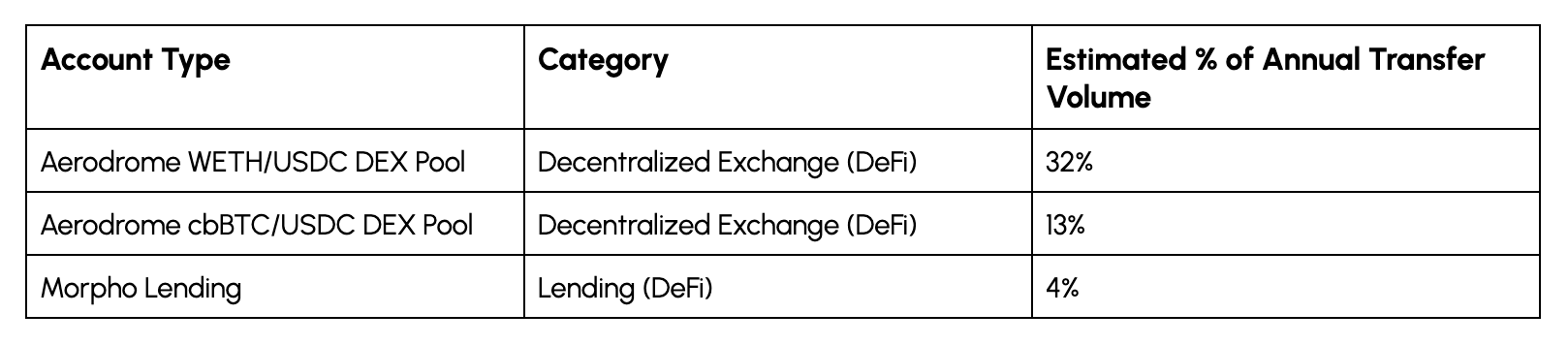
The most active account by a wide margin is Aerodrome’s WETH/USDC concentrated liquidity pool, which alone accounts for an estimated 32% ($6.4T) of all USDC adjusted transfer value on Base over the past year ($20T). Its cbBTC/USDC pool and Morpho are also significant contributors. Together, these represent flows tied to DeFi mechanics and plumbing rather than payments or settlement activity.
To understand how and why these contracts generate such outsized volume, we examine the mechanisms behind concentrated liquidity management on Aerodrome and flash loan arbitrage on Morpho.
Inside Aerodrome Concentrated Liquidity & Flashloans on Morpho
Aerodrome is the largest automated market maker (AMM) DEX on Base, and its Slipstream pools use a concentrated liquidity model similar to Uniswap V3. Liquidity providers (LPs) deploy capital within specific narrow price ranges, which improve spreads, capital efficiency and attract high volume traders. Importantly, LPs earn AERO token emissions when their position is within the active trading range, creating a strong incentive to constantly rebalance when market conditions shift.
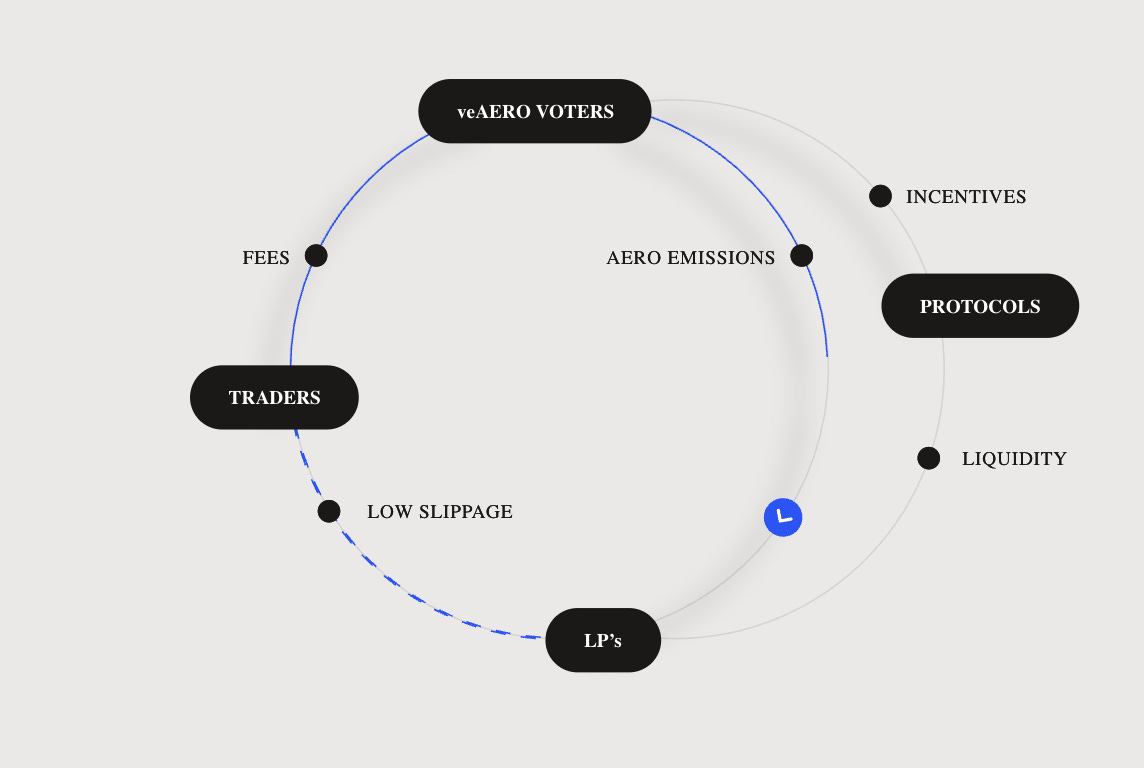
Source: Aerodrome Documentation
Transaction level event logs confirm that the dominant activity on the pool consists of liquidity position management (burn, decreaseLiquidity, collect) and gauge reward claims, rather than swap execution. This generates transfer volume through two main channels:
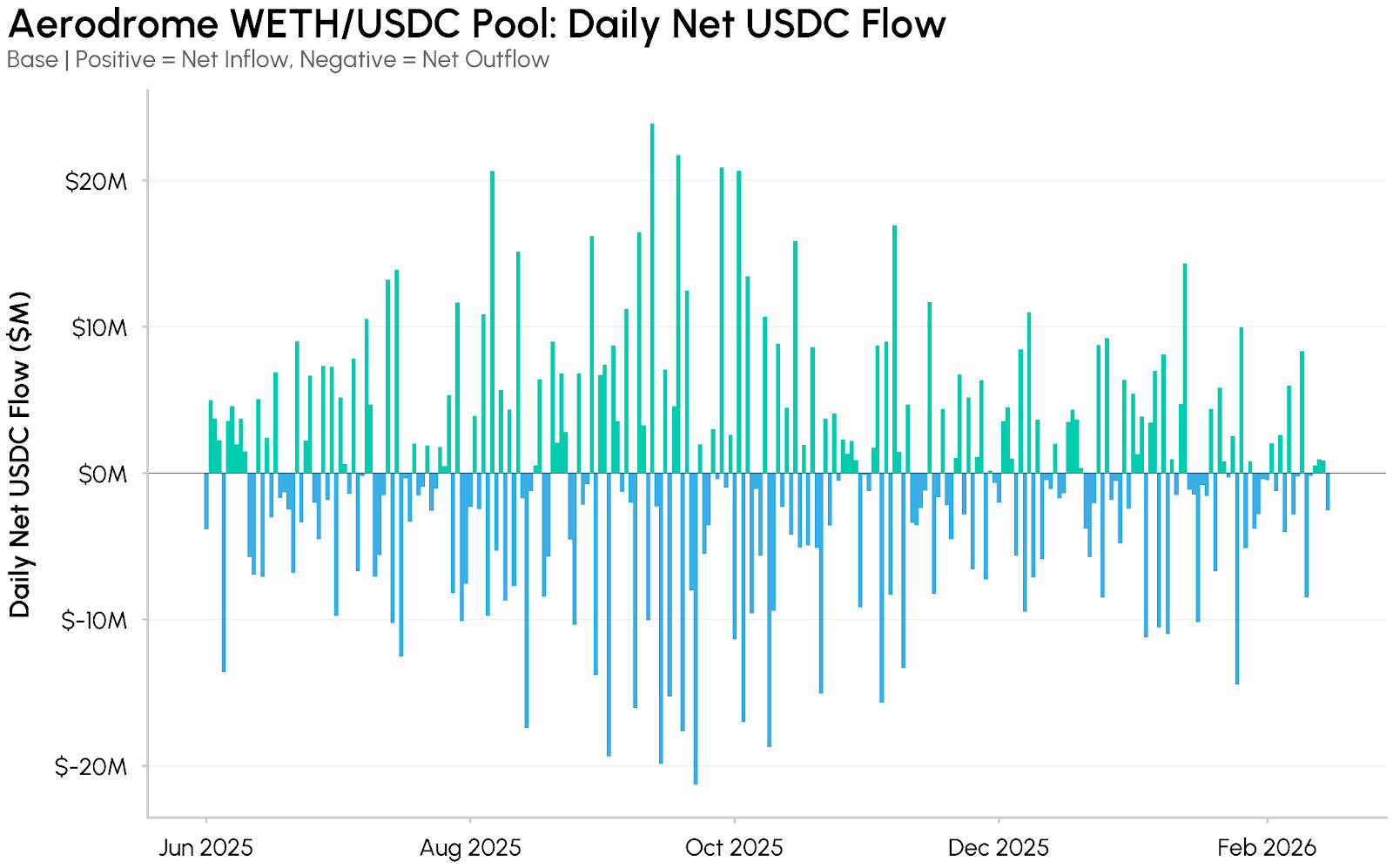
- Concentrated liquidity rebalancing: As ETH price moves, LPs and automated vault strategies withdraw USDC and re-deposit at updated tick ranges. Each rebalance generates large inflows and outflows with little net effect on the pool’s balance.
- Gauge driven repositioning: Aerodrome’s ve-style gauges and emissions mean liquidity chases AERO rewards. At the end of each epoch, LPs withdraw, claim rewards, and redeploy in size, producing multi-million dollar flows to manage positions.
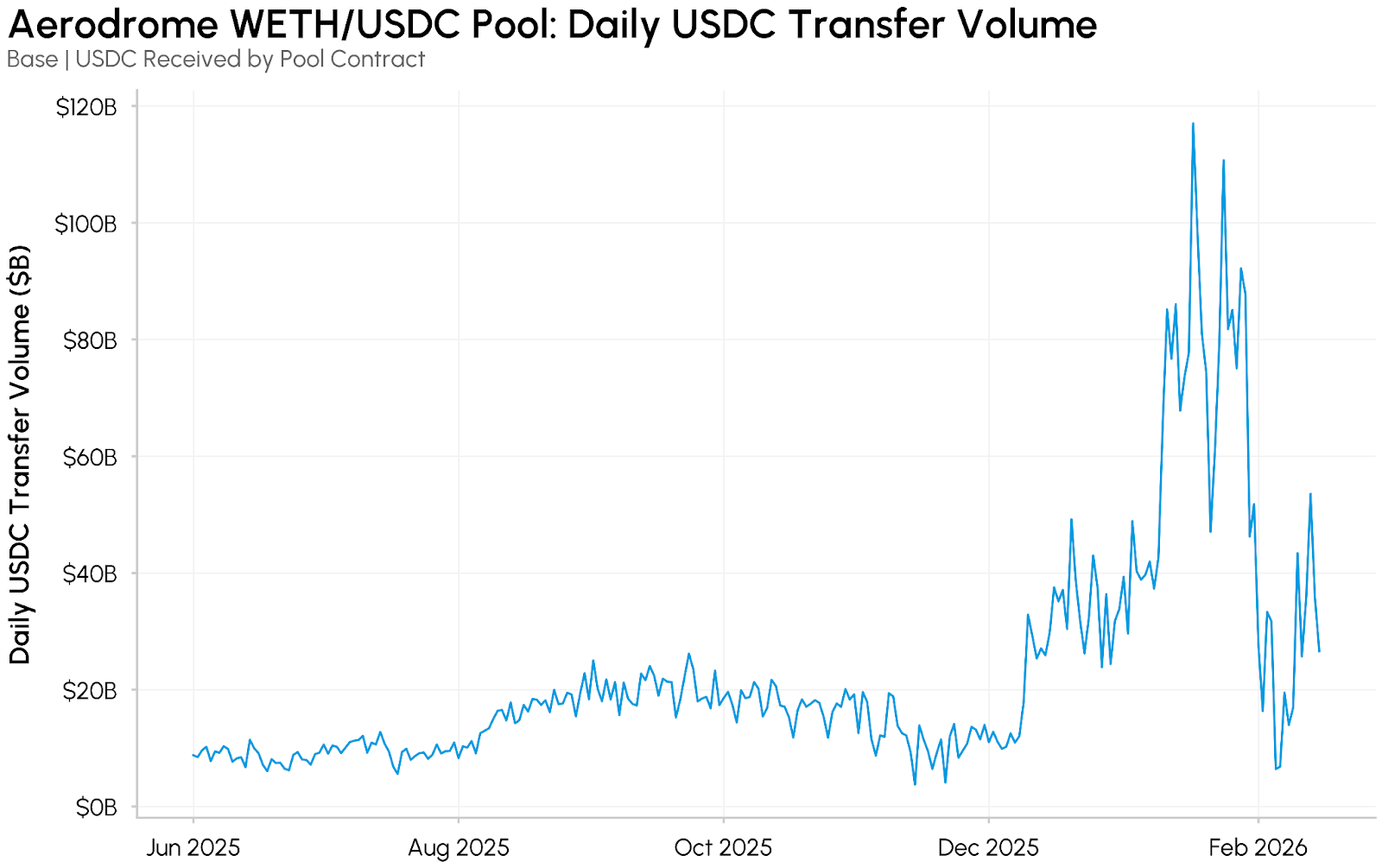
At the peak in January 2026, the WETH/USDC pool saw over $100B in USDC transfer volume, with daily net flow rarely exceeding ±$20M as capital cycled in and out. Drilling into the addresses that interact frequently with the pool (counterparties) reveals that just 5 addresses account for ~80% of this activity, with transaction counts exceeding tens of thousands per day. This suggests the presence of automated strategies rather than manual position management.
Morpho exhibits a different pattern. A large share of USDC transfer volume comes from flash loan activity as seen in this transaction involving $114M USDC. These are atomic transactions in which bots borrow large sums from Morpho to execute arbitrage, liquidations, or position restructuring, repaying the full amount within the same transaction. A single flash loan can move over $100M in USDC that leaves and returns to Morpho within seconds, registering substantial transfer volume without representing net economic movement.
Decomposing Transfer Volume
Decomposing USDC transfer volume on Base by these identified DeFi contracts shows the scale of their contribution. The blue shaded region represents the estimated transfer volume attributable to the top 3 contracts, primarily Aerodrome activity and Morpho, while the green region captures the remaining unclassified activity.
In January 2026, these identified DeFi contracts accounted for an estimated ~50% of the $5.3T in USDC adjusted transfer volume on Base, linking directly to LP rebalancing on DEXs, flash loan arbitrage, and related DeFi mechanical activity. The remaining activity still shows healthy growth, but nowhere near the $200B+ daily peaks that drove the headline figure.
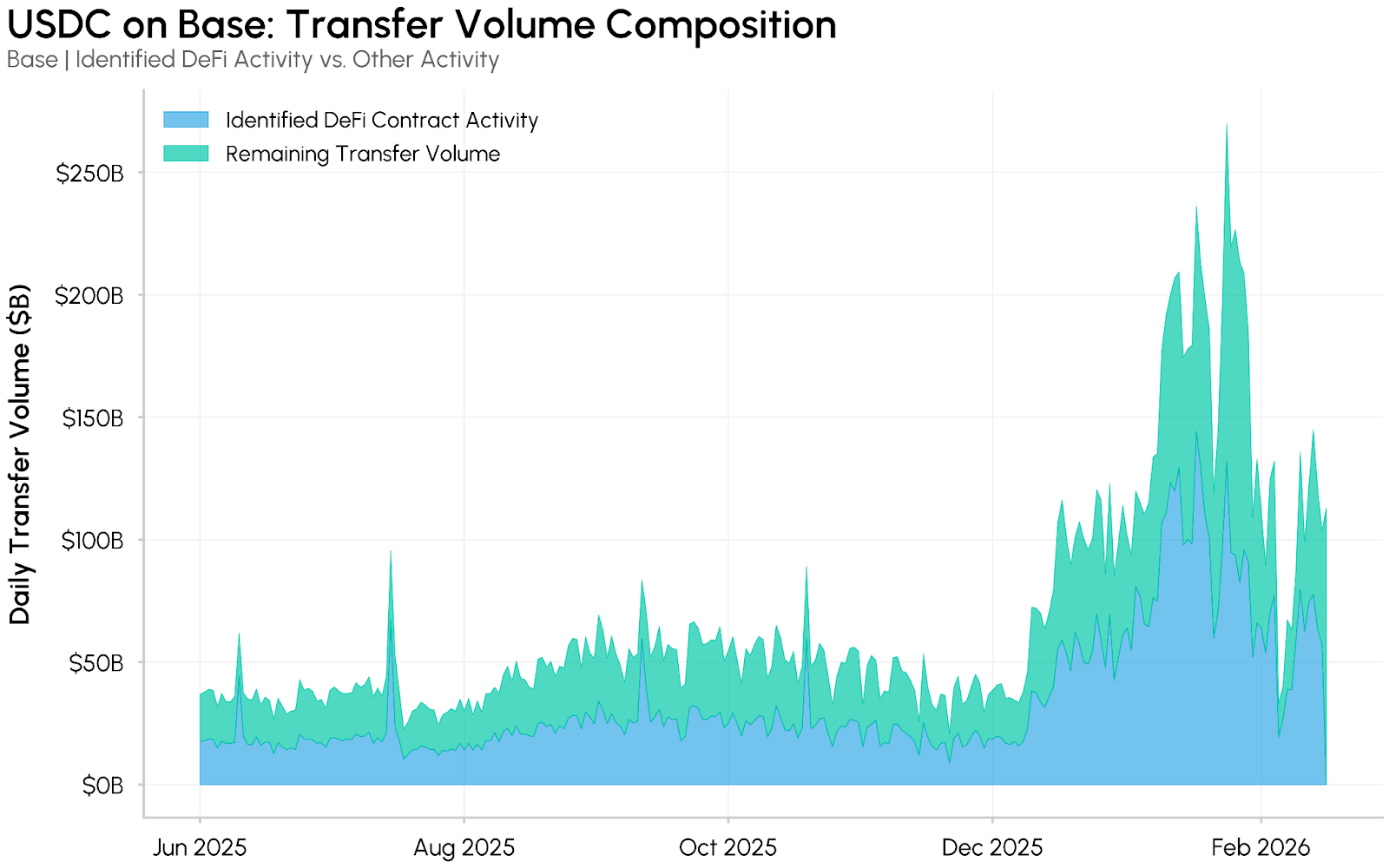
Source: Coin Metrics ATLAS & Network Data Pro
This doesn’t diminish the value of the underlying DeFi activity. Concentrated liquidity provisioning improves price efficiency and tightens spreads for traders, while flash loan enabled arbitrage helps align prices across venues, making them core functions of onchain financial markets. But a dollar cycling between LP tick ranges or flash loans is categorically different from a dollar settling a cross-border payment, and headline transfer volume metrics can conflate the two.
Conclusion
As stablecoins draw increasing attention from institutions, payment providers and regulators, the ability to distinguish between different types of onchain activity becomes increasingly important. Headline transfer volume captures the total movement of value on a network, but as this analysis shows, it mixes fundamentally different economic activities. The growth in stablecoin usage is real; the challenge is accurately measuring which kinds of usage are growing and by how much. While this analysis focused on USDC on Base due to its outsized role, it points toward a need for more holistic classification, decomposing transfer volume into meaningful categories that reflect how stablecoins are actually being used and bring clarity to an ever expanding onchain economy.
Disclaimer: The information herein is provided for informational purposes only. Talos Trading, LLC and its affiliates (“Talos”) does not give any representations or warranties in relation to the accuracy, validity, or completeness of the information of this material, including without limitation the factual information obtained from publicly available sources considered by Talos to be reliable at the time. Talos accepts no liability for any consequences of using the information contained in this material. Any opinions or estimates expressed herein reflect a judgment made by the author(s) as of the date of publication and are subject to change without notice. Neither this material nor any copy thereof may be taken, reproduced, or redistributed, directly or indirectly, without Talos’s prior written permission. Any views or opinions expressed are those of the authors and do not necessarily reflect the views of Talos. This communication does not constitute an offer to buy or sell, or a promotion or recommendation of, any digital asset, security, derivative, commodity, financial instrument, or product or trading strategy. This document and information are not intended to constitute investment advice or a recommendation to make (or refrain from making) any kind of investment decision and may not be relied on as such.
Subscribe
If you’d like to get State of the Network in your inbox, please subscribe below.
Latest insights and research


.jpg)
Request a demo
Find out how Talos can simplify the way you interact with the digital asset markets.