

Coinbase Q1 2026 Earnings: Diversification in a Down Market
State of the Network #363
Coinbase Q1 2026 Earnings: Diversification in a Down Market

Introduction
State of the Network #363
Coin Metrics State of the Network is an unbiased, weekly view of the crypto market informed by our own network (on-chain) and market data.
- Coinbase reported $1.4B in Q1 2026 revenue, down 21% QoQ as declining crypto prices and trading volumes weighed on transaction revenues.
- Despite the soft trading environment, Coinbase reached an all-time high in crypto trading volume market share and USDC held on-platform hit a record $19B, with subscription and services representing 44% of net revenue.
- The "everything exchange" strategy gained traction, with prediction markets, retail derivatives, and newly launched tokenized equity and commodity perpetuals showing early momentum.
Introduction
Coinbase Global Inc. (COIN) reported its Q1 2026 earnings on Thursday May 7th, a quarter of mixed results amid challenging market conditions. Against a backdrop of declining crypto prices and suppressed volumes, total revenue came in weaker than expectations at $1.4B, down 21% QoQ, with a net loss of $394M driven primarily by unrealized losses on its crypto investment portfolio. Yet green shoots emerged across derivatives growth, trading volume market share, and progress on the “everything exchange” strategy, with new offerings like prediction markets and tokenized equities gaining early traction.
In this issue of State of the Network, we unpack Coinbase’s Q1 2026 earnings through the lens of underlying market and on-chain data, with additional insights from a conversation with Coinbase CBO Shan Aggarwal. This follows our Q4 2025 pre-earnings outlook, where we estimated revenue across Coinbase’s key business lines.
Highlights from Q1 2026
Despite a challenging macroeconomic and market backdrop, Coinbase delivered on several strategic fronts in Q1 2026. Key highlights from the quarter include:
- Trading market share: Reached an all-time high in crypto trading volume market share across both spot and derivatives.
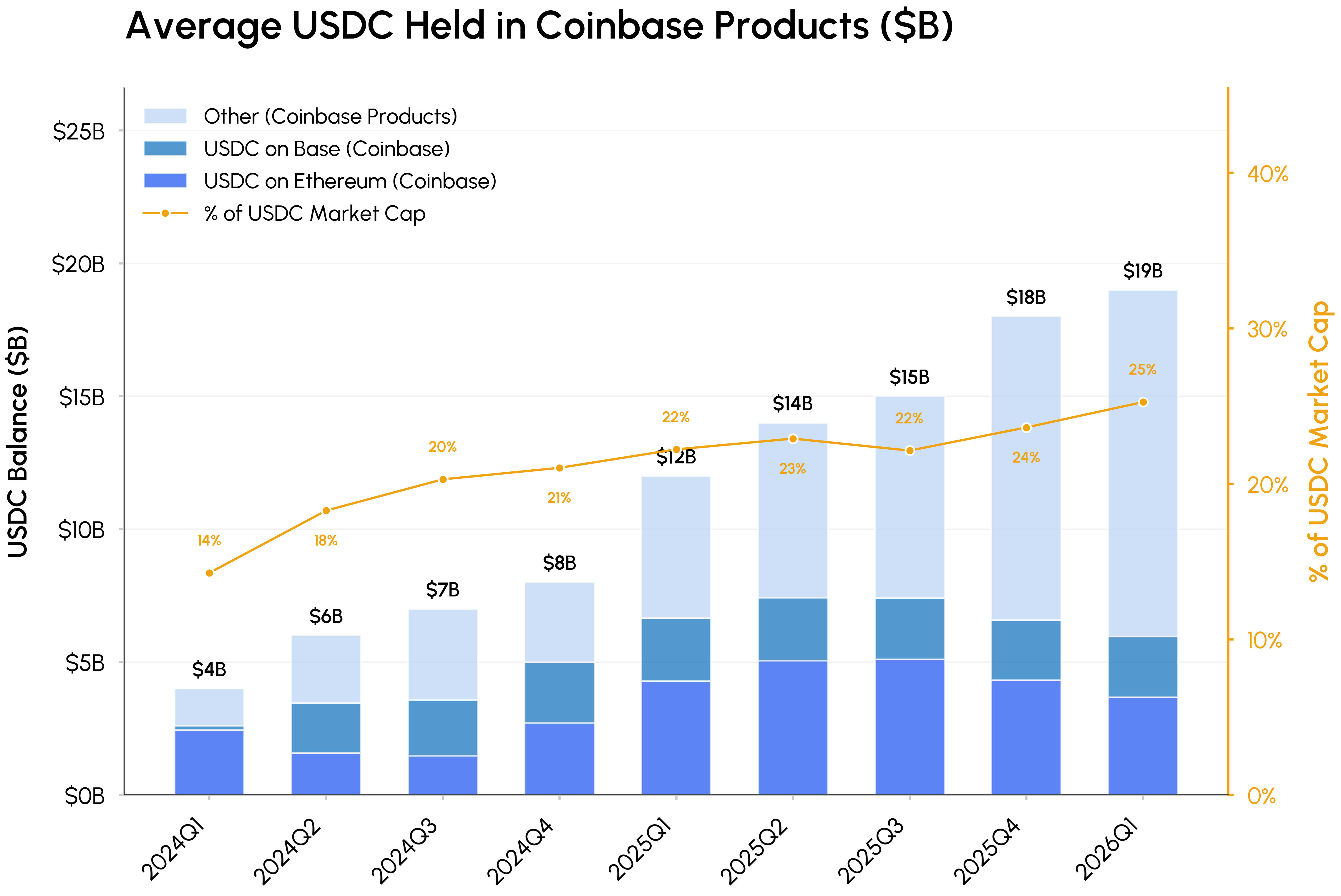
- USDC on Platform: Average USDC held in Coinbase products hit a new ATH of $19B, with over 25% of all USDC in circulation.
- Everything Exchange: Early traction in new verticals with retail derivatives passing $200M annualized revenue. Prediction markets reached $100M annualized in just their second full month live.
Declining Volume, Market Share on the Rise
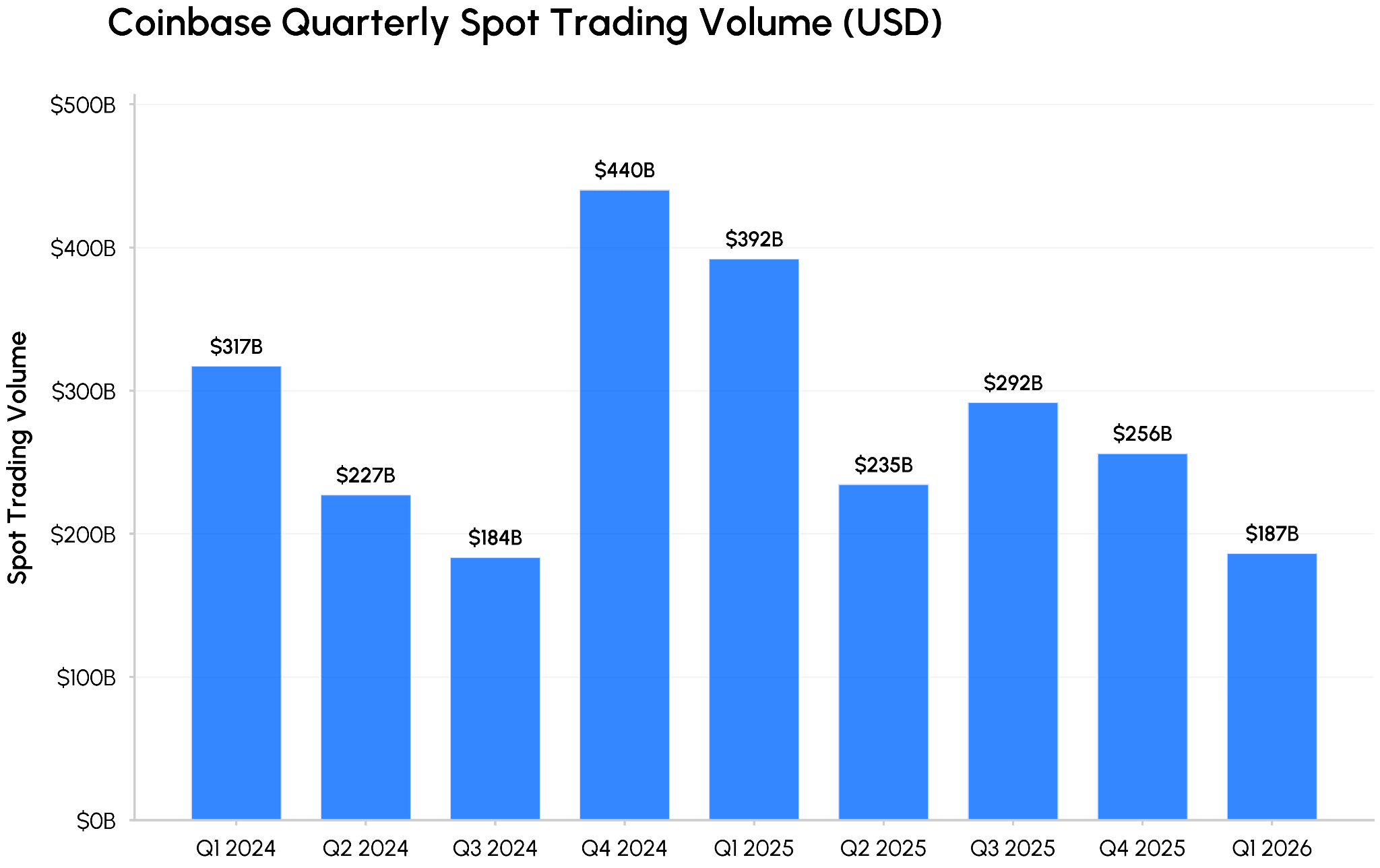
Transaction revenue driven by Coinbase’s core trading business came in at $756M, 23% lower QoQ. This was largely due to the overall downturn in trading volumes, especially across spot markets, with Coinbase seeing $187B in quarterly spot trading volume in Q1. Volatility in February drove a short-lived spike, but spot volume tapered off to the lowest quarterly level since 2023, as BTC became range-bound below $70K.
Source: Coin Metrics Market Data Pro
Transaction revenue was composed of $567M from consumer trading activity (down 23%) and $136M from institutional trading activity (down 27%), broadly in line with the overall market volume decline. Trading activity shifted to a more BTC-heavy mix (41% of quarterly volume) at the expense of a narrowing altcoin share, reflecting reduced retail participation. The decline in consumer revenue was primarily volume driven rather than a compression in take-rates.
Source: Coin Metrics Market Data Pro
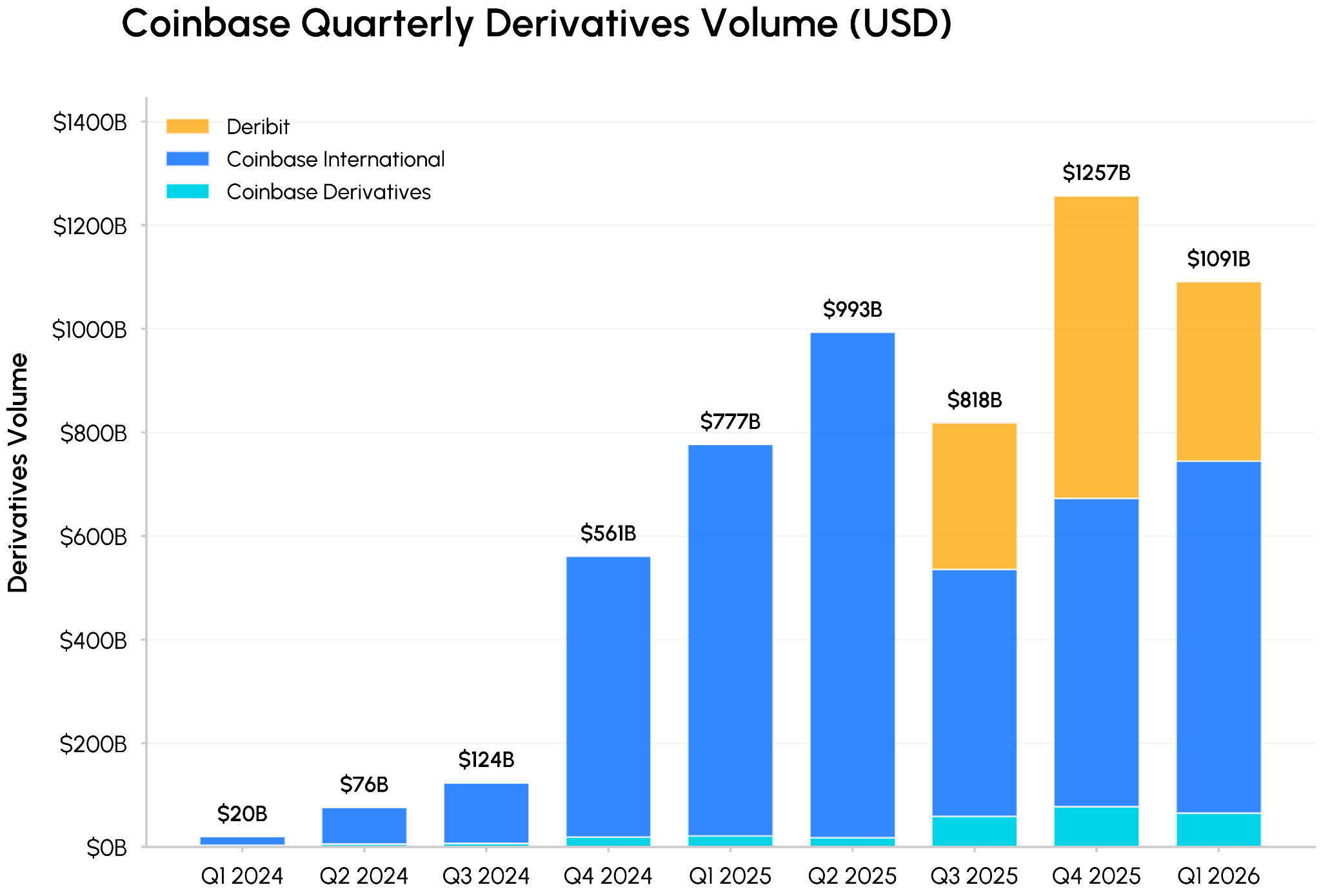
Derivatives were the brighter spot. Total derivatives volume across Coinbase Derivatives, Coinbase International, and Deribit reached $1.09T in Q1, Deribit’s second full quarter under Coinbase. Despite softer spot markets, Coinbase gained ground reaching an all-time high in crypto trading volume market share of 8.6% across spot and derivatives combined, reflecting the platform’s growing footprint even in a down market. As CBO Shan Aggarwal noted:
“Deribit has been foundational for us on the derivatives side. We’re making very good progress on the integration, which we expect to complete in 2026. And on the other side of that, we will have a cohesive exchange across spot, options and perpetuals with one unified deep global pool of liquidity.”
Notably, Q1 marked the first time Coinbase introduced derivatives directly into its core application, driving retail derivatives to a $200M+ annualized revenue run rate through its broadest retail distribution channel.
USDC, Base and the Emerging Agentic Commerce Layer
The breadth of Coinbase’s recurring revenue base is an often overlooked aspect of the company, as the market continues to view it primarily as a crypto exchange. However, diversification through subscription and services continues to provide a durable buffer to volatility, exemplified by Coinbase now having 12 products generating $100M+ in annualized revenue. In Q1, subscription and services revenue came in at $584M, down 16% QoQ, but represented 44% of net revenue even in a challenging quarter.
Coinbase continues to be a major driver and beneficiary of USDC growth, with stablecoin revenues contributing $305M. This was driven by average USDC held in Coinbase products reaching a new ATH of $19B, with over 25% of all USDC in circulation now held on Coinbase. Of this, ~$6B USDC resides on the Coinbase exchange across Ethereum and Base addresses, while the remainder is spread across Coinbase Prime custody, institutional accounts, and corporate balances.
This reflects Coinbase’s role as the primary distribution engine for USDC, capturing approximately 50% of total USDC economics through its revenue sharing agreement with Circle (44% in Q1 2026 with Circle reporting $694M in reserve income).
Source: Coin Metrics Network Data Pro & Coinbase Q1’26 Earnings Deck
On the regulatory front, the CLARITY Act continues to progress, with a markup expected this month and a floor vote anticipated later this summer. A key provision debated in the Senate draft proposed restricting passive holding rewards for stablecoin holders, which raised open questions about how it could impact Coinbase’s USDC interest-income monetization, rewards program and on platform balances. When asked how Coinbase would navigate this, Aggarwal explained:
“We expect to continue to monetize primarily through our commercial partnership with Circle, which is effectively perpetual and continues onward. It's been a hard fought piece on the stablecoin reward side, but with any good compromise both sides have had to make sacrifices. The most important thing is that rewards have been preserved for American consumers."
More broadly, the CLARITY Act’s progress reinforces rather than threatens Coinbase’s stablecoin position. By defining the broader regulatory framework for crypto markets and the licensed intermediaries within it, it further entrenches Coinbase’s role as a core part of that infrastructure.
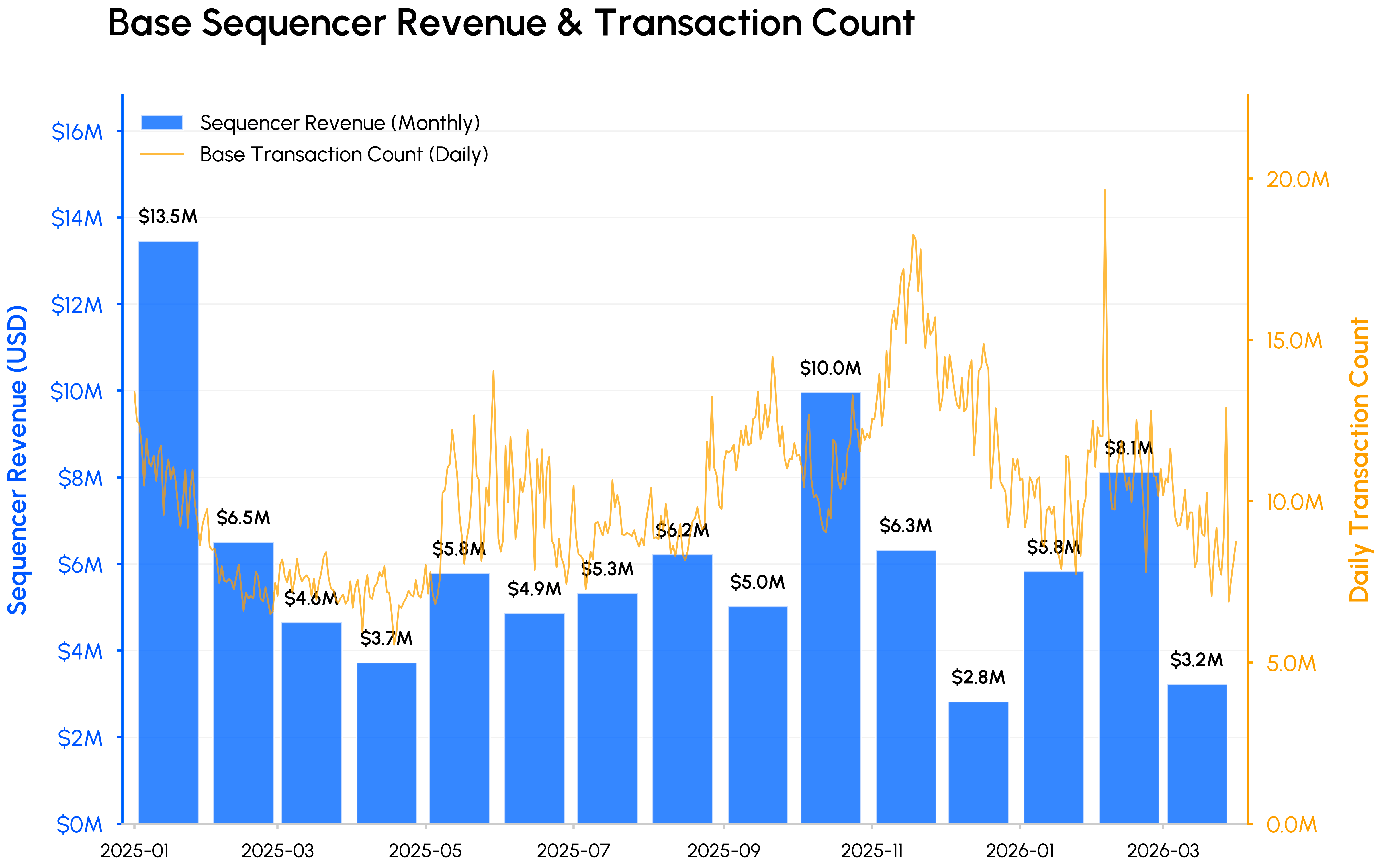
Beyond USDC interest income, Base is an increasingly important monetization layer. Coinbase captures sequencer fees through the transactions that take place on Base (reported within other transaction revenue), but its strategic importance extends well beyond that line item. Base is well-positioned to capture fees through any activity-based streams that settle on its infrastructure, from high-frequency agentic payments to DEX trading.
Source: Coin Metrics Network Data Pro
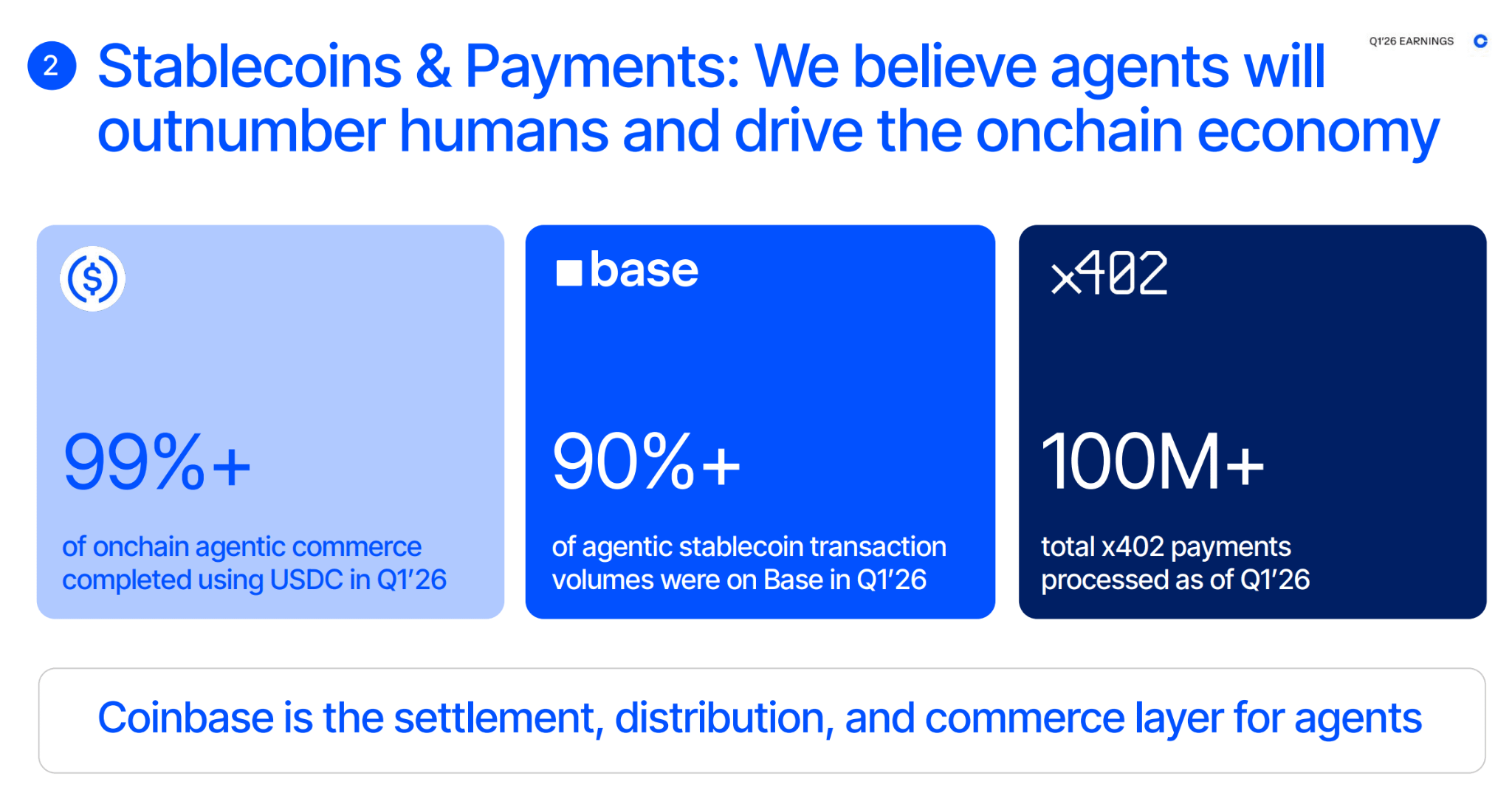
The most compelling signal comes from agentic commerce. Over 90% of onchain agentic stablecoin transactions occurred in USDC on Base in Q1, and Coinbase has processed 100M+ payments via its x402 protocol with 99%+ completed in USDC, positioning Coinbase as a vertically-integrated stack for the emerging AI-native economy. Aggarwal highlighted this momentum, noting:
“Over 90% of on-chain agentic stablecoin transactions happen in USDC on Base, while it’s still early days, we’re very encouraged by the progress there.”
Source: Coinbase Q1’26 Earnings Deck
Blurring the Lines: The “Everything Exchange” Takes Shape
This quarter also advanced Coinbase’s “everything exchange” strategy: one platform for trading every asset class from crypto-assets to tokenized equities and prediction markets. The structural thesis has gained broader validation, with Coinbase, Robinhood, Hyperliquid and others converging on the same idea of building a unified venue for digital and traditional assets.
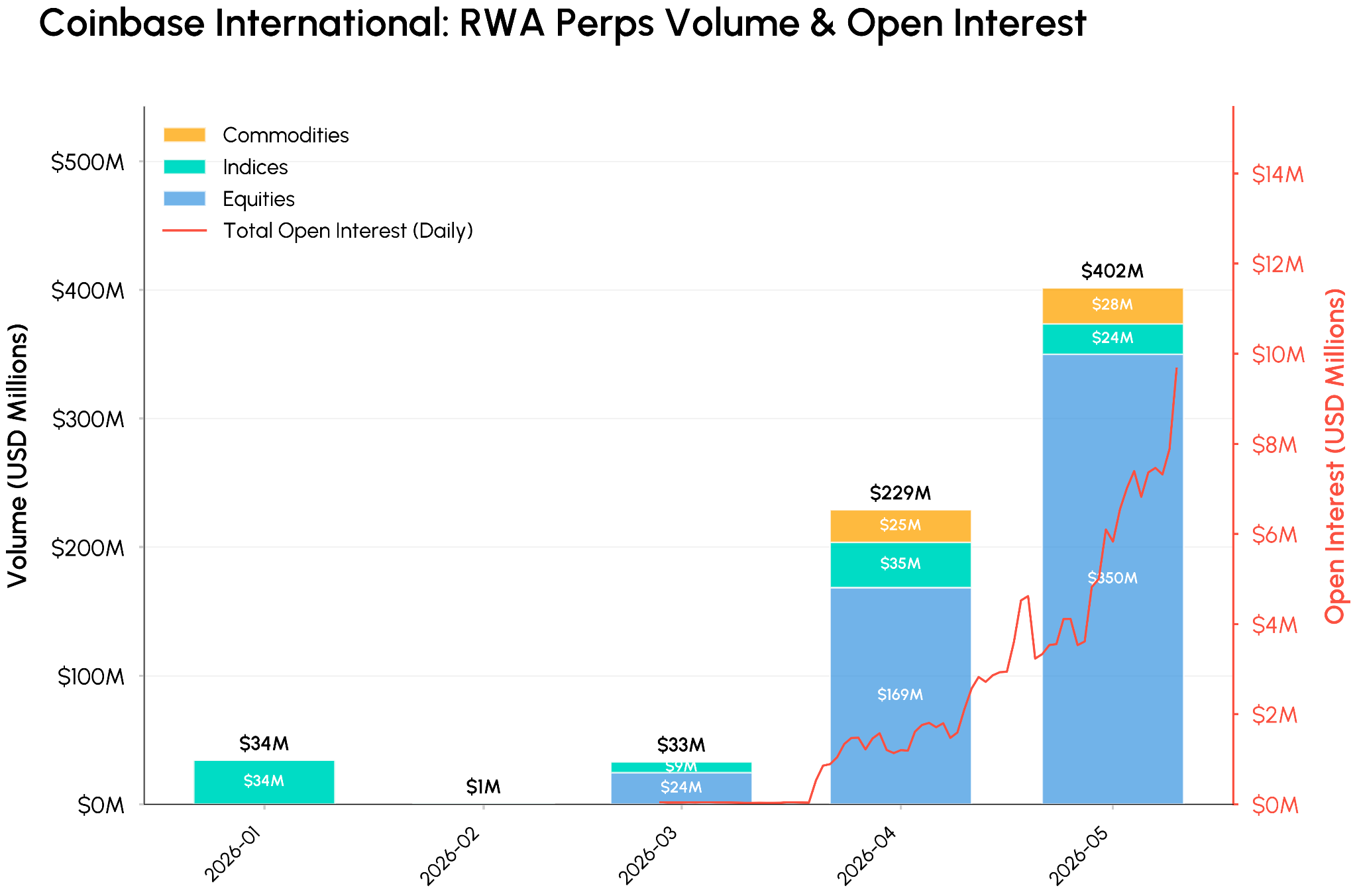
For Coinbase, Q1 delivered tangible early proof points. Prediction markets, launched in February in partnership with Kalshi, reached $100M+ annualized revenue in just their second full month live. Retail derivatives also crossed $200M annualized after being introduced to the core Coinbase app for the first time in Q1. Additionally, many new RWA perpetuals markets were introduced on Coinbase International, providing exposure to popular U.S. stocks, indices and precious metals like Gold and Silver.
“So we feel really good about the trajectory of these businesses. They’re still early days, but we feel like it really validates our strategy around offering multiple asset classes to our customers”.
Source: Coin Metrics Market Data Feed
Total volume across these categories has grown from $33M in March to $402M as of May 11th, with open interest steadily climbing to over $10M. As seen with growth in HIP-3 on Hyperliquid, RWA perps could provide diversification during periods when crypto trading slows. At $402M monthly volume ($4.8B annualized run rate), RWA perps remain small relative to Coinbase’s core business but are growing at a rate that could make them material to derivatives revenue in future quarters.
“We introduced a lot of new asset classes and we’re continuing to expand our capabilities within those asset classes. The goal is to offer users the ability to trade any asset class with deep liquidity and capital efficiency”.
Conclusion
Q1 was a challenging quarter that tested Coinbase’s business model. Declining prices dampened sentiment while spot volume softened to the lowest level since 2023. Despite this, Coinbase’s trading volume market share hit an all-time high, USDC reached record on-platform balances, and new verticals like prediction markets and retail derivatives gained early traction.
Coinbase remains a company in structural transition, from a crypto exchange cyclically tied to retail sentiment, to a diversified financial infrastructure platform. With three priorities looking ahead, “grow the everything exchange, scale stablecoins and payments, and win onchain”, navigating a competitive landscape alongside a recovering market and progress on the CLARITY Act could prove pivotal.
Disclaimer: The information herein is provided for informational purposes only. Talos Trading, LLC and its affiliates (“Talos”) does not give any representations or warranties in relation to the accuracy, validity, or completeness of the information of this material, including without limitation the factual information obtained from publicly available sources considered by Talos to be reliable at the time. Talos accepts no liability for any consequences of using the information contained in this material. Any opinions or estimates expressed herein reflect a judgment made by the author(s) as of the date of publication and are subject to change without notice. Neither this material nor any copy thereof may be taken, reproduced, or redistributed, directly or indirectly, without Talos’s prior written permission. Any views or opinions expressed are those of the authors and do not necessarily reflect the views of Talos. This communication does not constitute an offer to buy or sell, or a promotion or recommendation of, any digital asset, security, derivative, commodity, financial instrument, or product or trading strategy. This document and information are not intended to constitute investment advice or a recommendation to make (or refrain from making) any kind of investment decision and may not be relied on as such.
Subscribe
If you’d like to get State of the Network in your inbox, please subscribe below.
Latest insights and research



Request a demo
Find out how Talos can simplify the way you interact with the digital asset markets.