

Stock Market that Never Sleeps: Inside the Premiums and Liquidity Gaps of Tokenized Equities
State of the Network #388
Stock Market that Never Sleeps: Inside the Premiums and Liquidity Gaps of Tokenized Equities

Introduction
State of the Network #388
Key Takeaways:
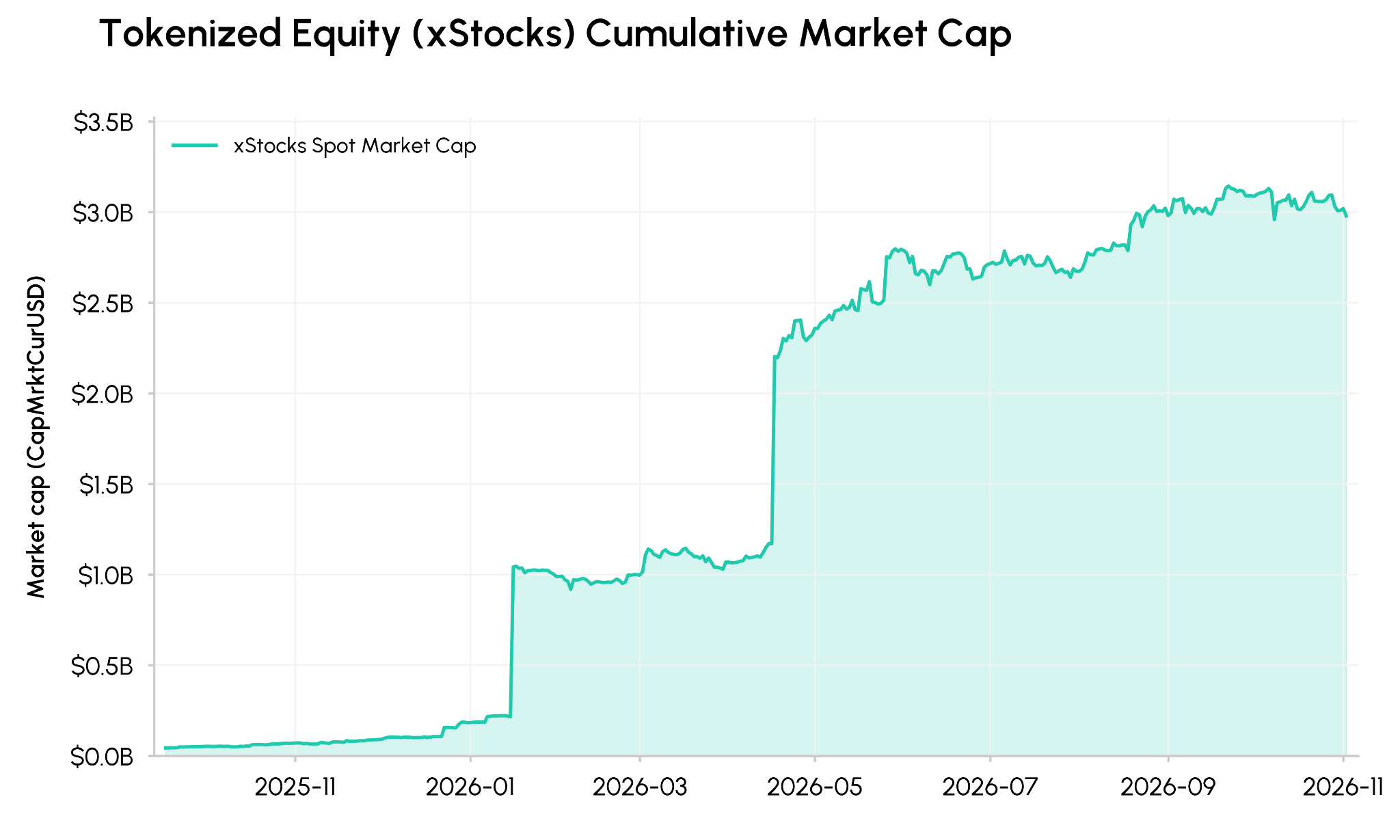
- The total market cap of tokenized equities has grown to over $3B. Investors can gain on-chain exposure to stock prices through various issuers including xStocks, Ondo Tokenized Stocks, and bStocks.
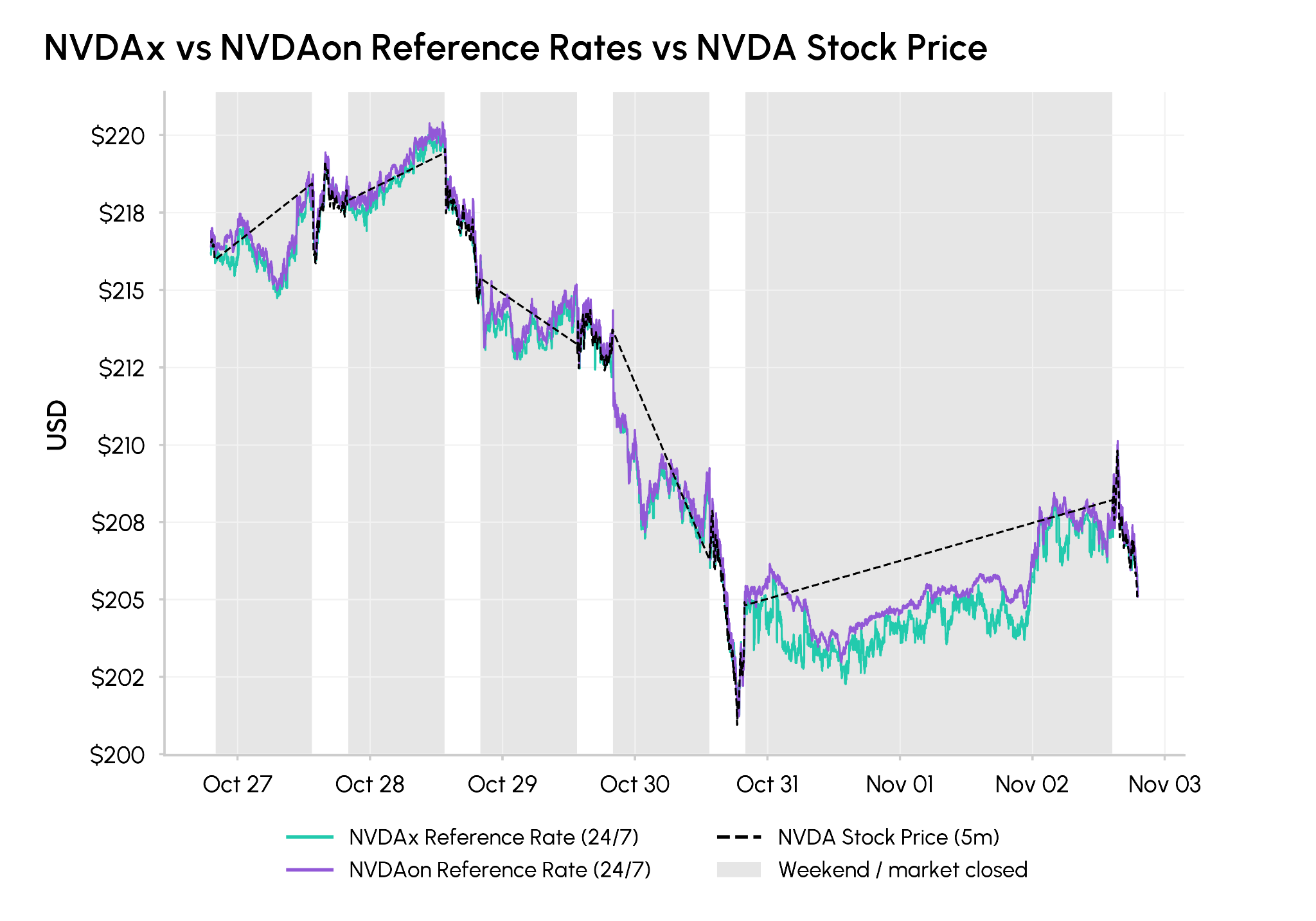
- NVDAx traded above the NVDA price in 58.6% of market-open hours, averaging 3.1 bps in those hours; NVDAon did so in 88.9%, averaging 14.1 bps.
- Tokenized stock prices also vary by market and trade size. One tokenized stock on a specific market might have the lowest slippage on a $10K trade but not $100K. This requires cross-venue data to compare both slippage and tokenized stock coverage.
Introduction
Between October 27 and November 2, exchanges have generated over $2B in volume on tokenized spot equity markets. As demand for on-chain exposure grows, custodians acquiring and issuing more tokenized stocks has led to the total market cap of tokenized equities jumping to over $3B.
Source: Talos CM Network Data Pro
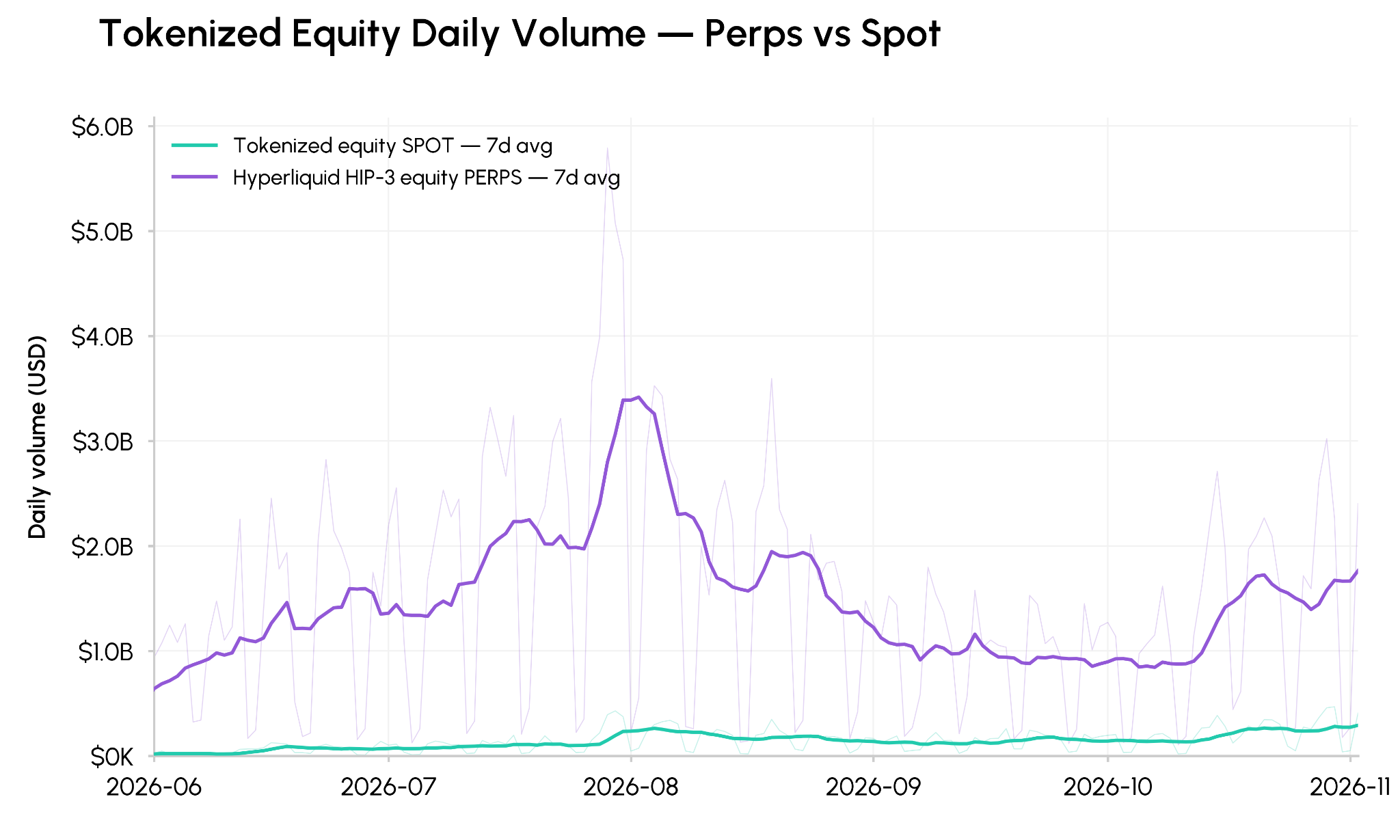
While the market cap of tokenized stocks has grown steadily to ~$3B, spot trading volumes remain small relative to their perpetual counterparts. Over the past week, equity perpetuals on Hyperliquid generated roughly $12.3B in volume or 6x the $2.0B traded across tokenized-equity spot markets.
Source: Talos CM Market Data Pro
In this State of the Network we break down how tokenized stocks trade against the underlying stock, pricing during aftermarket and pre-market hours, and the market fragmentation of these assets.
Tokenized Stocks v the Underlying Stock
Tokenized stocks are generally offered to non-U.S. investors and provide on-chain price exposure to U.S. equities, including outside U.S. market hours. Tokenized stocks are issued by entities that hold the underlying shares, typically through a custodian. Tokenized stocks trade in markets that operate 24/7, enabling continuous pricing when the underlying assets on traditional markets are closed.
Source: Talos CM Market Data Pro, Yahoo Finance
Select users are whitelisted to mint new tokens and redeem for the underlying stock. This creates redemption risk for holders who do not have the same privilege. From October 27 through November 2, NVDAx, issued by xStocks, traded at an average premium of 3.1 bps during 58.6% of open market hours. NVDAon, issued by Ondo Stocks, traded at an average 14.1 bps premium during 88.9% of open market hours. Tokenized NVDA traded below Friday’s close, alongside a broader sell-off.
Source: Talos CM Market Data Pro
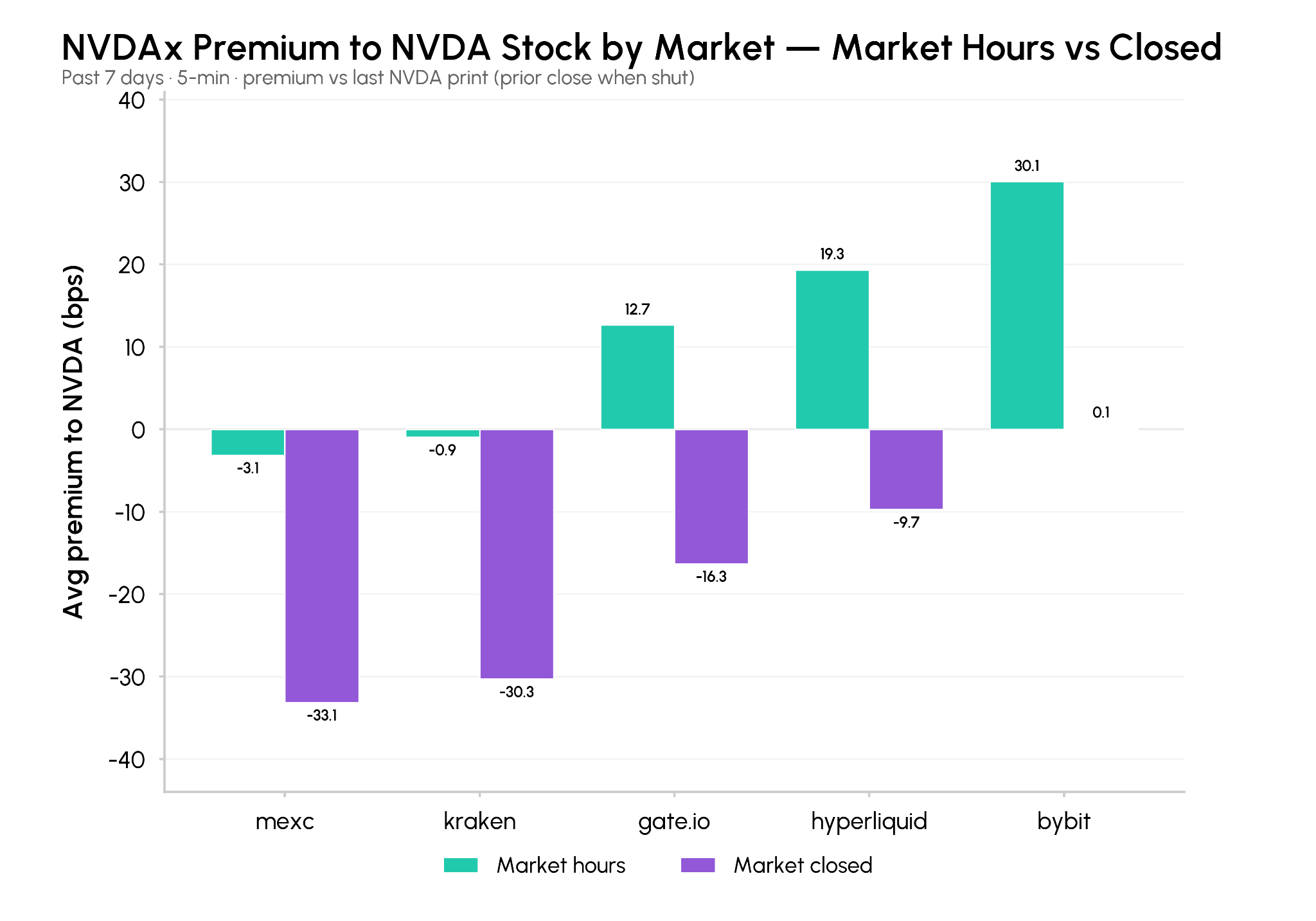
Exchange fragmentation has led to the same tokenized stock having different prices both during market open and closed hours across markets. Kraken’s NVDAx market averaged -0.9 bps versus NVDA during market-open hours.
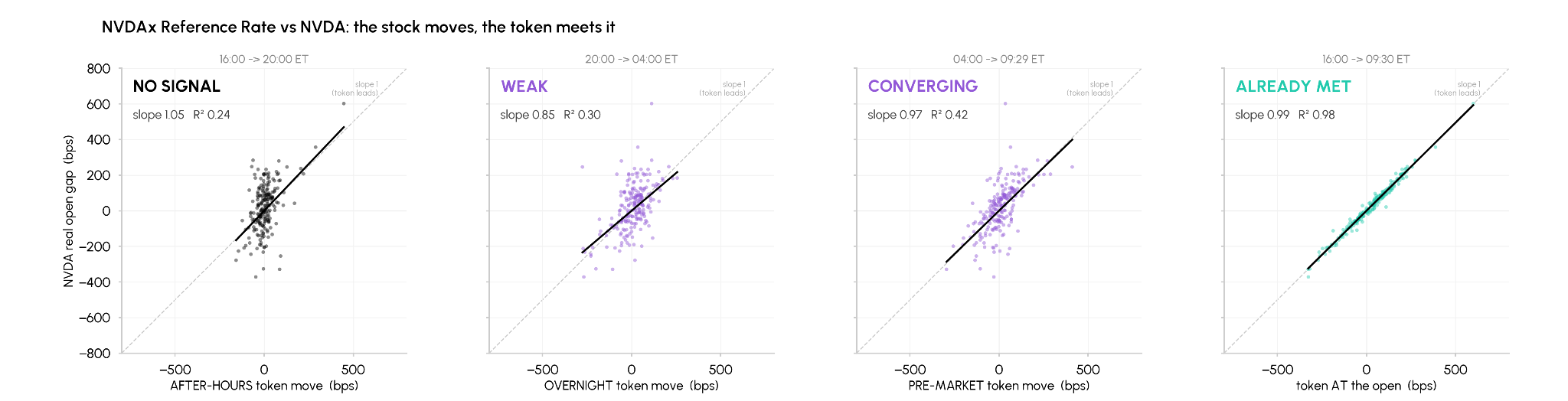
Using a lead-lag analysis, we compared NVDAx price moves while U.S. equity markets are closed against NVDA's actual move into the next open. We measured three windows over 210 trading sessions (Jan 2026–present):
- After-hours (4:00pm–8:00pm ET): evening token moves are only weakly related to where NVDA opens the next morning with a correlation coefficient of 0.24. Shortly after the close, the token carries little signal about the next day's direction.
- Overnight (8:00pm-4:00am ET): overnight hours are weakly correlated with NVDA open price the following morning with a correlation coefficient of 0.3. This is stronger than the after-hours session and growing into the U.S. pre-market session.
- Pre-market (4:00am–9:29am ET): NVDAx steadily converges toward NVDA's eventual open, reaching an R-squared of 0.42.
- Full overnight (4:00pm–9:30am ET): across the entire closed period the token tracks the stock almost perfectly with an R-squared of 0.98. By the open, NVDAx has fully met the underlying price, as expected.
The tokenized price and the real stock are tightly linked at the open, but that convergence builds through the pre-market hours. The after-hours session alone says little about the next day's move.
Source: Talos CM Market Data Pro, Yahoo Finance
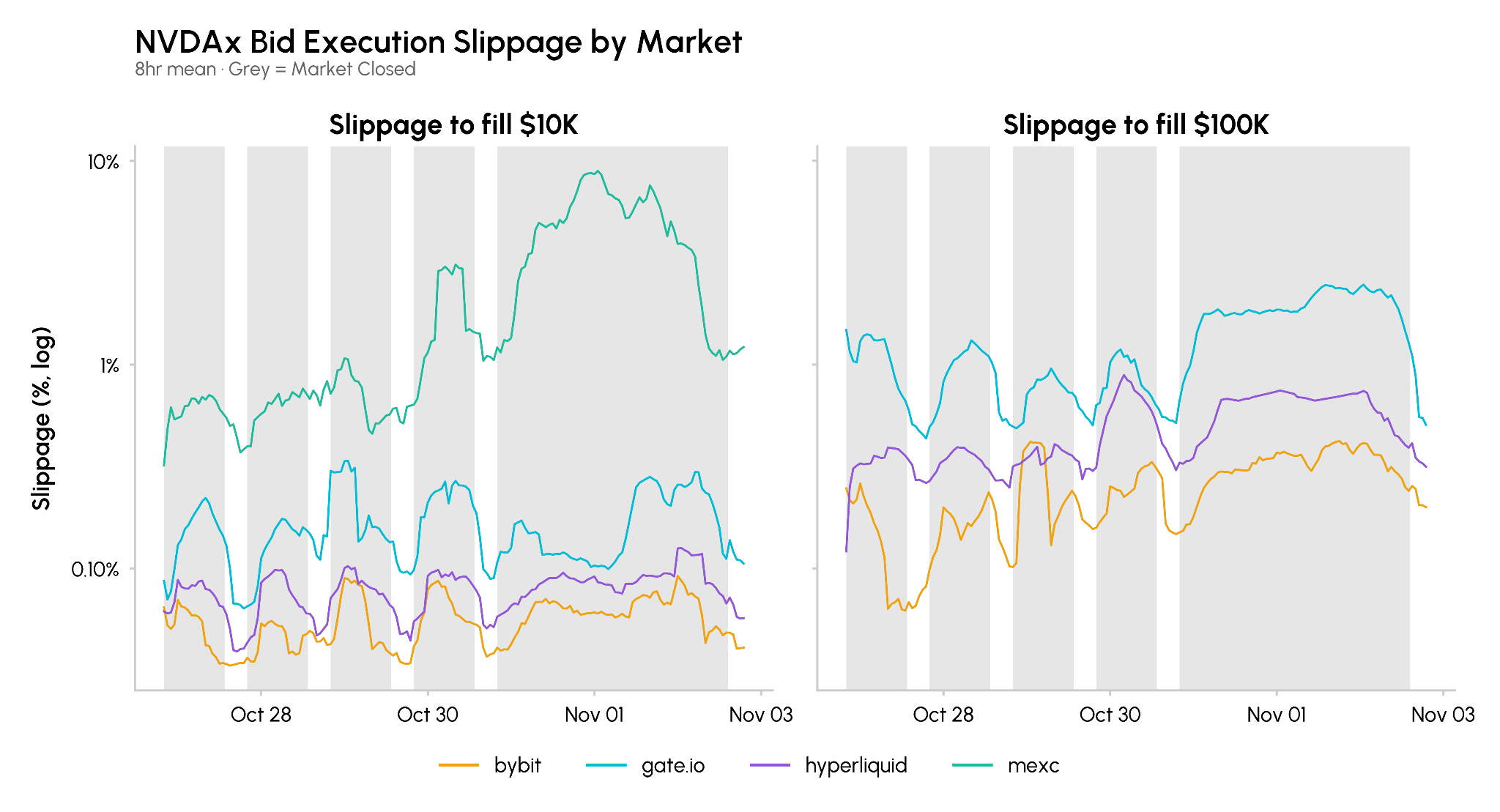
Tokenized stocks are sensitive to price movements, specifically during closed market hours. When closed, Bybit and MEXC NVDAx markets have on average 19% less liquidity within 1% of the midprice. Hyperliquid shed roughly 33% of its depth within 1% of the midpoint when markets closed. Buying and selling during these liquidity shocks can further misprice the same NVDAx token across markets until the market reopens.
Source: Talos CM Market Data Pro
When Do Tokenized Stocks Typically Trade?
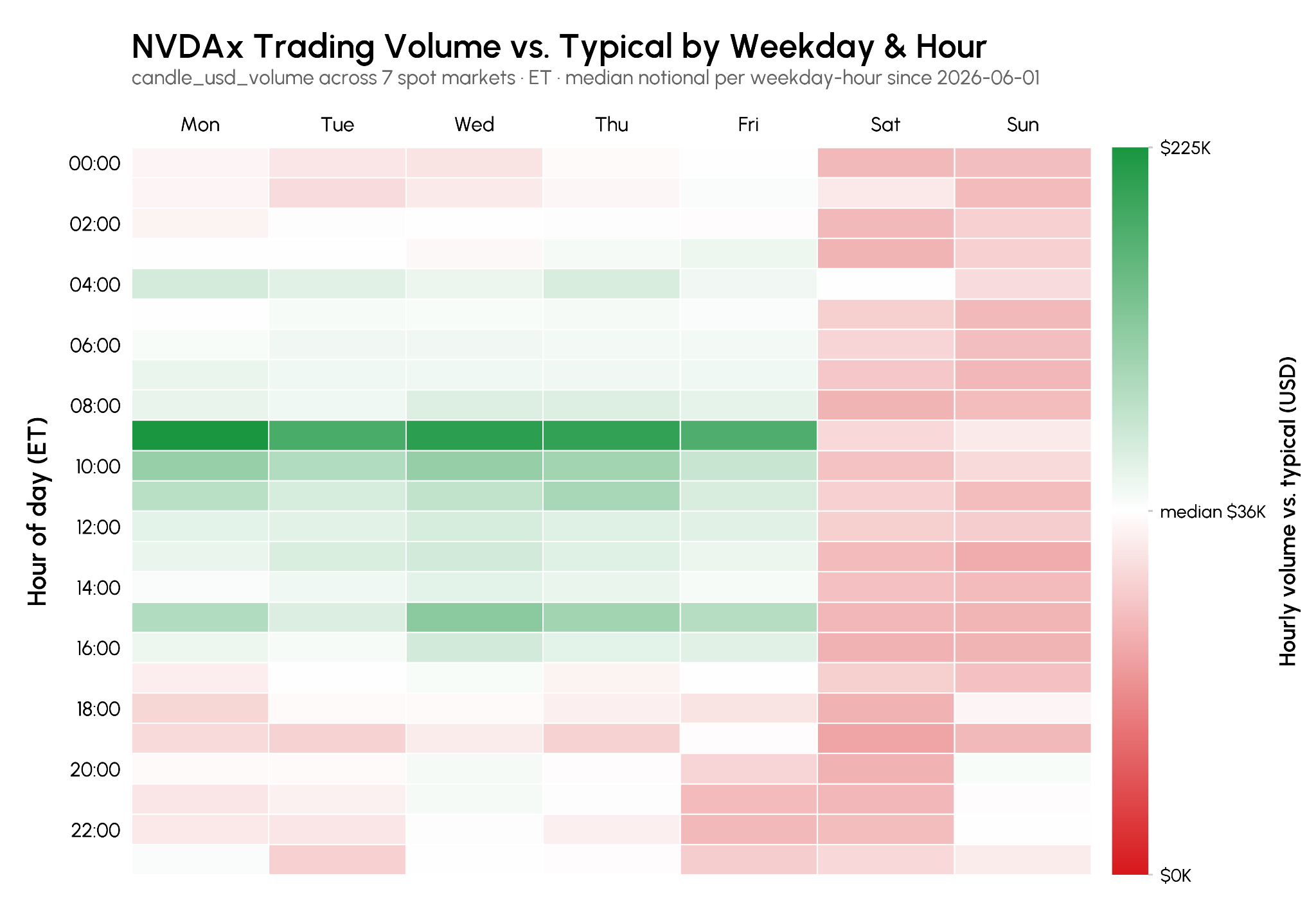
Tokenized stocks can provide access to prices of underlying U.S. stocks to non-U.S. investors. Examining when tokenized stocks trade during the day could show whether even in less liquid markets during closed hours, investors continue to trade tokenized stocks.
Source: Talos CM Market Data Pro
NVDA xStocks trade primarily around the market open and close. Between 9am and 10amET during weekdays, NVDAx averaged $225K in volume. Some trading occurs before and after market hours both in anticipation of the opening price and news occurring after. This does not clearly highlight which geographic region is trading these on exchanges. Offshore exchanges supporting these markets suggest international users are trading tokenized assets but primarily during U.S hours.
Cross-Venue Execution
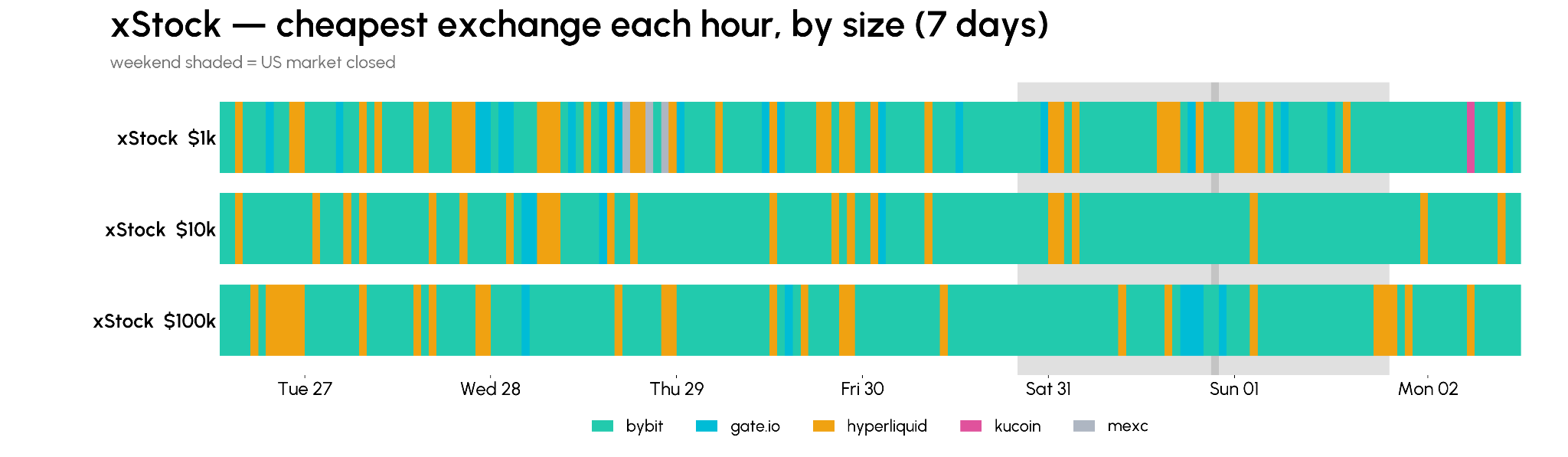
Prices for the same tokenized stock differ across venues, so the cost of acquiring exposure depends on where an order is executed.
Source: Talos CM Market Data Pro
At smaller sizes, more exchanges can support the execution. For trades of $1K from October 27 through November 2, Bybit and Hyperliquid were the venues with the lowest slippage 58% and 23% of the time respectively. On trades of $100K, Bybit or Hyperliquid is the best venue 98.2% of the time.
Source: Talos CM Market Data Pro
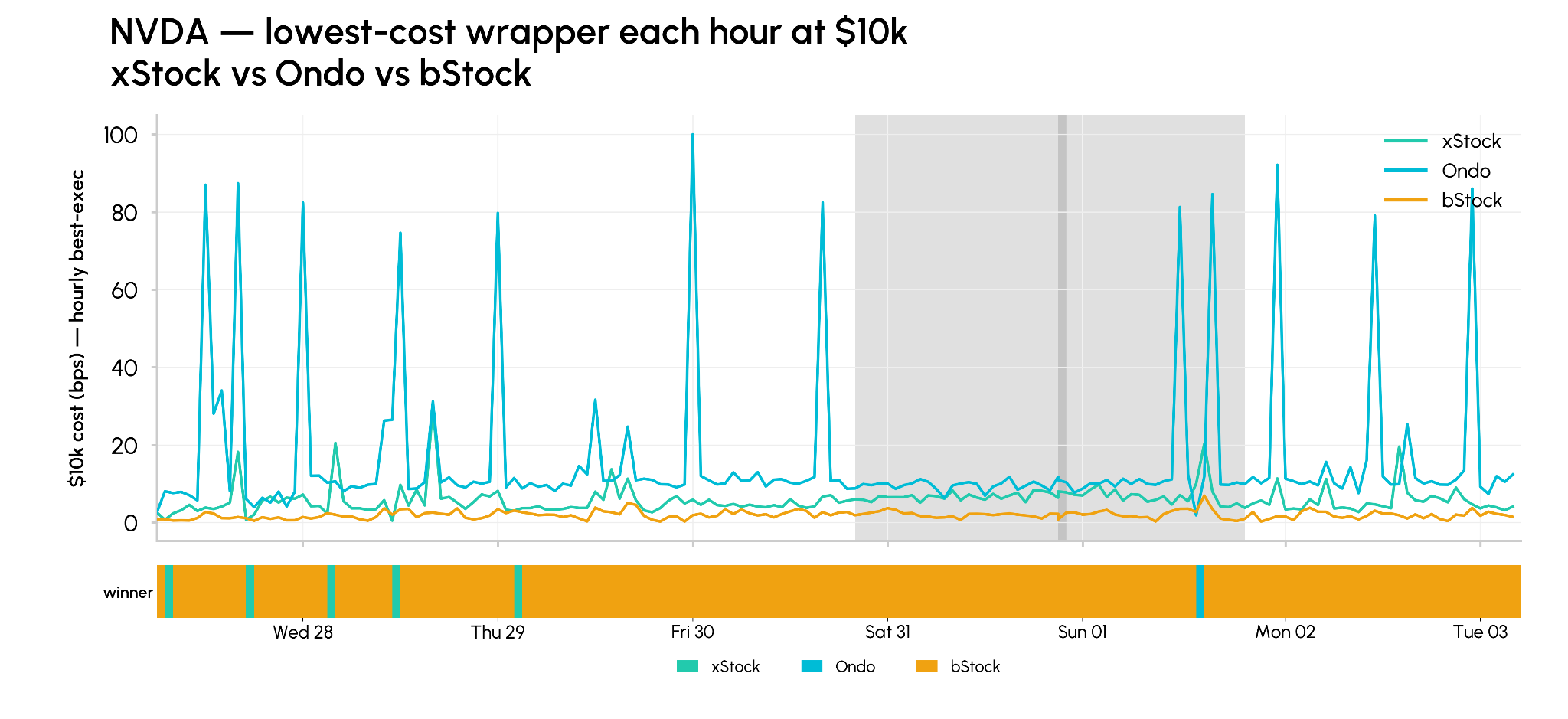
Comparing tokenized variants shows execution costs also differ by issuer. From October 27 through November 2, NVDAb on Binance showed the lowest slippage among the tokenized NVDA variants for $10K orders in 96% of observations.
Do Price Gaps Survive Trading Costs?
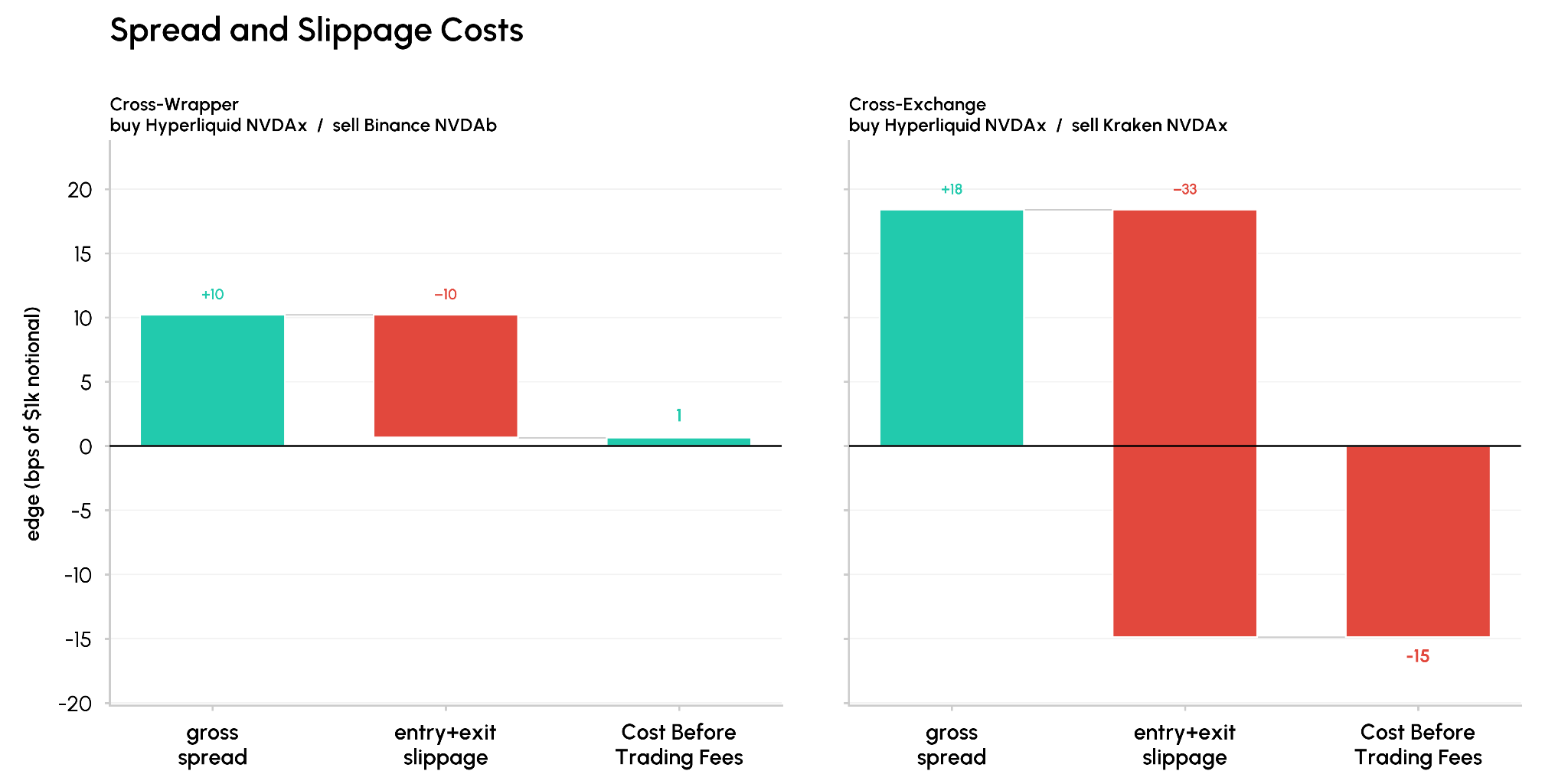
Although exchanges having different prices for different tokenized variants could create potential opportunities, liquidity and trading cost must be considered when trading. From June 2026 to November 2, the average spread and slippage outweighed the observed price gaps even at $1K, before fees.
Source: Talos CM Market Data Pro
Conclusion
Tokenized equities provide 24/7 pricing for assets that trade during traditional market hours to non-U.S. investors. These tokenized assets currently primarily trade during market hours and experience liquidity shocks during closed hours. Collecting data on tokenized asset order book depth, slippage, and reference rates help compare execution costs across tokenized stocks and exchanges.
Subscribe and Past Issues
Coin Metrics State of the Network is an unbiased, weekly view of the crypto market informed by our own network (on-chain) and market data.
If you'd like to get State of the Network in your inbox, please subscribe here. You can see previous issues of State of the Network here.
Disclaimer: The information herein is provided for informational purposes only. Talos Trading, LLC and its affiliates (“Talos”) does not give any representations or warranties in relation to the accuracy, validity, or completeness of the information of this material, including without limitation the factual information obtained from publicly available sources considered by Talos to be reliable at the time. Talos accepts no liability for any consequences of using the information contained in this material. Any opinions or estimates expressed herein reflect a judgment made by the author(s) as of the date of publication and are subject to change without notice. Neither this material nor any copy thereof may be taken, reproduced, or redistributed, directly or indirectly, without Talos’s prior written permission. Any views or opinions expressed are those of the authors and do not necessarily reflect the views of Talos. This communication does not constitute an offer to buy or sell, or a promotion or recommendation of, any digital asset, security, derivative, commodity, financial instrument, or product or trading strategy. This document and information are not intended to constitute investment advice or a recommendation to make (or refrain from making) any kind of investment decision and may not be relied on as such.
Subscribe
If you’d like to get State of the Network in your inbox, please subscribe below.
Latest insights and research



Request a demo
Find out how Talos can simplify the way you interact with the digital asset markets.