


Coin Metrics State of the Network is an unbiased, weekly view of the crypto market informed by our own network (on-chain) and market data.
Key Takeaways
- Bitcoin has recently shifted toward a digital gold regime. Its 90-day correlation with gold is at +0.56 while equities and the dollar sit near zero, a combination last seen in 2020 and 2023.
- Among macro releases, employment data now generates Bitcoin’s largest immediate moves, producing twice the reaction of a normal window in the first 30 minutes. The August payrolls report on September 4 was six times that typical size.
- With the Treasury supporting the long end and the Fed fighting inflation, Bitcoin sits between opposing macro forces. September’s CPI print and rate decision may help tip the balance.
Introduction
Bitcoin’s investment thesis has long centered on its role as a scarce, non-sovereign monetary asset often compared with gold. Yet at times its behavior has also resembled that of a high-beta asset sensitive to liquidity, interest rates, and risk appetite, much like technology stocks. These relationships have shifted across market cycles as macro conditions and the composition of Bitcoin’s investor base have evolved.
In this issue, we examine how Bitcoin’s relationships with gold, equities, and the dollar have shifted across market regimes, why its current elevated correlation with gold is notable, and how changes in real interest rates and recent macroeconomic data releases have influenced BTC’s recent performance.
Bitcoin’s Correlation Regimes Across History
As we explored in Is Bitcoin Decoupling from the Market?, Bitcoin’s relationship with traditional assets has shifted across market cycles. During different periods, BTC has traded alongside growth and technology equities, or behaved more like a scarce, alternative store of value. The current regime is notable because Bitcoin’s 90-day correlation with gold has risen to +0.56, its highest level since 2020, while its correlation with the Nasdaq 100 and the dollar has fallen to near zero.
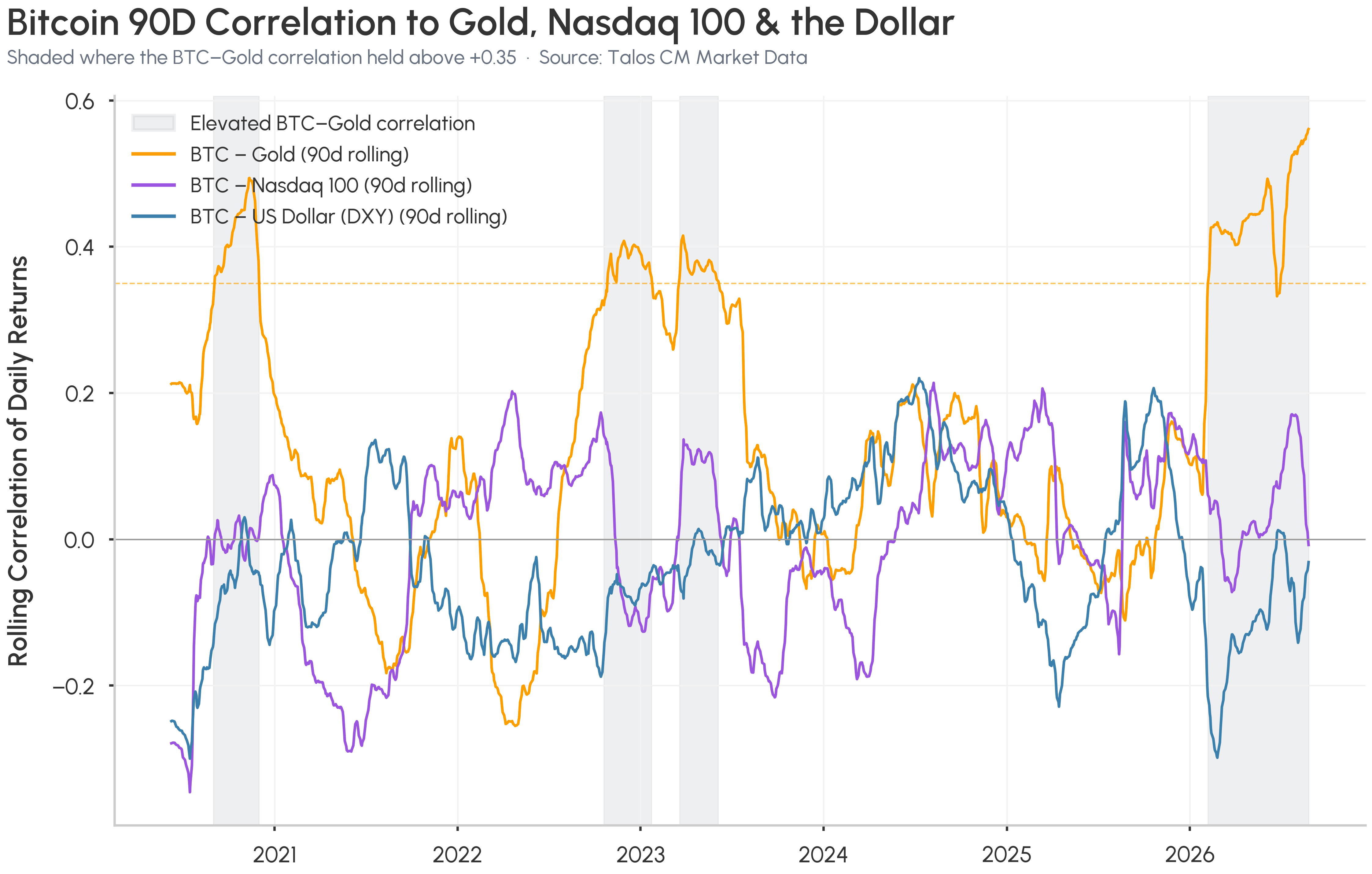
The divergence is notable because it suggests that Bitcoin’s behaviour and price action has been shaped less by technology stock beta and more by the macro forces also supporting gold. Bitcoin and Gold recently responded to a more similar set of market conditions: concerns around currency debasement, sovereign debt, and the outlook for real yields.
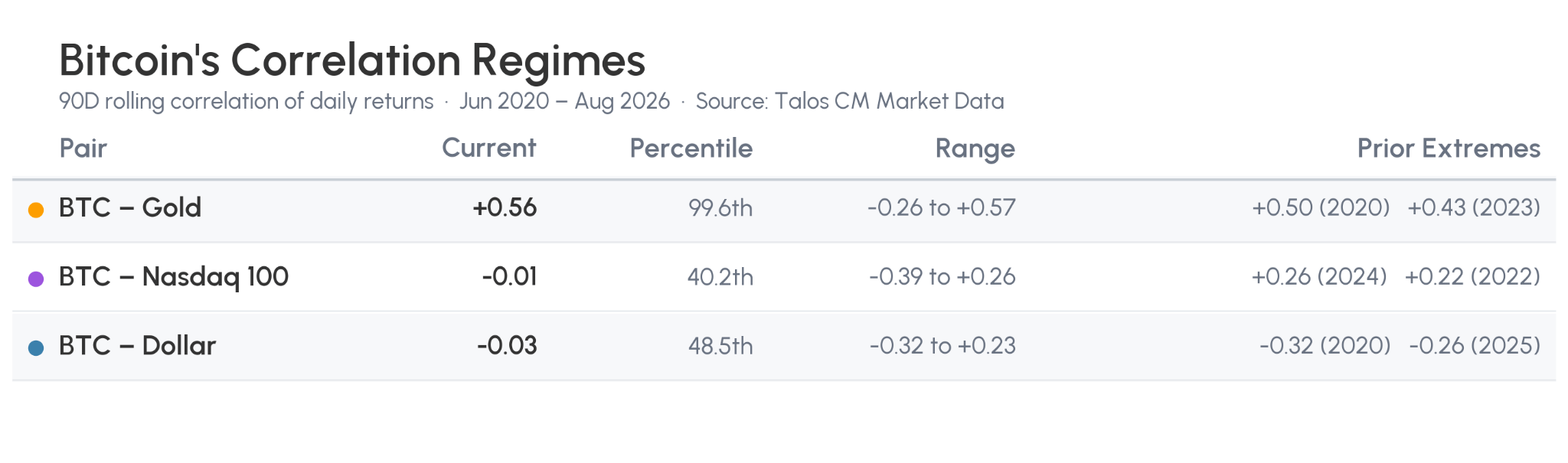
Previous periods of elevated BTC–gold correlation help contextualize the current regime.
- In 2020, Bitcoin initially fell alongside risk assets during the COVID liquidity shock, before the Fed’s emergency easing and large fiscal intervention pushed yields lower and supported a strong recovery in both BTC and gold.
- In 2023, the collapse of several U.S. regional banks and the Fed’s emergency liquidity response revived concerns around financial-system stress and brought the eventual path of policy easing into focus. Bitcoin and gold both benefited as markets reassessed rate expectations, although Bitcoin’s move was substantially more volatile.
- Today’s backdrop shares elements of both episodes. Treasury market concerns have renewed attention to the dollar’s long-term purchasing power, supporting the case for scarce assets. But unlike 2020, real yields remain elevated and limit the Fed’s room to ease. Bitcoin’s closer relationship with gold reflects this environment, while leaving it exposed if rates move higher.
What Makes This Regime Notable?
Bitcoin’s elevated correlation with gold has emerged as two macro forces pull in opposite directions. Treasury actions to support the long end of the bond market have kept concerns around government debt and the dollar in focus. At the same time, the Fed is still managing inflation, keeping interest rates and real yields important for Bitcoin’s near-term direction.
- Treasury Bond Expansion: Bitcoin and gold rallied after the U.S. Treasury announced larger buybacks of longer-dated bonds to support market liquidity. The move lowered long-term yields and the dollar, while bringing fiscal deficits, debt issuance, and the dollar’s long-term purchasing power back into focus. Although the buybacks are not direct stimulus, they helped revive the debasement trade and supported scarce assets such as gold and Bitcoin.
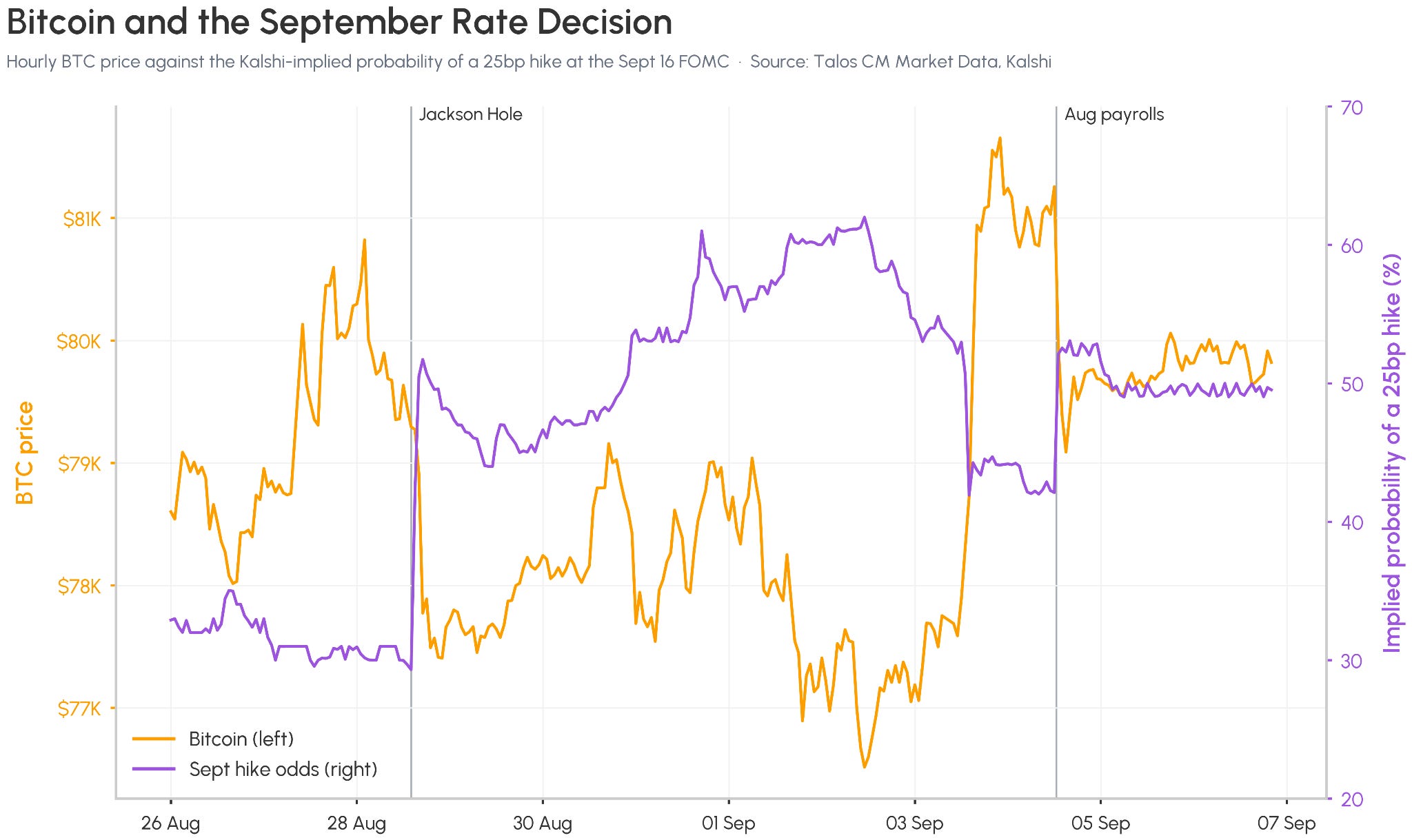
- The Fed’s inflation fight: The Fed faces the opposite challenge. Stronger jobs data and inflation concerns can keep rates higher for longer, pushing up real yields and making non-yielding assets like BTC less attractive. Bitcoin’s initial drop after the September 4 payrolls release shows how quickly a stronger labor report can raise rate-hike expectations and pressure BTC.
Source: Talos CM Market Data, Kalshi
The recent repricing of September FOMC hike odds highlights Bitcoin’s sensitivity to changing expectations for the next Fed decision. After Jackson Hole, the implied probability of a 25 bp hike rose from 29% to 51% over four hours, while Bitcoin fell 1.8%. BTC also initially sold off after the August payrolls report, before absorbing the shock as hike expectations settled.
Bitcoin’s Response to Recent Macro Data Releases
The implied odds of Fed policy are shaped by incoming data on inflation and growth. Employment reports (non-farm payrolls), consumer price inflation (CPI) releases, and FOMC rate decisions can make markets reassess the likelihood of further tightening or easing.
The chart below shows median absolute BTC moves around these macro events relative to typical non-event windows from January 2025 to September 2026, capturing the size of BTC’s reaction, rather than whether the move was positive or negative.
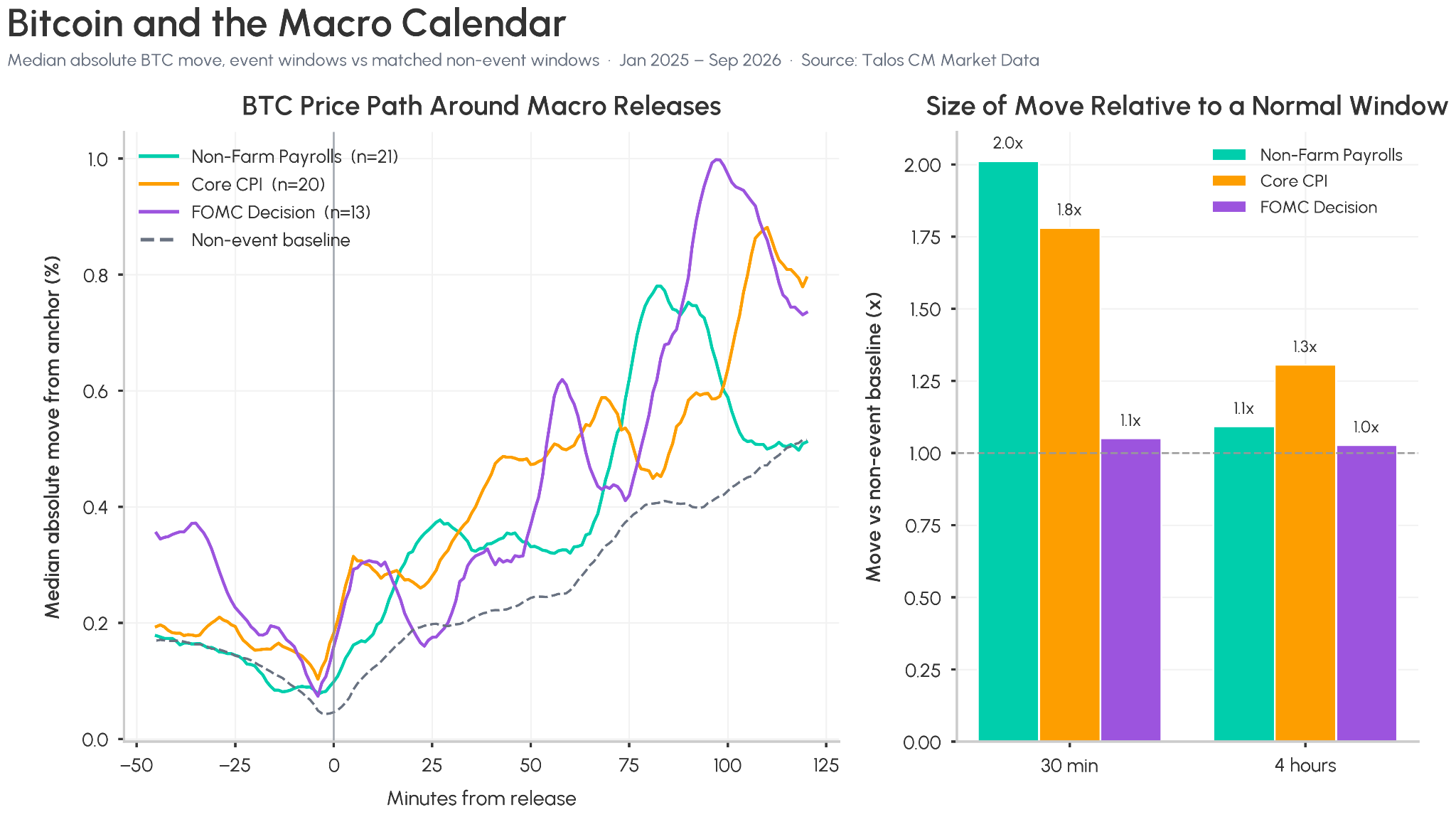
Employment reports have produced the largest immediate reaction, with Bitcoin moving 2x more than a typical non-event window in the first 30 minutes. Core CPI releases have generated a similarly elevated 1.8x move over that horizon, but their effect has been more persistent. FOMC decisions themselves on the other hand remain close to baseline moves across both horizons.
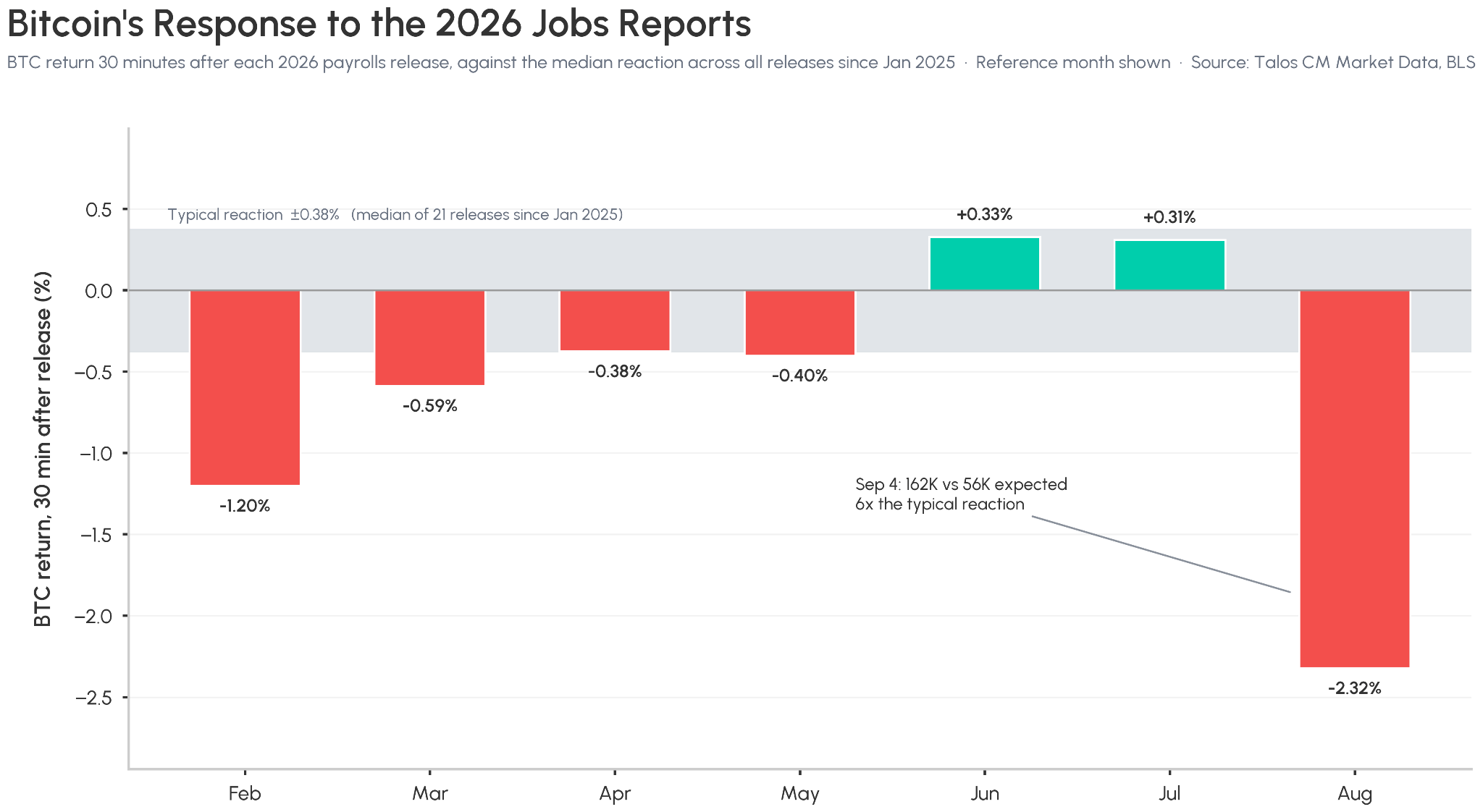
The most recent payrolls release data on September 4th illustrates the market’s current sensitivity to labor data. Bitcoin fell 2.32% in the 30 minutes after the August report (around six times its typical 30-minute payrolls reaction) following a 162K payroll gain vs. 56K expected.
Macro releases can set the initial direction of the move, while perpetual futures positioning, funding rates, open interest, and liquidations can influence its magnitude and persistence. On September 4, BTC open interest fell 3% within 30 minutes of the release, while long liquidations outpaced short liquidations by roughly five to one ($119 million versus $24 million).
The upcoming CPI release on September 11th is the next major input ahead of the September FOMC meeting. With probabilities in a fine balance, a hotter CPI print could reinforce rate pressure, while a softer reading could provide relief for Bitcoin, gold, and broader risk appetite.
Conclusion
Bitcoin remains a key barometer of risk appetite within crypto markets. A more restrictive Fed path would likely pressure BTC, altcoins, and leveraged positioning, while softer inflation and a favorable rate outcome could support a broader risk-on move.
Still, Bitcoin is not the entire digital-asset industry. Onchain trading, tokenization, settlement, and prediction markets are creating new sources of volume, fees, and liquidity with their own adoption drivers. Hyperliquid’s expanding equity and commodity perpetual markets, HIP-4 outcome markets, Robinhood Chain’s early traction, and growing tokenized-asset issuance illustrate an ecosystem compounding beyond BTC’s price action.
A supportive rate environment can lift liquidity and risk appetite across the market. But even in a more challenging one, demand for stablecoins, onchain yield, tokenized assets, settlement, and 24/7 trading infrastructure can continue to build. Bitcoin may set the market’s near-term tone, but the digital asset industry is well positioned to grow across macro regimes.
Subscribe and Past Issues
Coin Metrics State of the Network is an unbiased, weekly view of the crypto market informed by our own network (on-chain) and market data.
If you’d like to get State of the Network in your inbox, please subscribe here. You can see previous issues of State of the Network here.
Disclaimer: The information herein is provided for informational purposes only. Talos Trading, LLC and its affiliates (“Talos”) does not give any representations or warranties in relation to the accuracy, validity, or completeness of the information of this material, including without limitation the factual information obtained from publicly available sources considered by Talos to be reliable at the time. Talos accepts no liability for any consequences of using the information contained in this material. Any opinions or estimates expressed herein reflect a judgment made by the author(s) as of the date of publication and are subject to change without notice. Neither this material nor any copy thereof may be taken, reproduced, or redistributed, directly or indirectly, without Talos’s prior written permission. Any views or opinions expressed are those of the authors and do not necessarily reflect the views of Talos. This communication does not constitute an offer to buy or sell, or a promotion or recommendation of, any digital asset, security, derivative, commodity, financial instrument, or product or trading strategy. This document and information are not intended to constitute investment advice or a recommendation to make (or refrain from making) any kind of investment decision and may not be relied on as such.
Subscribe
If you’d like to get State of the Network in your inbox, please subscribe below.
Latest insights and research
.jpg)


Request a demo
Find out how Talos can simplify the way you interact with the digital asset markets.