

Bitcoin is not the Digital Asset Industry
In August, bitcoin had its best week of the year, and it still told you almost nothing about the industry compounding underneath it
Bitcoin is not the Digital Asset Industry

Introduction
In August, bitcoin had its best week of the year, and it still told you almost nothing about the industry compounding underneath it
In the space of eight weeks, the same number told two completely opposite stories about our industry.
In the second quarter, bitcoin fell roughly 11% while the S&P 500 and Nasdaq 100 gained about 16% and 28%, a divergence our research team documented in Q2 2026 Market Update: Reversals, Rotations and Rates. The obituaries wrote themselves. Then, over eight days in August, bitcoin gained 23% and reclaimed $80,000 for the first time in three months. The “revival” pieces wrote themselves too. Nothing structural about digital asset markets changed between those two points in time.
A number that can swing by a third in either direction inside a single quarter, without the industry underneath it changing shape, is not a health indicator. Bitcoin remains our industry's largest asset, its deepest market and its most important collateral, and nothing here is a view on its price. The point is narrower and more useful: price and progress have decoupled, and anyone allocating capital, building products or writing regulation off the bitcoin chart is reading last cycle's instrument panel.
What the August rally was actually made of
Our researchers took the rally apart the week it happened in August 19th Market Rally: Crypto Makes a Comeback As Bessent Bails Out Bonds. The trigger was not adoption. It was the US Treasury expanding long-dated buybacks from $2 billion to at least $4 billion, which pulled long yields and the dollar lower and lifted hard assets across the board. The transmission into crypto was mechanical: over $800 million of short positions were liquidated within a single hour and over $1.6 billion across 24 hours, among the largest short liquidation events on record, while futures open interest went from $80 billion to $96 billion. Capital did follow, with $1.7 billion of net inflows into bitcoin ETFs on the week. But the sequence is the point. Price moved first on a macro headline and forced covering, and the money arrived afterwards.
Nine days later it ran in reverse. On August 28, the new Fed Chair used his first Jackson Hole keynote to warn that inflation remains too high and that the Fed may have more work to do. Rate expectations repriced sharply and bitcoin gave back roughly 3% in a day. One speech, on a subject with no connection whatsoever to blockchain adoption, undid a meaningful slice of the move. If a single central bank appearance can do that, the number is telling you about the macro cycle, not about our industry.
Where the industry's actual vital signs are
Now look at the curves that ran straight through both the drawdown and the rally without pausing for either.
Settlement. Stablecoins have settled $41.7 trillion in adjusted transfer volume in 2026 so far. The most clarifying statistic in our research all year is in Beneath the Trillions: on-chain adjusted transfer volume has exceeded $250 billion per day at points this year, while exchange trading volume has fallen to roughly $18 billion per day. The rails are now an order of magnitude busier than the speculation they were built to serve, and each dollar of USDC supply turns over 741 times a year against USDT's 74.
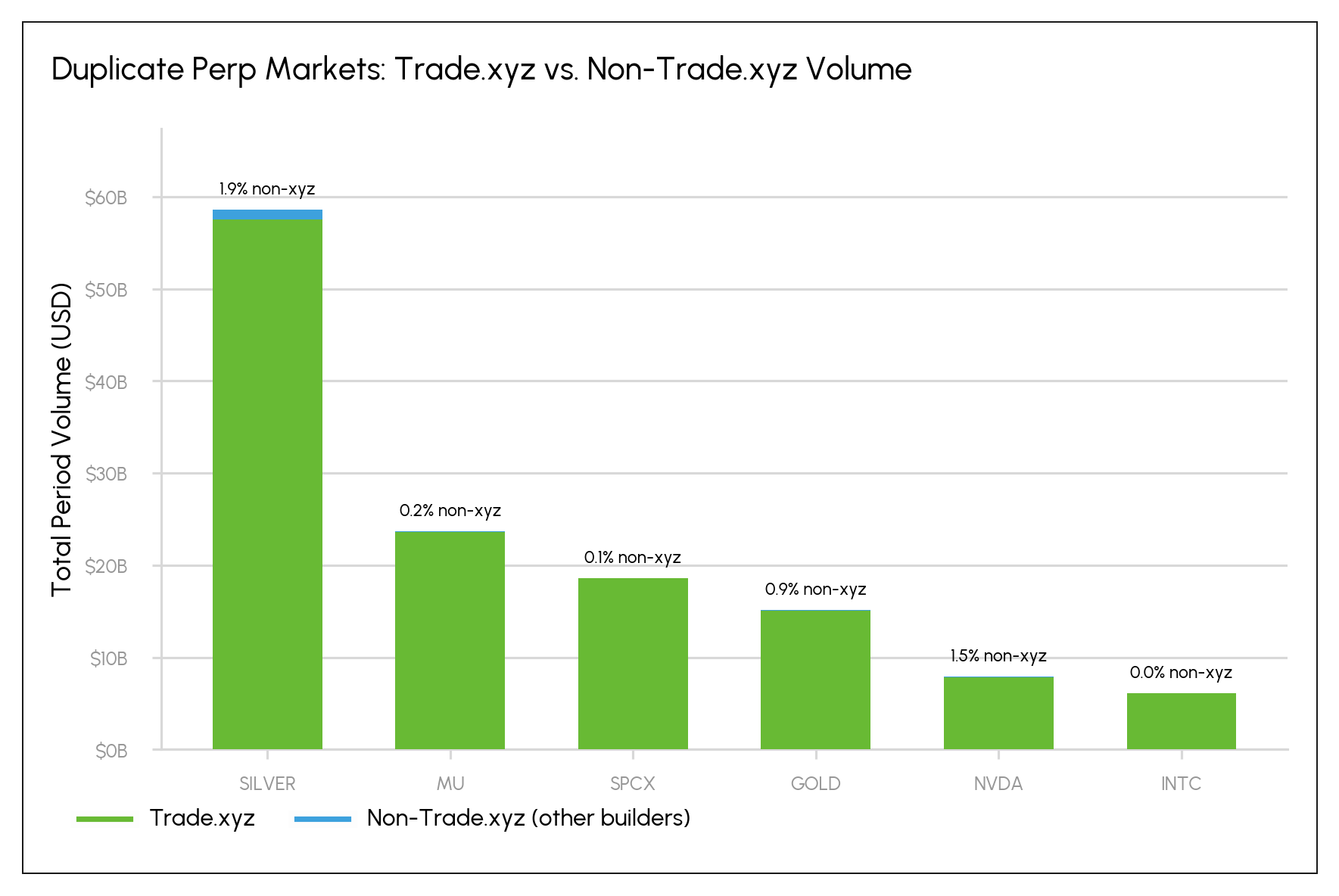
Real-world assets on perpetual rails. The ratio of crypto to RWA perpetual volume across Binance and Hyperliquid compressed from about 19 times in February to under 3 times by August as commodity and equity perps took share. In Trade.xyz's Role in Hyperliquid, Cooper Duschang showed that Trade.xyz, the leading builder of equity and commodity perp markets on Hyperliquid, accounted for around 55% of all Hyperliquid volume in August, having facilitated over $460 billion since January. There are now 484 markets on Hyperliquid and only 232 of them are natively issued. AI and compute equities and indices alone were about 53% of Trade.xyz volume in July.
Figure 1: The growth is in markets that are not crypto.
Monthly Hyperliquid volume by market origin, natively issued versus Trade.xyz versus other HIP-3 builders.
Source: Talos State of the Network #377, Trade.xyz's Role in Hyperliquid
Tokenized securities. SpaceX, at a $1.7 trillion valuation, had its shares trading on tokenized venues and pre-IPO perpetual markets before it ever listed, which means price discovery for one of the largest listings in history began on crypto infrastructure rather than on an exchange. On July 15, DTCC ran its first pilot trades using tokenized securities, which it described as the largest tokenization pilot to date by breadth of use cases, asset classes and participants, and Talos was part of it (Behind the Scenes of Moving Finance On-Chain with Tokenized Securities).
The clearest proof is an asset class that is not a digital asset at all
Prediction markets are the most news-dominating new asset class in finance right now, and strictly speaking they are not digital assets. That is exactly why they matter here. In Prediction Markets Are Going Institutional, Execution Should Too, Sirui Zhang and I showed combined monthly volume growing roughly ninefold in under a year, from under $5 billion to about $44.8 billion, with around 40% of Kalshi's volume now institutional and institutional activity up 800% in the first half of 2026. Polymarket is the on-chain expression of it, collateralised in USDC and settling on the same rails carrying that $41.7 trillion. Kalshi is a CFTC-regulated exchange that lists event contracts and onshore crypto perpetuals side by side, so a single venue now covers an election outcome and a bitcoin basis trade.
The deeper point is who is providing the liquidity. The market makers and OTC desks pricing these contracts are largely the same participants who learned to run 24/7 risk in volatile digital assets, using the same machinery. That is the industry's real asset: rails and participants that transfer to a brand new market almost immediately. We are bringing these markets onto institutional infrastructure soon (Talos Brings Prediction Markets Onto Institutional Trading Infrastructure), which will include algos, block trading through RFQ and multi-leg perp-to-spot spreads for basis and funding strategies, and our compliance team filed two comment letters with the CFTC in August on event contracts and data reporting (an institutional perspective on CFTC prediction market rulemaking). Institutional access goes live shortly.
There is a second-order benefit worth naming. These markets are becoming a continuous, tradable read on policy, macro and event risk, which is a genuinely new information layer for allocators rather than another thing to speculate on. An industry that can stand up new price discovery for questions that had no market at all a year ago is not an industry in decline, whatever its largest token happens to be doing that week.
Figure 2: Execution analytics on a market that did not exist institutionally a year ago.
Order book, match and price events from our 100,000 contract simulation across live Kalshi markets.

Source: Prediction Markets Are Going Institutional, Execution Should Too, and the live dashboard
Mature markets separate a sector from its marquee name
This is not a new problem, and other markets have already learned the lesson. Amazon lost more than 90% of its value between 1999 and 2001, falling from about $106 to roughly $6 a share (CNBC). Over that same stretch, its customer count went from 14 million to 20 million and sales grew 68% to $2.76 billion. The stock was saying one thing and the business was saying another, and the business was right. Cisco tells the infrastructure version of the same story: in March 2000 it passed Microsoft to become the most valuable public company in the world, then gave up around 80% over two years (CNBC), while the internet it was plumbing kept expanding and its revenue today is several times its 2000 level. Nobody in 2003 concluded that e-commerce or the internet had failed. Markets simply learned to hold two ideas at once: a marquee asset can be repriced while the sector underneath it keeps compounding. Digital assets are due the same maturity, and August was the moment to prove it in the other direction, because the rally is no more informative than the drawdown was.
Measure the infrastructure, not the headline asset
If not price, then what? Five things we would put on the dashboard instead, all of them measurable today with data Talos already publishes.
- Settlement throughput. On-chain transfer volume by issuer and by chain, and its ratio to exchange trading volume. This is the adoption signal and it currently dwarfs speculation. Network Data Pro.
- Where volume and fees are forming. The crypto to RWA perpetual ratio, and the share of volume in equity, index and commodity markets. Fees are the closest thing this industry has to earnings. Market Data Pro.
- Positioning quality. Open interest, funding and liquidations together, so you can tell a short squeeze from real demand. This is the metric that would have told you what August actually was, in real time.
- Execution quality and depth. Order book depth by hour, spreads and realised slippage against arrival price. The same $1 million order costs 4.4 basis points in bitcoin and 17.9 in dogecoin (Before the First Fill), a market structure fact that is invisible in any price series.
- Venue and counterparty quality. Where liquidity is genuinely deep, how venues behave under stress, and how concentrated your access really is, which we score in the Talos Exchange Scorecard.
The State of the Market dashboard and our weekly State of the Network research exist so the industry can watch these vital signs directly, rather than through the proxy of a single price. Last month, Talos also crossed $1 trillion in notional volume since inception (The Journey to $1 Trillion). That growth did not flinch when bitcoin fell in the second quarter and it did not inflect when bitcoin rallied in August, because institutional adoption of this infrastructure has stopped being a function of the spot price.
So the next time someone asks how crypto is doing, the honest answer is still: which part? In the second quarter the asset had a terrible run and the market structure had its best one. In August the asset had its best week of the year, and the market structure barely noticed, because it had already stopped waiting for permission from the price.
Related links:
- Talos Research: August 19th Market Rally, Crypto Makes a Comeback As Bessent Bails Out Bonds (Tanay Ved and Cooper Duschang, Aug 25, 2026)
- Talos Research: Trade.xyz's Role in Hyperliquid (Cooper Duschang, Aug 18, 2026)
- Talos Research: Beneath the Trillions, What's Driving USDC and USDT Transfer Volume? (Tanay Ved, Aug 11, 2026)
- Talos Research: Talos Exchange Scorecard, Plus Digging into the Coldcard Exploit On-Chain (Victor Ramirez and Tanay Ved, Aug 4, 2026)
- Talos Research: Q2 2026 Market Update, SOTN #369: The Spectrum of Tokenized Stock Exposure and SOTN #368: Hyperliquid, Perps, Outcome Markets and USDC Yield
- Quantitative Execution Services: Prediction Markets Are Going Institutional, Execution Should Too (Sirui Zhang and Eliad Hoch, Jul 31, 2026) and the Prediction Markets Execution Dashboard
- Quantitative Execution Services: Before the First Fill, An Empirical Model of Market Impact in Cryptocurrency Trading and Execution Cost Savings by the Numbers
- Talos: The Journey to $1 Trillion (Anton Katz, Aug 18, 2026)
- Talos: Talos Brings Prediction Markets Onto Institutional Trading Infrastructure (Jul 22, 2026) and Talos Brings an Institutional Perspective to CFTC Prediction Market Rulemaking (Josh Peschko, Aug 28, 2026)
- Talos: Behind the Scenes of Moving Finance On-Chain with Tokenized Securities (DTCC pilot, Jul 16, 2026), xStocks Tokenized Equities Now Supported Through Talos and Nasdaq and Talos Partner on Tokenized Collateral Management
- Talos: Regulatory Roundup #22 (Aug 27, 2026) and What the CLARITY Act Could Mean for Digital Asset Market Participants (Jul 27, 2026)
- External: NYDIG Q2 2026 Review, Chairman Warsh's Jackson Hole keynote, CNBC on the Treasury buyback expansion, and CNBC on Amazon and Cisco
Disclaimer: The views and opinions expressed herein are those of the author(s) and do not necessarily reflect the views of Talos Global, Inc. or its affiliates (collectively, "Talos") and summarizes information and articles with respect to cryptocurrencies or related topics. This material is for informational purposes only and is only intended for sophisticated institutional investors, and is not (i) an offer, or solicitation of an offer, to invest in, or to buy or sell, any interests or shares, or to participate in any investment or trading strategy, (ii) intended to provide accounting, legal, or tax advice, or investment recommendations, or (iii) an official statement of Talos. No representation or warranty is made, expressed or implied, with respect to the accuracy or completeness of the information or to the future performance of any digital asset, financial instrument or other market or economic measure. The information is believed to be current as of the date indicated and may not be updated or otherwise revised to reflect information that subsequently became available or a change in circumstances after the date of publication. Talos and its employees do not make any representation or warranty, expressed or implied, as to accuracy or completeness of the information or any other information transmitted or made available. Investing in cryptocurrency comes with risk. Certain statements in this document provide predictions and there is no guarantee that such predictions are currently accurate or will ultimately be realized. Prior results that are presented here are not guaranteed and prior results do not guarantee future performance. Recipients should consult their advisors before making any investment decision. Talos may have financial interests in, or relationships with, some of the assets, entities and/or publications discussed or otherwise referenced in the materials. Certain links that may be provided in the materials are provided for convenience and do not imply Talos's endorsement, or approval of any third-party websites or their content. Any use, review, retransmission, distribution, or reproduction of these materials, in whole or in part, is strictly prohibited in any form without the express written approval of Talos.
Latest insights and research



.jpg)
Request a demo
Find out how Talos can simplify the way you interact with the digital asset markets.