


Coin Metrics State of the Network is an unbiased, weekly view of the crypto market informed by our own network (on-chain) and market data.
Key Takeaways:
- The stablecoin market is over $290B. Across Aave v3 and Morpho, more than $8.6B is deposited in lending protocols earning interest from borrowers.
- The same stablecoin on different lending protocols can have different returns. The USDC lending rate on Aave and Morpho is on average 31 bps below and 65 bps above the 1-year treasury rate respectively.
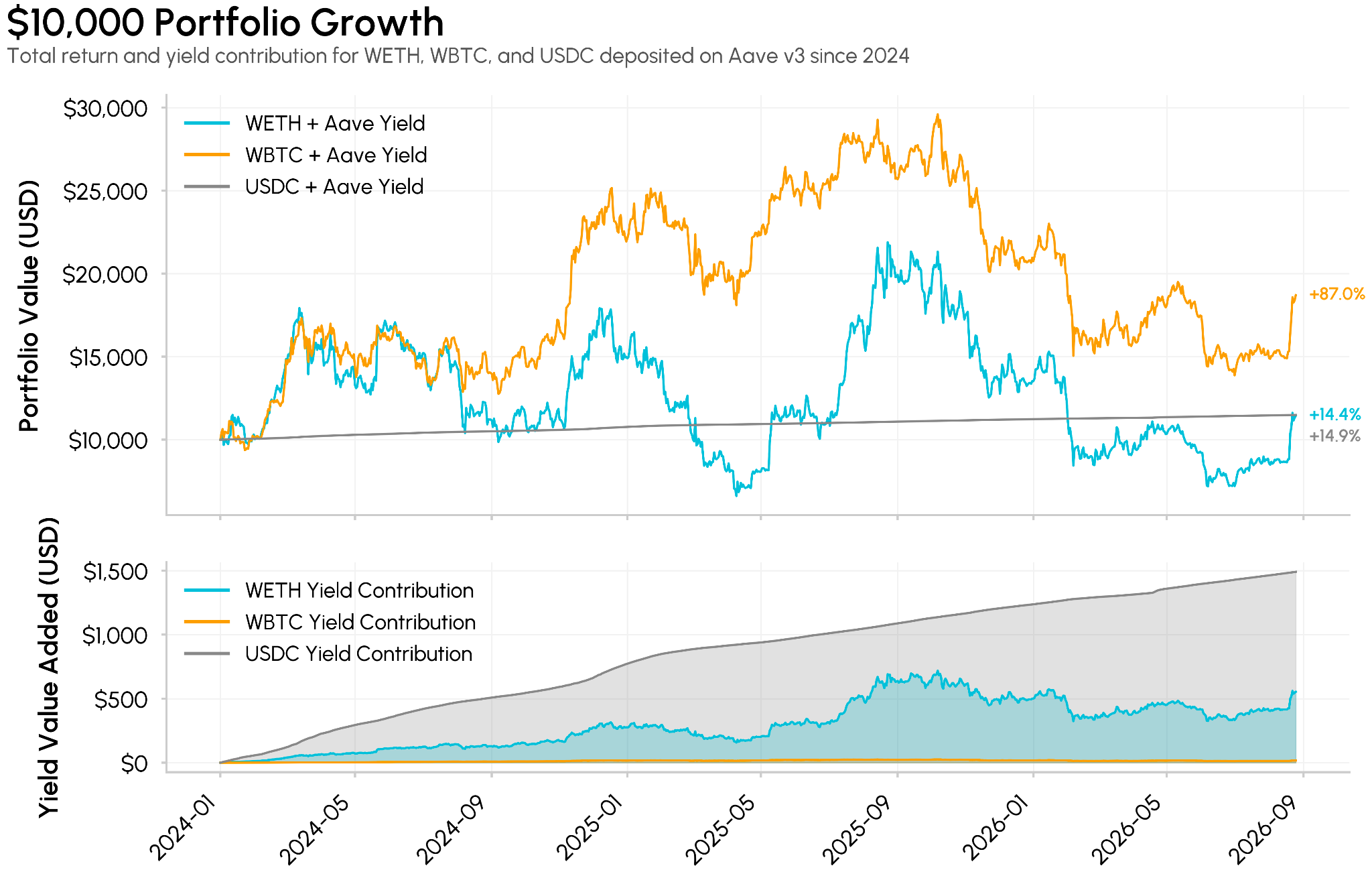
- Stablecoin interest does not consistently outperform traditional fixed-income products. However, if invested since 2024 on Aave, USDC outperforms ETH lent on Aave by 50 bps, showing stablecoins are a productive source of steady yield.
Introduction
The U.S. treasury market trades $1.2 trillion per day. Ranging from U.S. treasury bonds to junk bonds, fixed-income products are effective products to earn interest on idle assets. The stablecoin market has grown to over $290 billion. Holders can deposit stablecoins in different on-chain venues, popularly lending protocols including Aave and Morpho, to earn yield just like traditional financial instruments.
The introduction of tokenized treasuries, corporate bonds, and money market funds on-chain has expanded the number of opportunities to earn interest on assets, or borrow against them. These assets provide competitive rates to stablecoins in lending protocols. The expansion should lead investors to reevaluate the risks and rewards of owning different yield-bearing products.
In this State of the Network, we break down the additional risks earning on-chain yield, stablecoin and lending protocol differentiations leading to diverse returns, and stablecoin versus volatile asset lending.
Blurring the Line Between Traditional and On-Chain Yield
Investors have historically invested in short-term treasuries and money market funds to earn yield with minimal risk exposure. The returns on these investments are relatively low but also considered safest because of the asset’s short duration and deep liquidity.
The emergence of on-chain yield includes yield-bearing stablecoins, interest on stablecoin deposits in DeFi protocols, and tokenized treasuries that possess similar properties to traditional fixed-income. They both are intended for low-risk, consistent returns, backed by credible institutions and reserves.
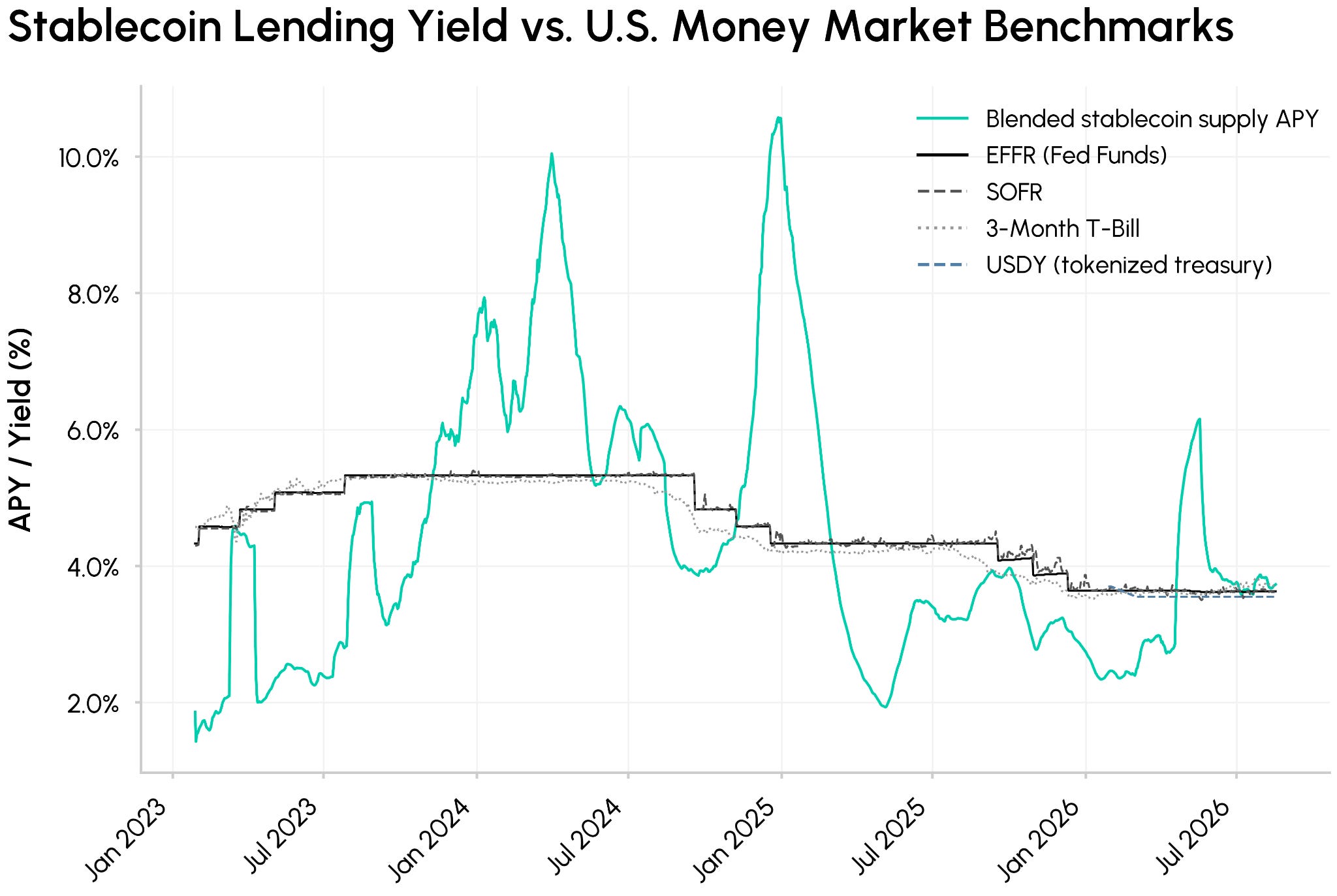
Source: Talos CM Protocol Metrics, FRED
Investing on-chain brings instant settlement, programmability, and composability difficult to replicate in traditional markets. With these benefits though comes additional risk. Tokenized treasuries such as Franklin Templeton’s Money Market Fund (BENJI) or the BlackRock USD Institutional Digital Liquidity Fund (BUIDL) must manage smart contract risk and redemption or liquidity risk.
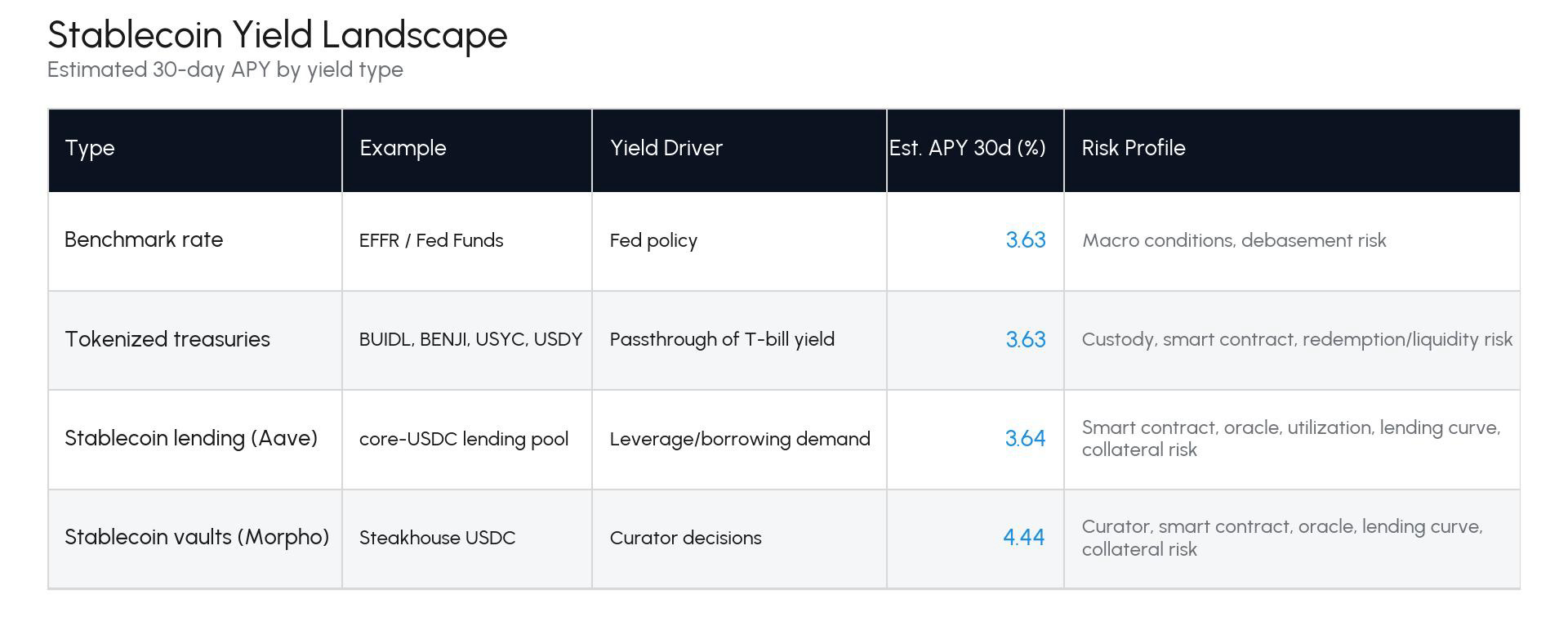
Tokenized treasuries imitate the yield from the Effective Federal Funds Rate despite carrying more risk. This leaves stablecoins and its integrations in DeFi to offer new chances for on-chain yields to compete with traditional products.
Additional DeFi complexities and risk should lead stablecoins towards offering higher yields. These higher yields however, are not always available.
The Same Stablecoin on Different Lending Protocols
Across Morpho and Aave v3, lending protocols hold over $8.6B in stablecoin deposits. After the KelpDAO exploit in April 2026, some analysts suggested there was a lack of yield compensated to investors for the risks exposed in lending pools. Stablecoin lenders must consider the stablecoin price depegging from its fiat currency, oracle manipulation, and smart contract exploits. Like traditional fixed-income products, if an investment has more risk, it is expected the investor should receive greater compensation.
One stablecoin’s return is non-uniform across different lending protocols. Since January 2026, the average yield on USDC deposited in Aave versus Morpho has a 1.59% spread. Aave and Morpho have different risk-adjusted yields because they have different protocol designs. Morpho supports isolated lending markets for each collateral-borrow pair, generating different borrow and supply rates. Aave provides the same borrow and supply rate for an asset using a shared pool per market.
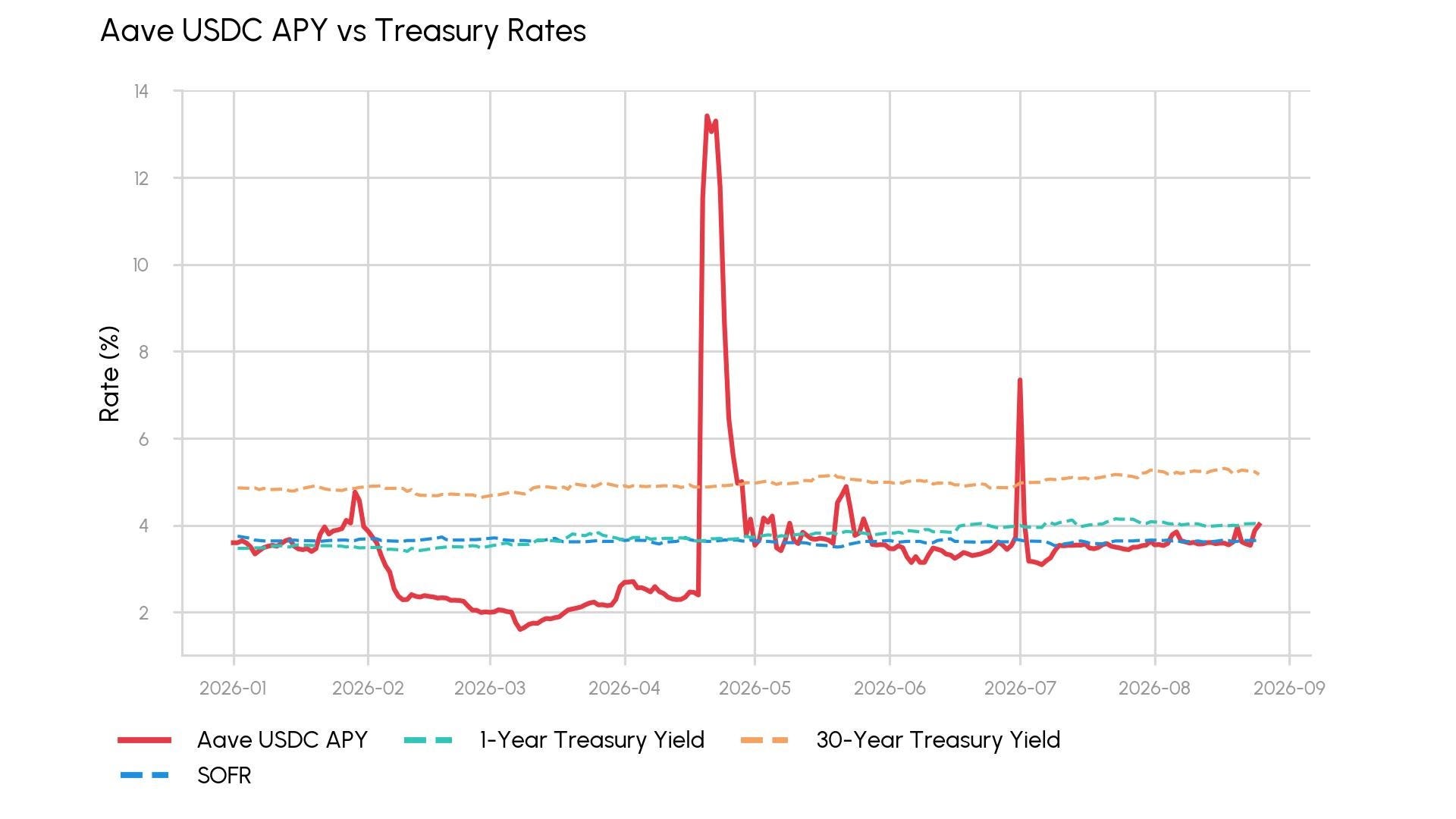
Source: Talos CM Protocol Metrics, FRED
USDC’s yield fluctuations in the Aave Core USDC lending market highlight the variable nature of returns relative to traditional fixed-rate products. USDC on Aave yield is on average a 31 basis point discount from the 1-year treasury rate. For 78% of 2026, USDC on Aave has earned lower annualized returns than the 1-year treasury rate.
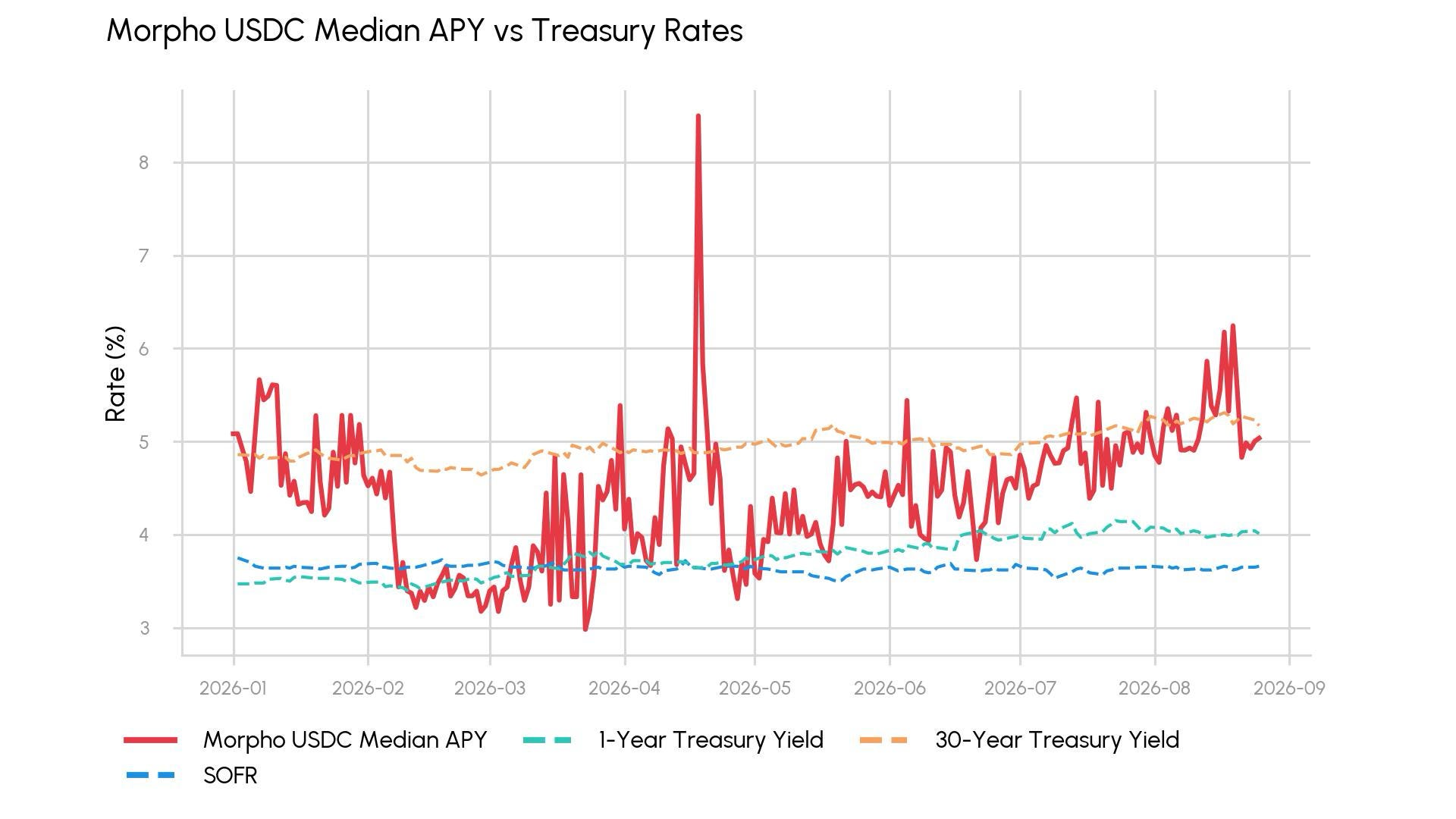
Source: Talos CM Protocol Metrics, FRED
The return of the median USDC Morpho v2 vault is on average 65 basis points greater than the 1-year treasury yield but is ~3.3x more volatile throughout the year. Lending yield is driven by supply and demand which can change at any time, whereas treasury yield is set by Fed policy and shifts more gradually.
Different Stablecoins on the Same Lending Protocol
Current lending rates are designed around the amount supplied and borrowed from a pool. Because of this, different stablecoins have different yields within individual lending protocols despite having similar reserves.
Source: Talos CM Protocol Metrics
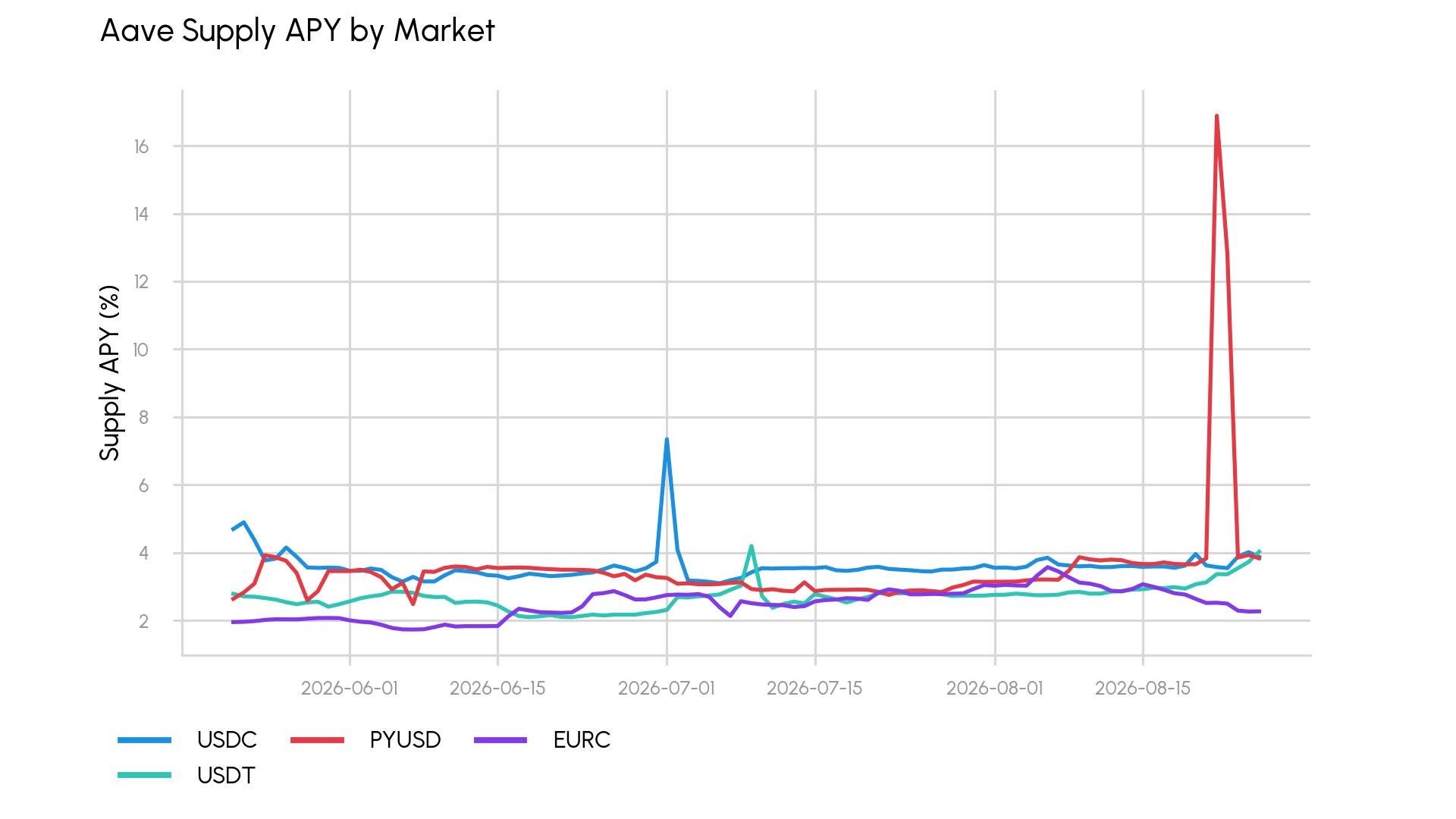
Between USDC and USDT on Aave, the two largest stablecoins by deposits, there is an average spread of 90 basis points. This is due to stablecoins having different average utilization rates. USDC has a 10% greater utilization rate on average over the past 90 days. PYUSD’s supply rate rose temporarily due to lenders removing available liquidity, increasing the utilization rate and therefore raising interest rates for all borrowers and lenders.
Source: Talos CM Protocol Metrics
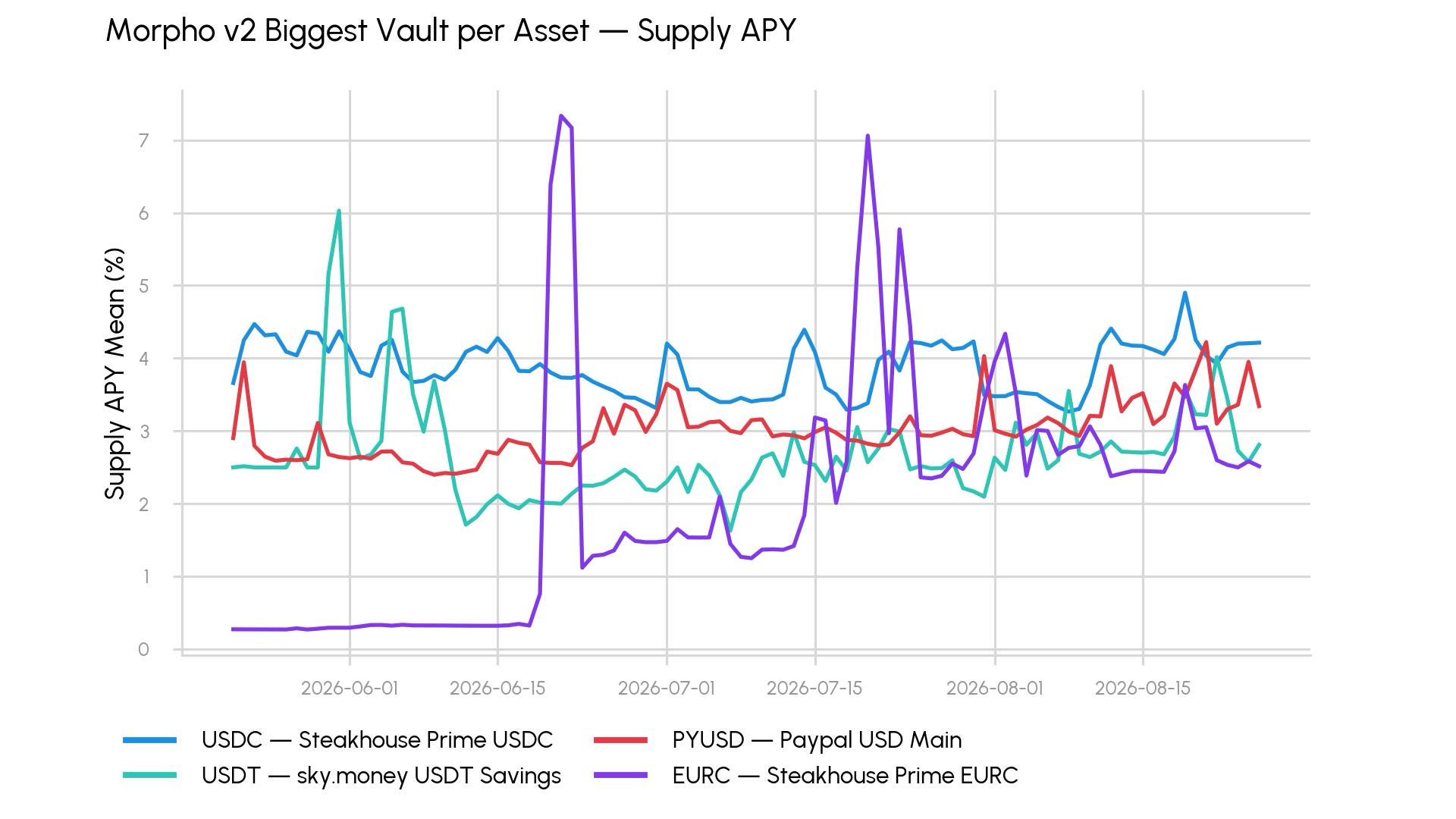
Morpho highlights similar discrepancies. Rates on Morpho v1 vaults can be more volatile due to capital rotating into v2 vaults and changing market deposits with remaining liquidity. Between USDC and USDT, there is an average 126 basis point difference in yield across Morpho v2 vaults. All four stablecoins listed provide attestations, invest in cash and short-term treasuries, and support a multi-network distribution. Yet small differences in DeFi integration, regulation, demand, and protocol design all lead to diverse yield expectations.
How Curators and Yield-Bearing Stables Expand Yield Opportunities
On-chain yield is not solely determined on the protocol architecture or asset level. Protocol governance and vault curators also drive on-chain yield. Aave governance can adjust lending curves based on the collective’s assessment of an asset’s risk. Yield on Morpho is earned based on the decisions of vault curators. Curators act like investment managers and allocate deposits to various lending markets to earn yield.
Source: Talos CM Protocol Metrics
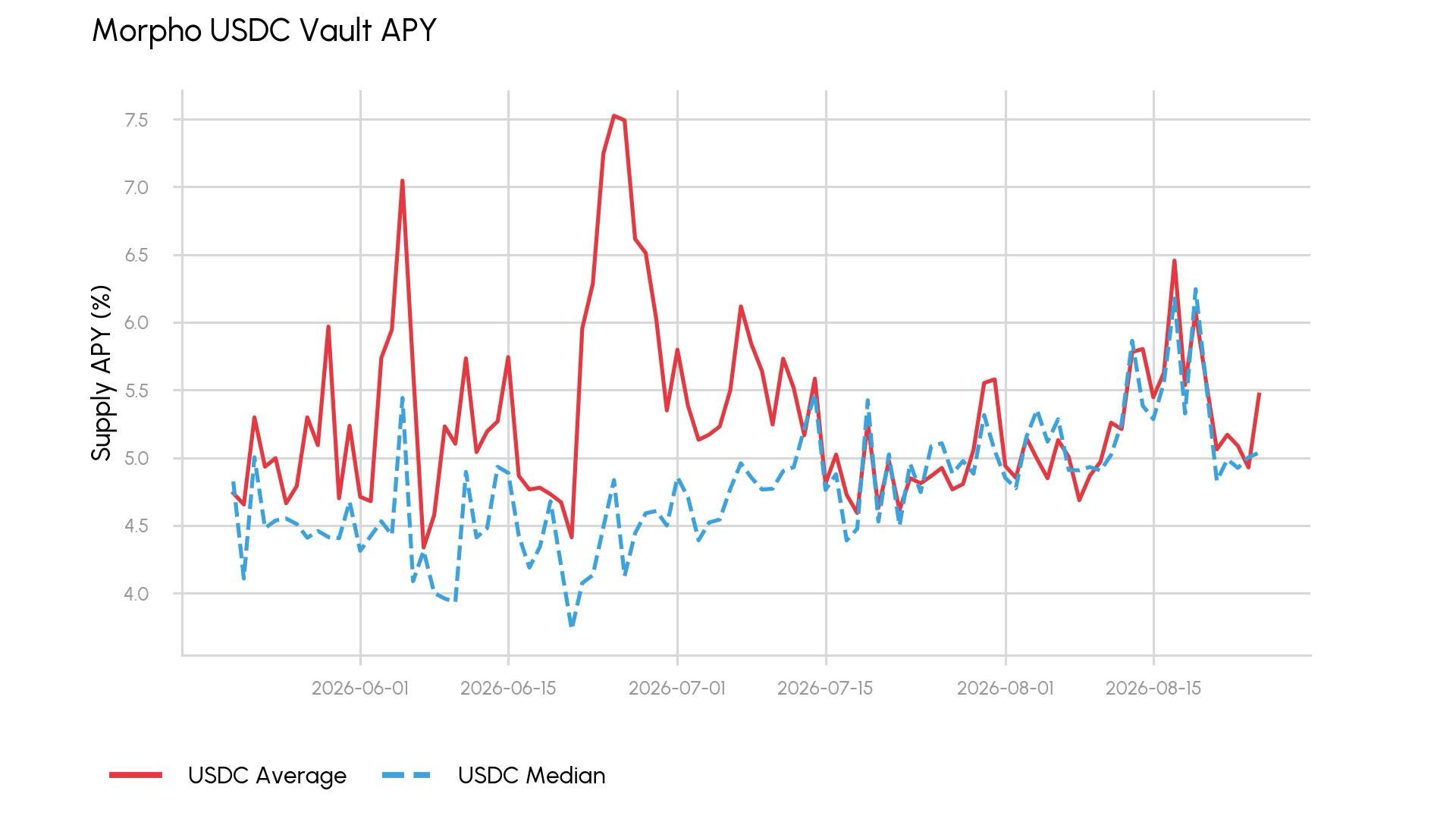
Curators allocating to different markets based on risk tolerance highlights various strategies using the same underlying borrow asset. Over the last 90 days, amongst USDC vaults the median yield for deposited USDC is 4.79%. There are high-yield outliers which drive the average Vault yield up around 5.31%, revealing curators can augment rewards without lending protocol intervention.
Source: Talos CM Network Data Pro
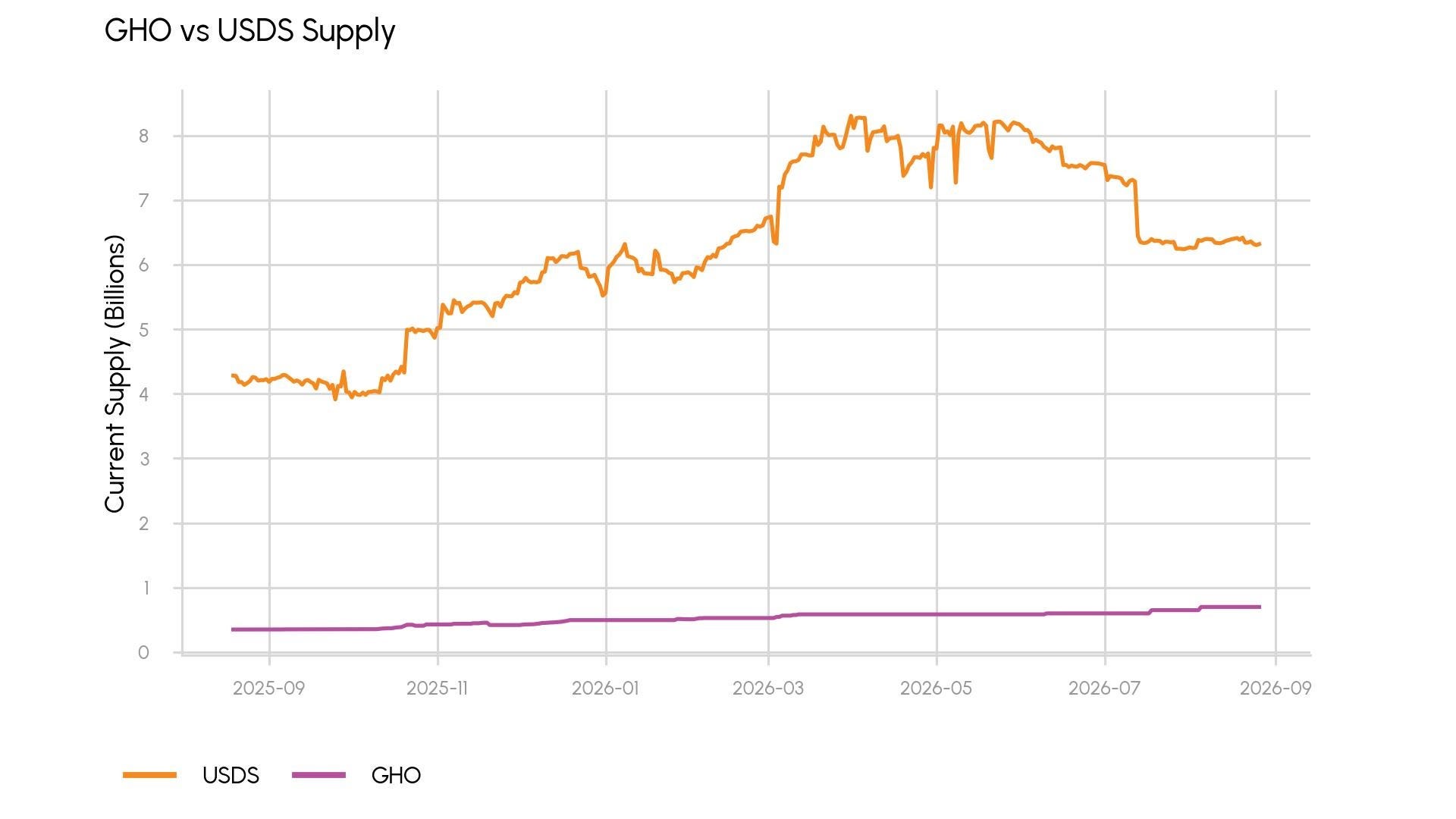
Stablecoin issuers can also incentivize adoption by distributing rewards to holders without intermediary lending markets. Users can stake stablecoins such as USDS issued by Sky and GHO issued by Aave natively to earn governance-managed rewards. More than 66% of outstanding USDS is staked as sUSDS, earning a variable rate currently around 3.52%. Users staking GHO receive sGHO and a fixed 4.25% yield.
Stablecoins versus Volatile Asset Lending
Despite struggling to compete against the returns of similar assets due to possessing higher risk at the same rate of return, stablecoins and their yield have historically provided steady returns compared to more volatile lending assets.
Source: Talos CM Protocol Metrics
If an investor deposited assets in 2024, on Aave, their return from USDC would be greater than the return from lent ETH. While ETH experienced an 8.9% price return, it earned around $940 less from Aave yield than USDC. Only 0.1% of WBTC’s return is attributable to yield because it is primarily used for collateral; the other 86.9% return is from price appreciation.
On Morpho, investing in vaults from 2025, the Steakhouse USDT vault achieves a 4.5% return while the Steakhouse ETH vault returns a 1.9% loss. Barring price returns, Steakhouse USDT still outperforms Steakhouse ETH by 2%.
Stablecoins provide a consistent source of yield. Relative to its traditional peers, it does not always provide competitive results. Relative to other cryptoassets, its rewards clearly highlight why over $8.6B stablecoins capture on-chain yield.
Subscribe and Past Issues
Coin Metrics State of the Network is an unbiased, weekly view of the crypto market informed by our own network (on-chain) and market data.
If you’d like to get State of the Network in your inbox, please subscribe here. You can see previous issues of State of the Network here.
Disclaimer: The information herein is provided for informational purposes only. Talos Trading, LLC and its affiliates (“Talos”) does not give any representations or warranties in relation to the accuracy, validity, or completeness of the information of this material, including without limitation the factual information obtained from publicly available sources considered by Talos to be reliable at the time. Talos accepts no liability for any consequences of using the information contained in this material. Any opinions or estimates expressed herein reflect a judgment made by the author(s) as of the date of publication and are subject to change without notice. Neither this material nor any copy thereof may be taken, reproduced, or redistributed, directly or indirectly, without Talos’s prior written permission. Any views or opinions expressed are those of the authors and do not necessarily reflect the views of Talos. This communication does not constitute an offer to buy or sell, or a promotion or recommendation of, any digital asset, security, derivative, commodity, financial instrument, or product or trading strategy. This document and information are not intended to constitute investment advice or a recommendation to make (or refrain from making) any kind of investment decision and may not be relied on as such.
Subscribe
If you’d like to get State of the Network in your inbox, please subscribe below.
Latest insights and research



.jpg)
Request a demo
Find out how Talos can simplify the way you interact with the digital asset markets.