

Event Contracts and Prediction Markets: Welcome to 24/7
Panel Takeaways from the FIX Americas Trading Conference 2026
Event Contracts and Prediction Markets: Welcome to 24/7

Introduction
Panel Takeaways from the FIX Americas Trading Conference 2026
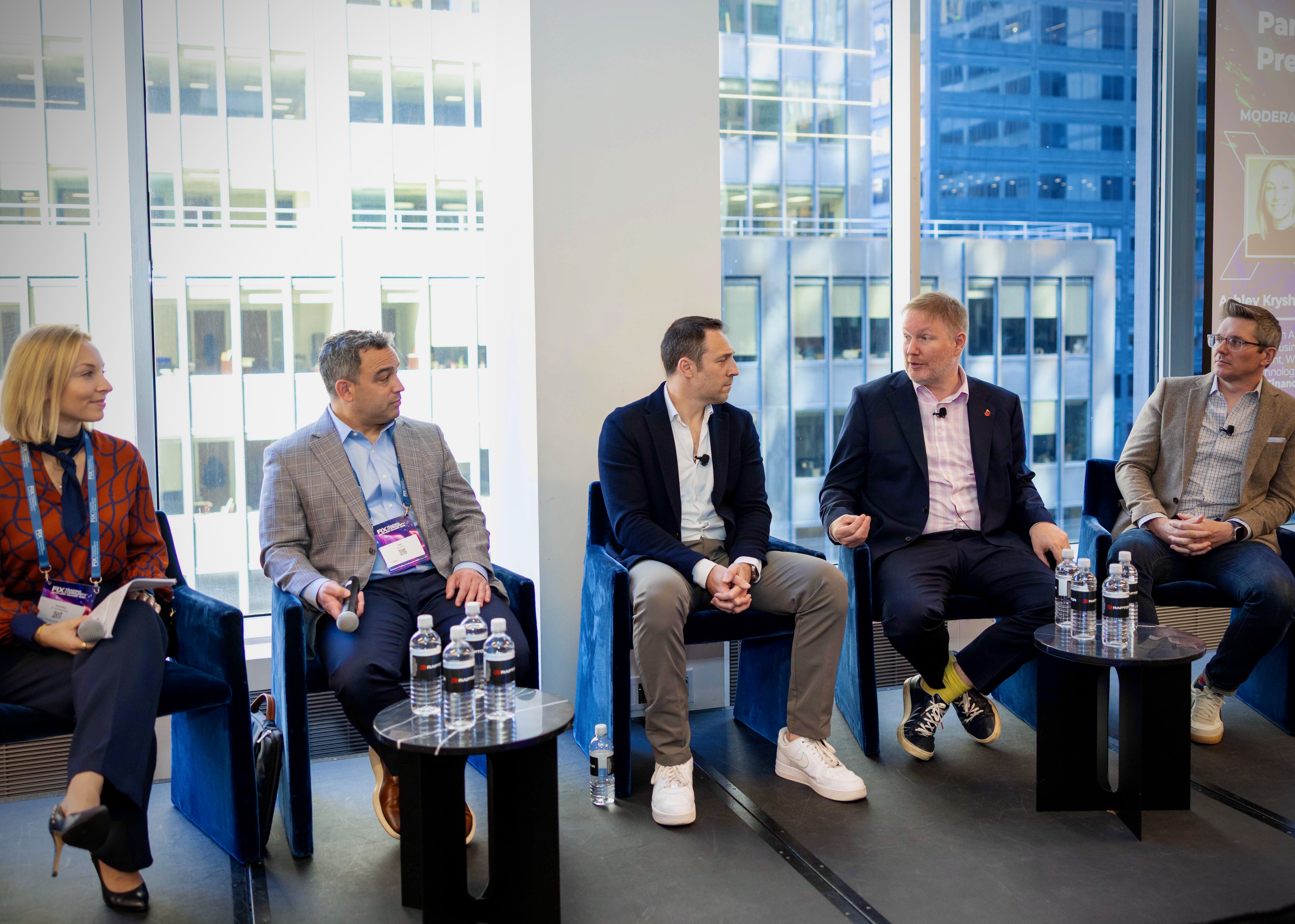
At the FIX Trading Community's Americas Trading Conference 2026 in New York on October 29, Talos CEO and Co-Founder Anton Katz joined Andy Ross, Head of Institutional Business at Kalshi; Joe Green, VP and Head of Prediction Markets at Cboe; and Mike Gatny, President and COO of Connamara, for a panel on event contracts, prediction markets and market structure, examining what institutional adoption of prediction markets requires.
Moderated by Ashley Kryshtalsky, Head of North America Sales and Business Development, Workflow Technology at Virtu Financial, the discussion covered the demands event contract-based trading places on infrastructure: market structure, connectivity, workflow and the role of standards. Panelists agreed that institutional participation is already underway. The debate centered on how quickly the rest of the market can follow.
Six key takeaways
1. Retail and institutional traders meet on the same prediction market venues
The panel pushed back on the assumption that sports contracts serve retail traders and financial or geopolitical contracts serve institutions. Retail and institutional participants trade on the same venues, without the tiered access typical of traditional capital markets. Institutional use extends to sports contracts: corporates with revenue tied to event outcomes, such as stadium owners exposed to season-ticket sales, use them as hedges. Institutional participants include both directional hedgers and market makers providing liquidity. Andy described onboarding activity at Kalshi as accelerating among institutional clients.
“Talos provides technology to some of the largest financial institutions. About half our business is buy side, and about half is white label for the sell side: we power retail brokers and some of the exchanges. People tend to think of sports as a retail activity and financial or geopolitical contracts as an institutional hedge. The reality is a lot more nuanced. Retail meets institutions on a level playing field, on exactly the same platform.” – Anton Katz
2. Prediction markets have created a new 24/7 market category
Talos was founded in crypto by a team from traditional capital markets, on the premise that traditional assets would migrate on-chain. Prediction markets represent a second development: markets that did not previously exist at institutional scale and now operate continuously. Talos recently launched connectivity to Kalshi for its institutional and White Label clients.
“We always thought traditional assets would migrate on-chain, and that is happening right now. The one thing we did not account for is that newer markets would also be enabled. Prediction markets are the poster child.” – Anton Katz
3. Institutional trading infrastructure has to run 24/7 without maintenance windows
Anton described two client approaches. Some run a dedicated 24/7 execution environment, which Talos operates for a number of clients. Others build 24/7 capability into their existing stack. Increasingly the two run in parallel: clients trade inside the Talos environment, spanning data, portfolio management, trading and settlement, which feeds downstream systems such as Aladdin.
“Digital assets are 24/7, and now I would like to welcome everybody else. We could never take the shortcuts we could in capital markets. We could never go down for an hour each day to reset FIX sessions. We operate 24/7, so our clients can operate 24/7, because the risk is 24/7.” – Anton Katz

4. Clearing, settlement and funding have to catch up to 24/7 execution
Mike noted that exchange technology supports continuous trading and rolling deployments, while settlement, collateral movement, risk management, compliance and regulatory reporting still assume fixed points in the trading day. Prediction market contracts resolve whenever the underlying event concludes, including weekends, which makes weekend funding an operational requirement. Digital asset payment rails offer one route to moving collateral outside banking hours.
Joe argued that most exchange participants operate within an intermediated model, so the transition has to be coordinated across firms, their development cycles and their staffing. Andy described Kalshi's weekend margin calls on its perpetuals product and held that any risk traded at the weekend must also be cleared and risk-managed at the weekend.
“When clients look at the risk behind an entire portfolio, you can't have assets lingering behind, where the risk can't be expressed or adjusted during the weekend. The market cares about what the client needs to do. You are either going to be there or you are going to be left behind.” – Anton Katz
5. Event contracts need standardized reference data before risk can be aggregated
Contracts that look alike across venues can carry different settlement terms or wording, which makes cross-venue risk difficult to aggregate. Andy focused on resolution integrity. Kalshi settles its 15-minute crypto contracts on a one-minute TWAP across four exchanges to deter manipulation, and declines markets whose underlying data cannot be measured reliably. Joe noted that listed options largely solved standardization through multi-listed contracts. Mike described the FIX Trading Community's new prediction markets working group, which is focused on standardizing event reference data such as estimated and actual resolution dates.
Talos maps equivalent contracts across venues at the data and execution layers, applying the approach it uses for instruments such as USDT and USDC: similar assets with different risk parameters. Risk aggregation across venues remains the open problem.
“Contracts can look similar but have a different settlement structure or different wording, and a lot of that is not properly standardized yet. We are solving more of it on the data and execution side: there is a direct relationship between a contract on platform A and a contract on platform B, and we can express that to our clients. On the risk side it is still fairly bifurcated, and we are working toward a single risk platform across all these assets.” – Anton Katz
6. Capital efficiency for institutions requires margin frameworks and regulatory clarity
Joe named capital efficiency and intermediary connectivity as the two largest barriers, noting that fully funded markets will not scale for institutions. Anton said the mechanics of capital efficiency are already being worked out with partners, but implementation requires a margin and collateral regime supported by regulation, while federal and state approaches remain unsettled. Andy built on the point, citing a small oil producer whose real exposure is freezing weather and who can now hedge at a size traditional markets would not write.
“We are experiencing something we experienced in crypto: a disconnect between the federal level and the state-by-state level. Government officials we talk to in other jurisdictions are looking at the United States for clarity. Resolving that will expand traction in other jurisdictions as well.” – Anton Katz
Panelists described institutional adoption of prediction markets and 24/7 trading as already underway, concentrated in specific firms and firm types. The pace of broader adoption depends on how quickly clearing, funding, risk and regulation align with markets that trade and resolve around the clock.
To learn more about institutional prediction markets trading, visit the Talos prediction markets page.
Disclaimer: The information herein is provided for informational purposes only. Talos Trading, LLC and its affiliates (“Talos”) make no representations or warranties as to its accuracy or completeness. Nothing herein constitutes an offer to buy or sell, or a recommendation of, any digital asset, security, derivative or trading strategy, nor investment advice. Any references to execution approaches, schedule durations, or participation rate strategies are illustrative of model outputs and do not constitute execution or trading advice.
Related reading
- Talos Brings Prediction Markets Onto Institutional Trading Infrastructure →
- Why Institutional Investors Are Now Trading Prediction Markets on Talos →
- Prediction Markets Are Going Institutional – Execution Should Too →
- Talos Brings an Institutional Perspective to CFTC Prediction Market Rulemaking →
- 50 Shades of Gray: Explore Pricing Gaps in Midterm Prediction Markets →
Latest insights and research



Request a demo
Find out how Talos can simplify the way you interact with the digital asset markets.