

Perpetually Open: Tokenized Gold & The Rise of 24/7 Onchain Markets
State of the Network #354
Perpetually Open: Tokenized Gold & The Rise of 24/7 Onchain Markets

Introduction
State of the Network #354
Coin Metrics State of the Network is an unbiased, weekly view of the crypto market informed by our own network (on-chain) and market data.
Key Takeaways
- Bitcoin has remained resilient in the face of escalating geopolitical tensions, rising roughly 7% since the February 28th shock.
- Tokenized gold products such as PAXG and XAUT saw elevated usage as investors sought gold exposure both onchain and on exchanges.
- Hyperliquid’s HIP‑3 perpetual futures emerged as a 24/7 barometer for macro risk, with metals, energy, and equity perpetuals accounting for a meaningful share of overall volume and open interest.
- Oil futures on Hyperliquid repriced the supply shock, illustrating how onchain rails can lead price discovery when traditional markets are shut.
Introduction
On February 28th news of coordinated US and Israeli strikes on Iran echoed across the world. With it being a Saturday, traditional equity and commodity markets were shut, leaving investors unable to react to such a major geopolitical shock that has now entered its second week. Traditional macro exposures and digital assets, however, were moving in real time on blockchains, from tokenized gold to perpetual futures on oil. In a moment when macro assets were at the center of the story, onchain markets were the only venues perpetually open.
In this issue of State of the Network, we examine onchain activity across tokenized gold products such as PAXG and XAUT, as well as Hyperliquid’s HIP‑3 perpetual futures contracts on commodities and equities, to understand how 24/7 markets absorb and reflect geopolitical stress
Market Reaction Amid Geopolitical Stress
Gold rose to near record highs in the immediate aftermath of the headlines, while BTC sold off. This was a classic “gold as safe haven”, “BTC as risk asset” reaction to the initial shock. As the conflict continued and shifted from a sudden surprise to a more known risk, gold drifted lower while BTC consolidated and recovered, showing relative strength as it pushed back above $73K amid heightened volatility.
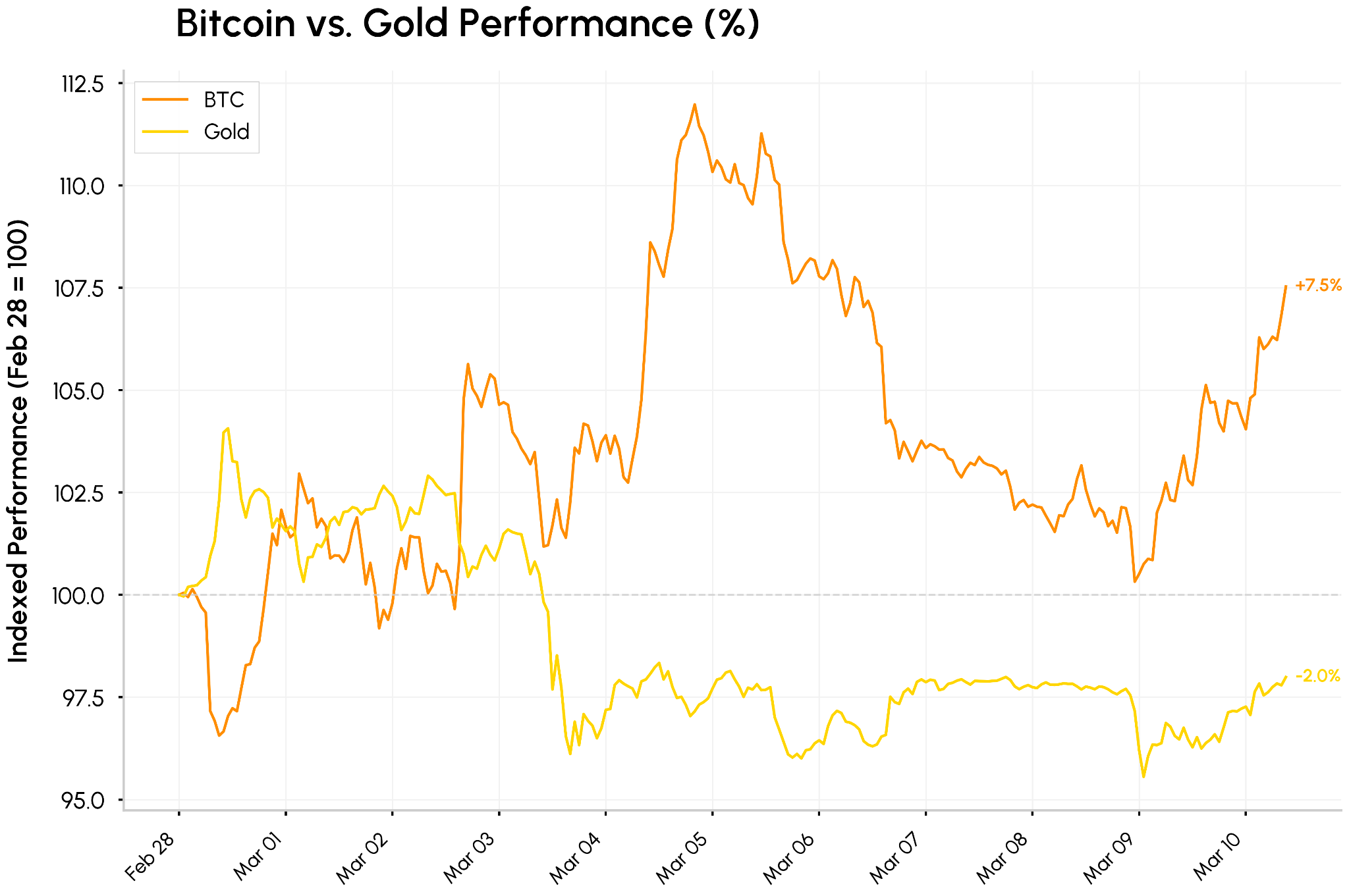
BTC price action was also supported by a streak of positive net flows into spot Bitcoin ETFs between March 2nd and 4th. This suggests a nuanced dynamic rather than a simple risk-off move, where Bitcoin’s strength may reflect a mix of oversold conditions, technical positioning, and some willingness to hold higher‑beta exposure even as geopolitical risks remain elevated.
Tokenized Gold
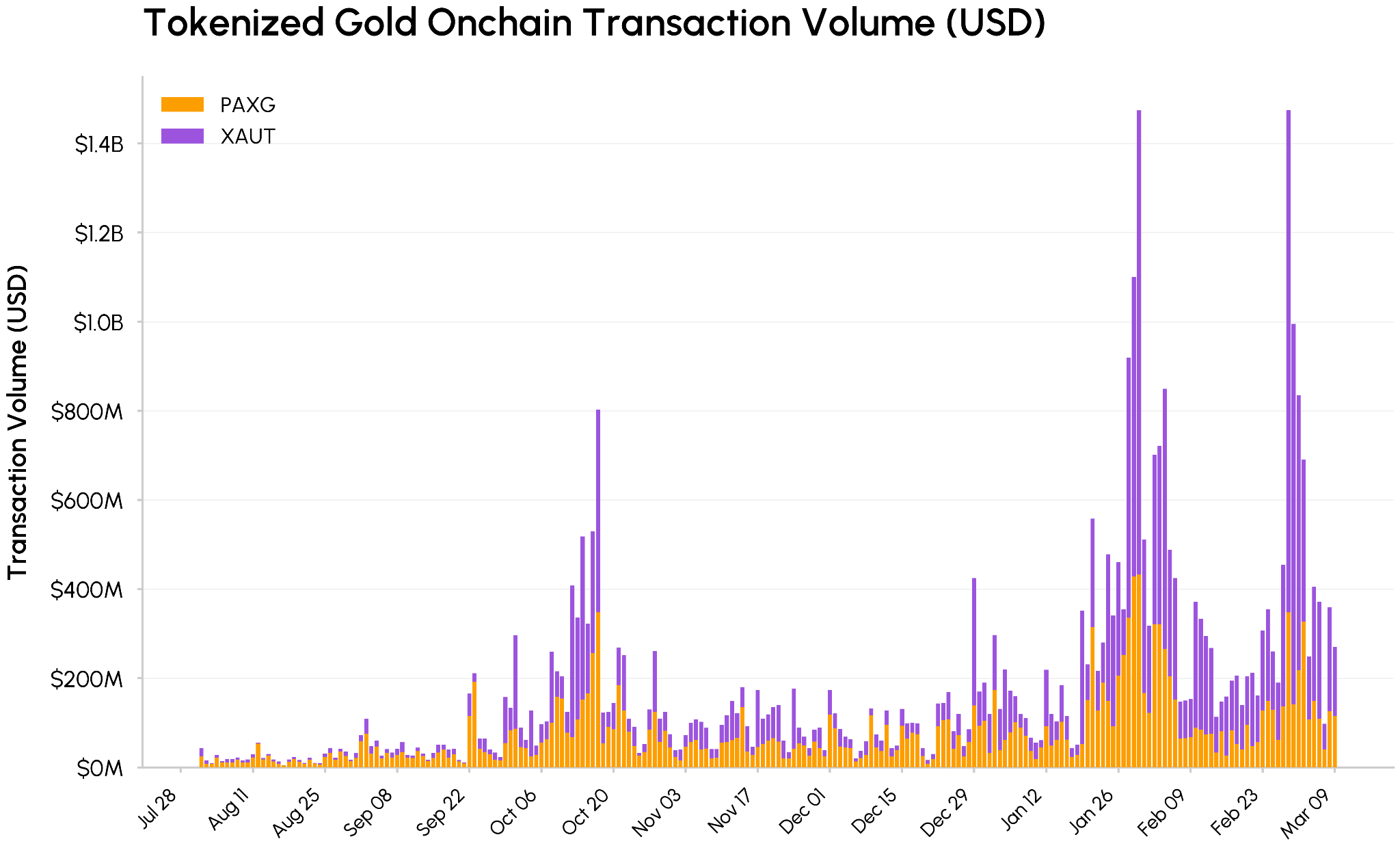
As spot and futures gold markets were closed, PAXG and XAUT traded through the weekend, attracting flows as investors looked for a live proxy onchain. Paxos Gold (PAXG) and Tether Gold (XAUT) are tokenized gold products where each token represents one troy ounce of vaulted gold, issued as ERC‑20 tokens that move and settle on Ethereum. Together, they account for a majority ($6.1B) of the tokenized gold market and give investors a way to move in and out of gold exposure without waiting for traditional markets to open.
Source: Coin Metrics Network Data Pro
With growing geopolitical and macro tensions in 2026, from the capture of Venezuelan president Nicolás Maduro, to tariff uncertainty and escalating conflicts in the Middle East, gold has seen a surge in demand (crossing $5000/oz).
Combined tokenized gold spot trading volumes across major centralized exchanges reached over $1.8B in early February and again crossed $1B as tensions flared between Iran, Israel, and the U.S. Onchain transaction volume on Ethereum also exceeded $1.4B on two occasions, with Tether’s XAUT making up the majority of activity. This, alongside growth in active addresses and transaction counts, suggests rising demand for onchain gold across hedging, wealth preservation, DeFi collateral, and DEX liquidity pairs.
HIP-3 Perpetual Futures on Hyperliquid
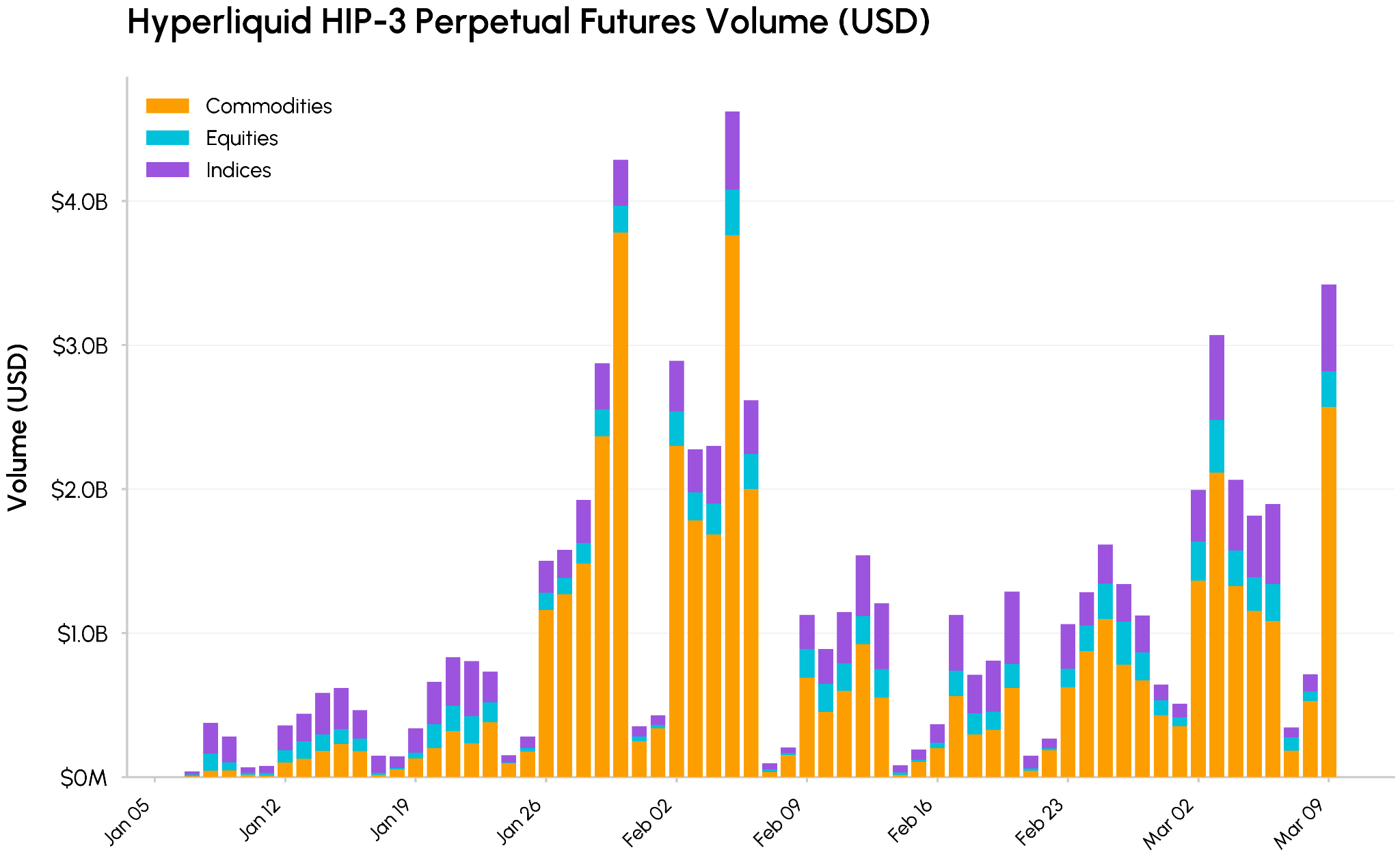
Similarly, onchain perpetual futures contracts on Hyperliquid also emerged as a key outlet. This was enabled by Hyperliquid’s HIP-3 markets, a protocol that allows permissionless listing of perpetual futures for any asset (by staking 500,000 HYPE) with a reliable price feed, including crude oil, gold, silver, and equity indices, all trading 24/7 with no expiry. The largest deployers include DEX instances such as Trade[XYZ], which lists U.S. equity and commodity perps, and Ventuals, which offers pre‑IPO and alternative asset markets such as Anthropic and SpaceX.
Source: Coin Metrics Market Data Feed
Total volume across HIP‑3 markets has surpassed $95B, with open interest recently reaching a record $1.2 billion (~20% of total OI). Non‑crypto assets such as oil, gold, silver and equities now account for a meaningful share of that activity, with metals and energy perps recently contributing billions in daily volume and a growing slice of total open interest. This growth highlights the platform’s evolution from a niche DeFi venue into a 24/7 extension of traditional markets and also channels a growing share of protocol fee revenue from non‑crypto markets.
Fueling the Commodity Craze
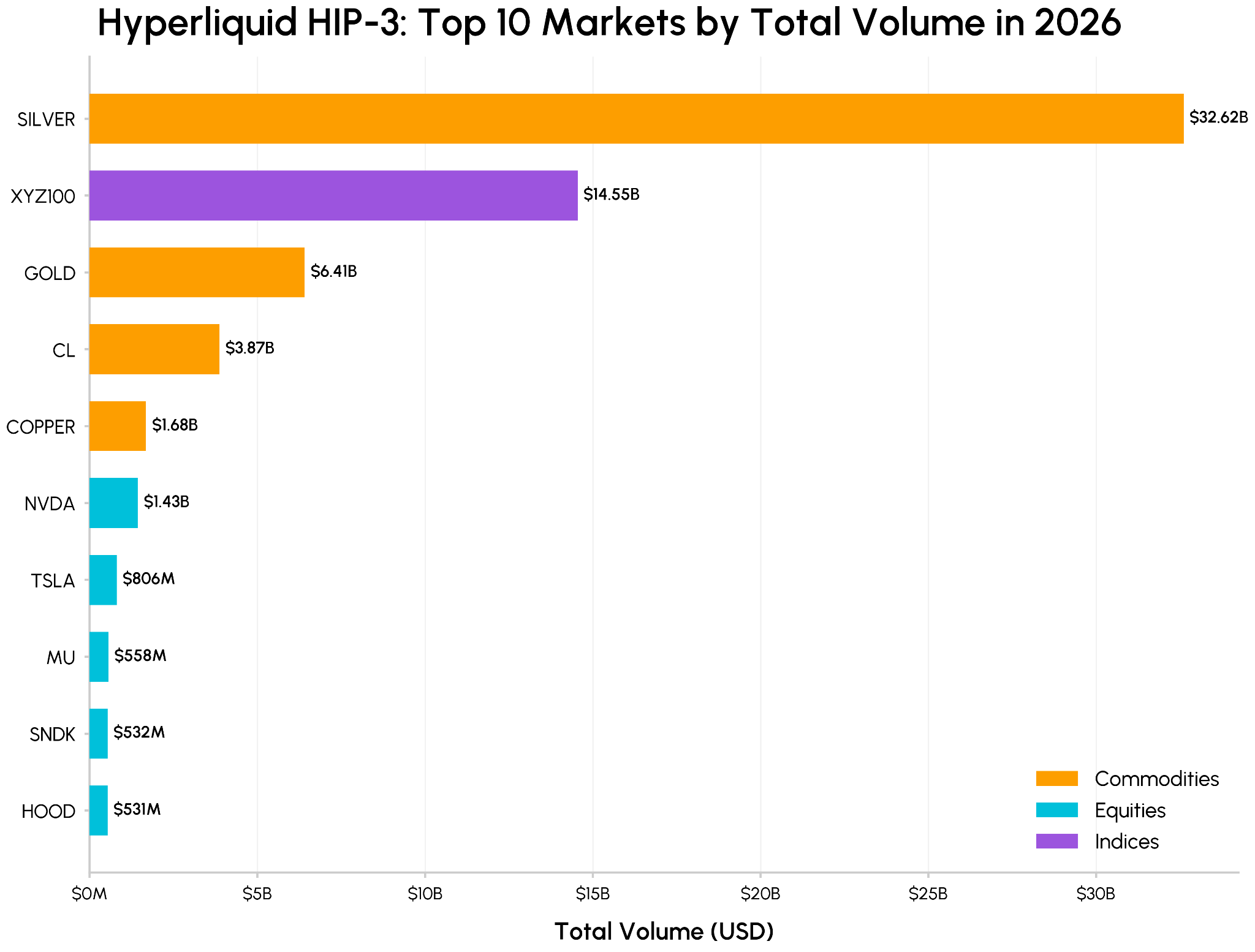
Within HIP‑3, the largest markets by 2026 cumulative volume are increasingly commodities. Silver and gold perps lead all RWA contracts by a wide margin, followed by crude oil (CL-USDC), which has climbed the ranks as the conflict in the Middle East raised concerns about supply disruptions.
Source: Coin Metrics Market Data Feed
Average trade sizes in these markets are still relatively small compared to institutional futures, but meaningful for a retail driven onchain venue: around $2.7K for gold perps, $3.4K for silver, roughly $2.8K for CL crude, and about $1.1K for the XYZ100 (Nasdaq 100) index.
Pricing Oil When Markets Sleep
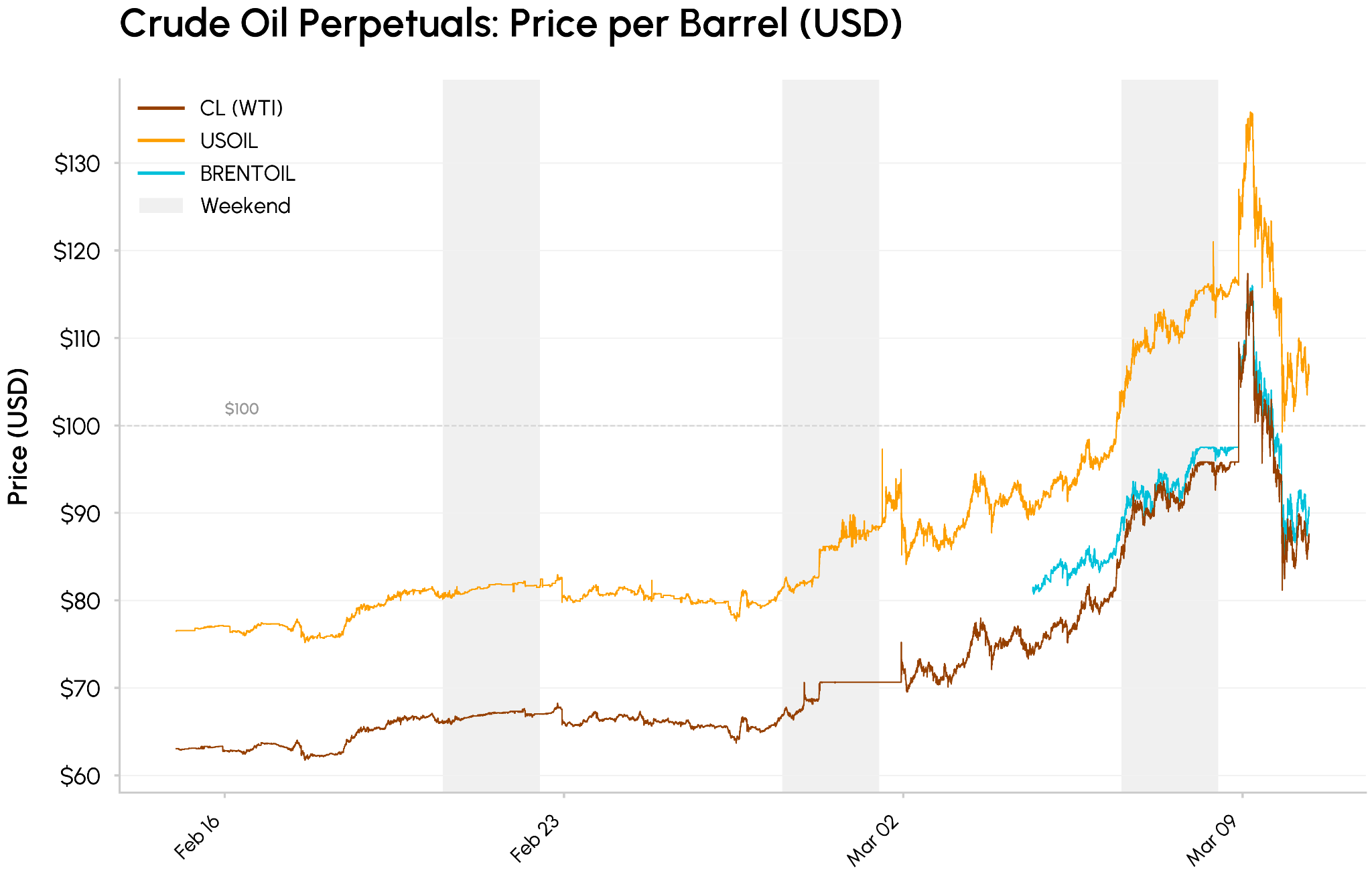
Hyperliquid hosts several oil‑linked perpetual futures, including contracts such as CL (West Texas Intermediate), BRENTOIL (Brent Crude) and USOIL (US Oil Composite), which track different benchmark crude prices. They trade 24/7 on an onchain order book and are margined and settled in stablecoins (USDC/USDH). Each oil listing is effectively its own market with its own liquidity, funding rate, and index source, which can lead to small spreads even if they all broadly reference crude oil.
Source: Coin Metrics Market Data Feed
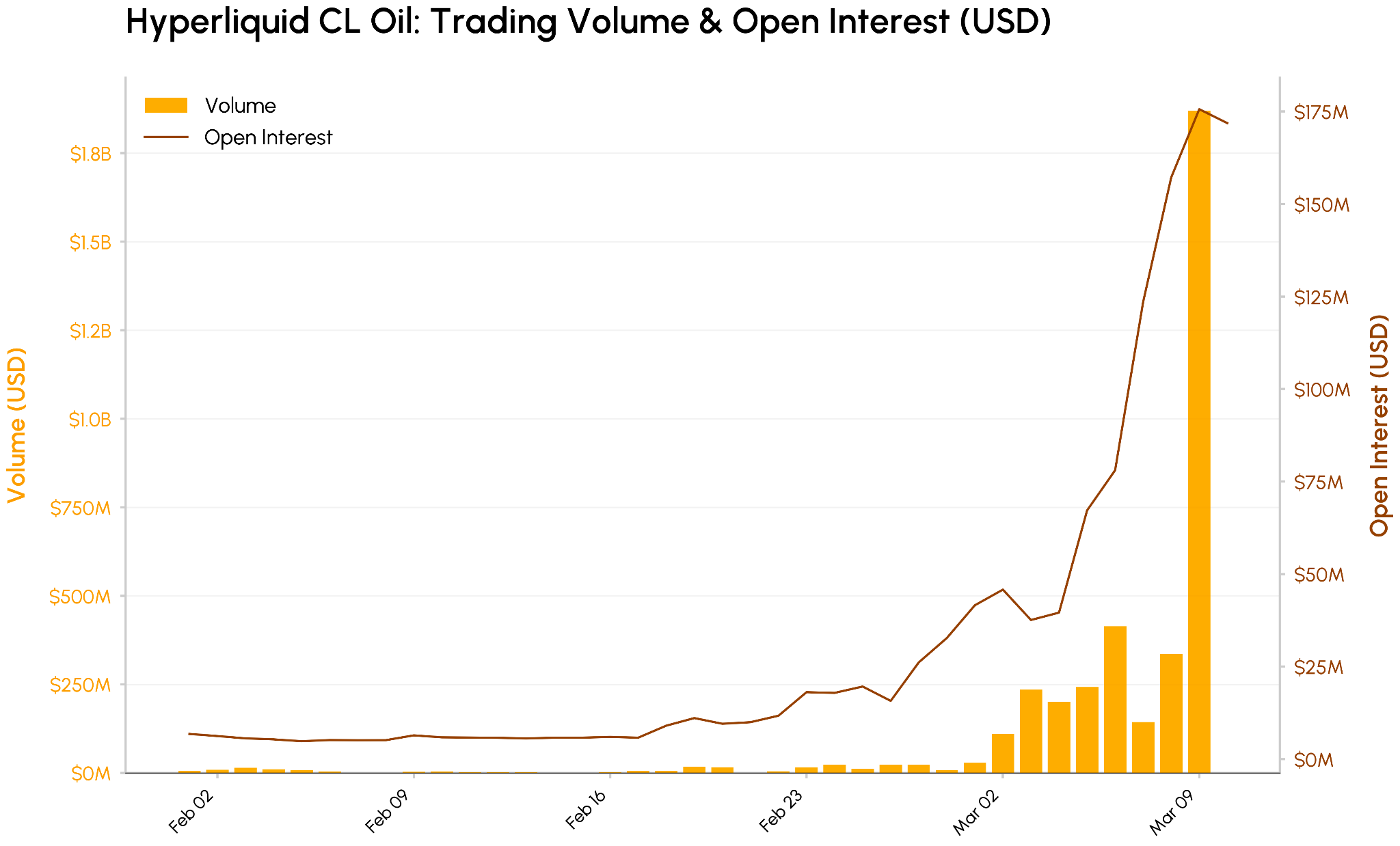
When U.S. and Israeli strikes hit Iranian facilities, disrupting supply routes and raising fears around the Strait of Hormuz, oil perps repriced within minutes while traditional futures were closed. As the 1-minute candle price chart above shows, Hyperliquid’s CL-USDC contract priced oil in real time over the weekend, with a sharp spike to $109 before traditional markets reopened. Open interest and volume in the market climbed to roughly $175M and $1.9B over the same window. This made CL-USDC the second most traded market on the platform, surpassing ETH perpetual volumes as traders used it to express views on the evolving supply shock.
Source: Coin Metrics Market Data Feed
Exposure to Equities
While commodities dominated flows during this period, HIP‑3 also hosts perpetuals linked to equity indices and stocks, giving traders a way to express views on equities around the clock. Volumes in these markets remain smaller than in oil and metals, but their presence rounds out HIP‑3’s role: gold and oil for direct macro hedges, and equity perps for risk‑on/risk‑off positioning independent of crypto price swings. Several exchanges such as Kraken, with its xStocks products, are moving in a similar direction by offering tokenized equities and, more recently, perpetual futures on those tokens to extend 24/7 equity exposure.
Conclusion
Recent geopolitical conflicts offer a narrow but telling glimpse of what 24/7 onchain finance looks like in practice. In those windows, crypto rails facilitated activity in tokenized gold and perpetual futures while traditional venues were shut, validating the idea that blockchains can serve as always‑on market infrastructure even if the ecosystem is still early, relatively small, and constrained by liquidity and regulatory uncertainty.
Platforms like Hyperliquid and tokenized‑asset products show how these rails are expanding from pure crypto exposure into metals, energy, and equities, pointing toward a future where continuous, onchain access to macro assets is a core feature of global markets.
Disclaimer: The information herein is provided for informational purposes only. Talos Trading, LLC and its affiliates (“Talos”) does not give any representations or warranties in relation to the accuracy, validity, or completeness of the information of this material, including without limitation the factual information obtained from publicly available sources considered by Talos to be reliable at the time. Talos accepts no liability for any consequences of using the information contained in this material. Any opinions or estimates expressed herein reflect a judgment made by the author(s) as of the date of publication and are subject to change without notice. Neither this material nor any copy thereof may be taken, reproduced, or redistributed, directly or indirectly, without Talos’s prior written permission. Any views or opinions expressed are those of the authors and do not necessarily reflect the views of Talos. This communication does not constitute an offer to buy or sell, or a promotion or recommendation of, any digital asset, security, derivative, commodity, financial instrument, or product or trading strategy. This document and information are not intended to constitute investment advice or a recommendation to make (or refrain from making) any kind of investment decision and may not be relied on as such.
Subscribe
If you’d like to get State of the Network in your inbox, please subscribe below.
Latest insights and research
.jpg)


Request a demo
Find out how Talos can simplify the way you interact with the digital asset markets.