

The Perpification of Everything: What Brokers Need to Offer Perps
Ten years ago, the perpetual swap was introduced. BitMEX wanted to offer leveraged bitcoin exposure without expiries, delivery or a settlement calendar, so it listed a future that never settles and used a funding payment to hold it near spot. This innovation is now the dominant way crypto trades, and it is starting to appear across real-world assets.
The Perpification of Everything: What Brokers Need to Offer Perps

Introduction
Ten years ago, the perpetual swap was introduced. BitMEX wanted to offer leveraged bitcoin exposure without expiries, delivery or a settlement calendar, so it listed a future that never settles and used a funding payment to hold it near spot. This innovation is now the dominant way crypto trades, and it is starting to appear across real-world assets.
During the month of August 2026, perpetual futures traded an average of $116 billion a day across the exchanges Talos covers for Coin Metrics data, while dated futures traded $17 billion and options traded $4 billion of notional. Perpetual futures account for 84% of total derivatives volume and represent roughly five times reported spot volume. That share has not fallen below 83% in any month since the start of 2022.
Perpetual Futures Have Become a Popular Instrument for Crypto
Monthly average daily volume across all Talos-covered exchanges, log scale
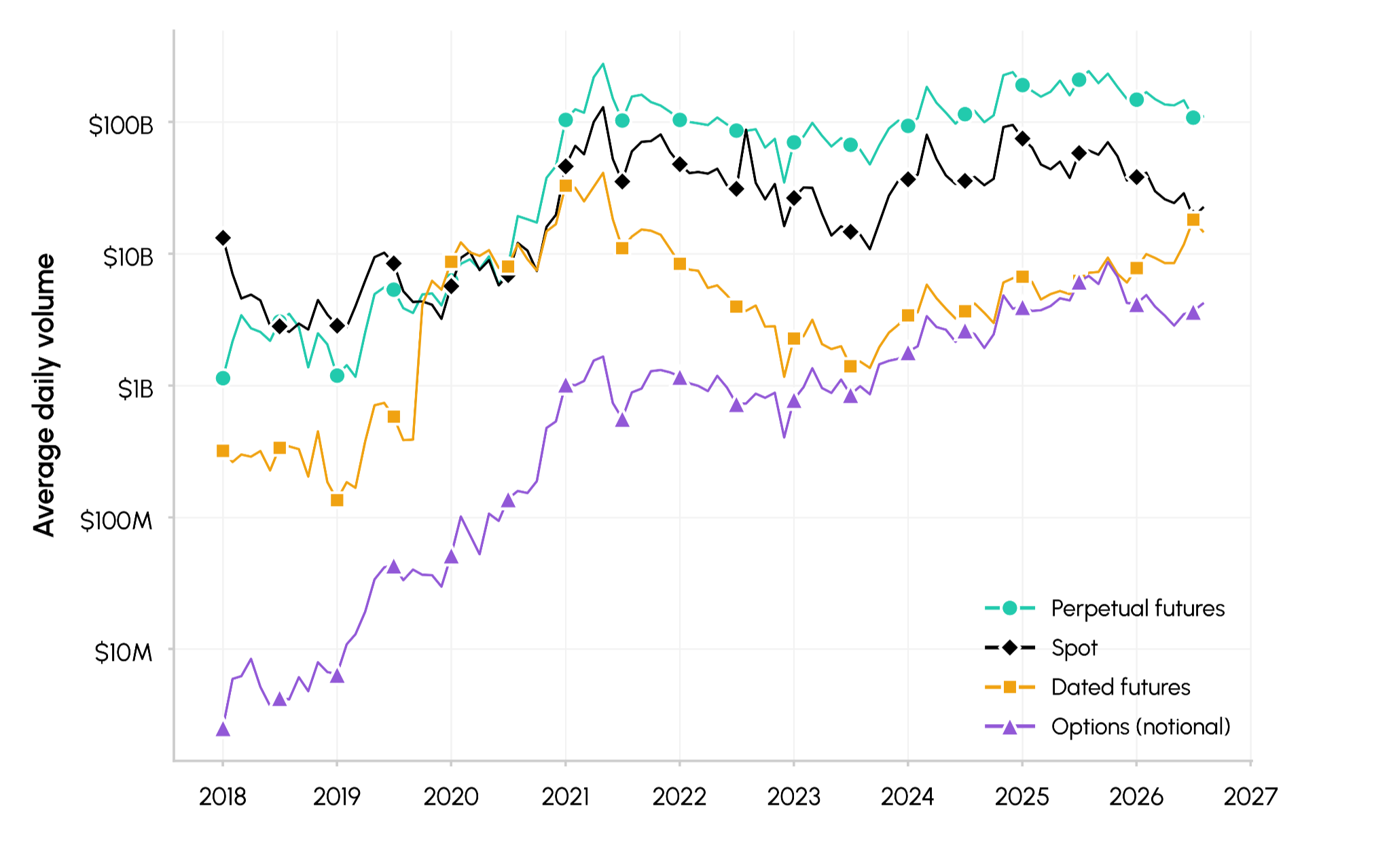
Empirically, support for perpetual futures by exchanges and brokers continues unabated. In January 2022, we covered about 900 perpetual markets on 11 exchanges. Today our coverage is 7,247 markets on 20 exchanges, and the list consists of a wide variety of exchanges across varying geographies.* Perpetual futures have increasingly become a popular instrument among traders due to its relatively convenient contract specifications: no expiry ladder to maintain, nothing to deliver, and no options chain to quote.
Perpetual Futures Listings and Support Continue to Grow
Perpetual markets live in a given month, and the number of exchanges listing them

Why other asset classes are moving into a perp
Perpetual futures are experiencing growing interest from traders outside of crypto due to several exchanges listing contracts on equities, commodities and other real-world assets. A year ago, 16 perpetual contracts tracked an equity, an ETF or an index, on three exchanges. As of August 2026, there are 584 perpetuals that track a wide variety of real-world assets on 16 exchanges. In some cases, exchanges have even listed a perpetual future on an equity that is in pre-IPO with no public equity market, raising regulatory questions around the nature of price discovery.
Perpetual Futures are Rapidly Expanding to Non-Crypto Assets
Perpetual instruments whose underlying is an equity, ETF, index, metal, energy or currency
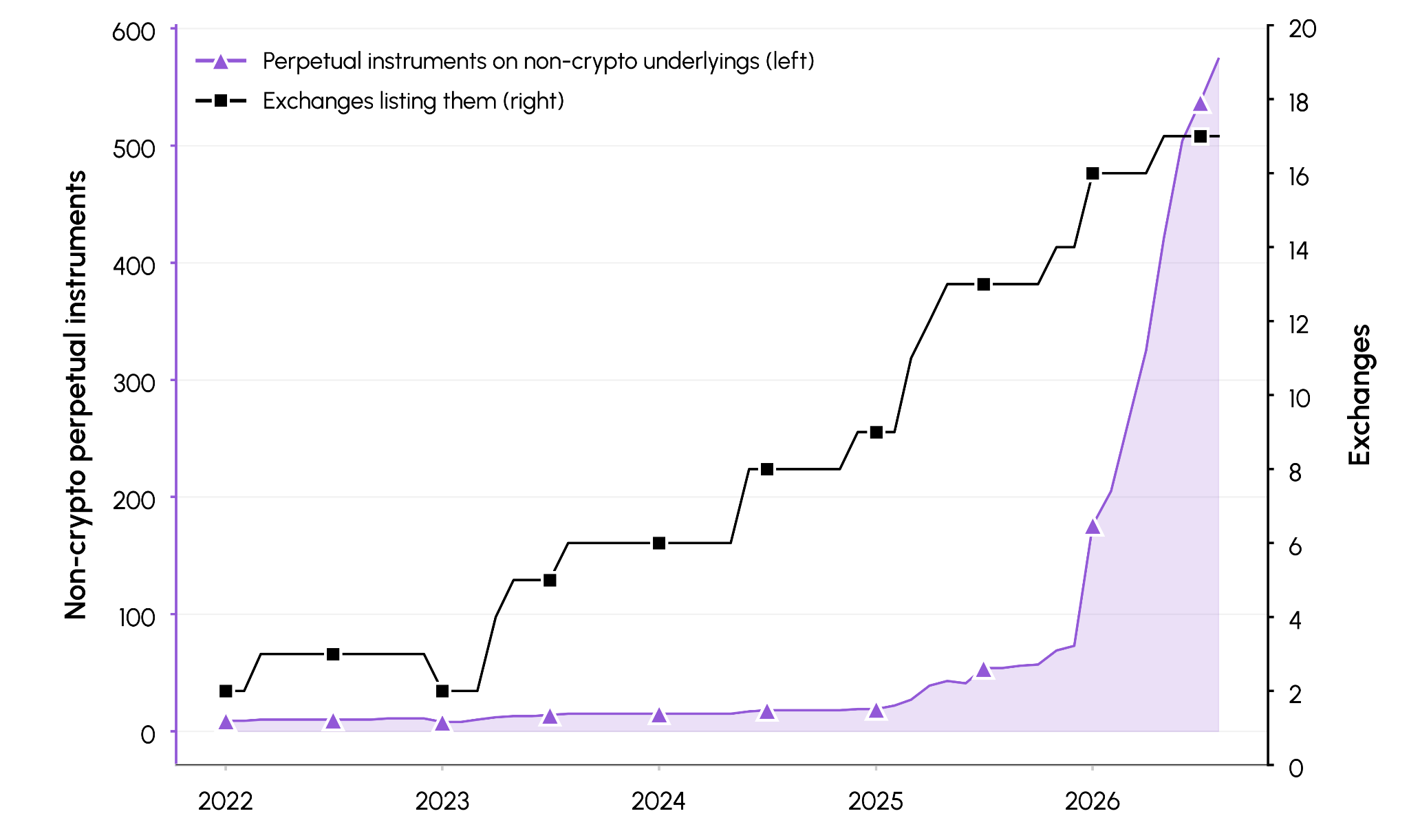
Non-crypto perpetual futures traded $3.7 billion a day during August 2026, about 3% of all perpetual futures volume, with 47 individual instruments averaging more than $10 million a day. Metals are $2.3 billion of that and energy $338 million, so gold and crude still carry the category. Equities, ETFs and indices are $1.0 billion and quickly growing.
Perpetual futures represent an increasingly popular alternative to standard securities offered through traditional brokers. A client can hold leveraged, round-the-clock exposure to bitcoin, gold, traditional equities and the Nasdaq in a single margin account at an exchange and settle it in stablecoins. Some brokers are taking notice and modifying their offerings.
What a dealer needs to offer perpetuals
To an end client, a perpetual future is simple: one instrument, one margin balance, and no expiry to track. However, offering that simplicity is a challenging problem to solve for the dealer. Several systems must work together to support a perp, from how the contract is defined, priced, funded, and hedged to how it's distributed to the dealer's customers.
- Contract creation. The dealer defines the instrument: underlying, tick size, contract multiplier. This holds for all bilateral contracts: a client can't trade until the dealer defines it.
- Pricing and execution. A client is trading against the dealer, not against other clients on an order book. The contract has no market of its own. The dealer needs a source of economically similar liquidity to quote from: a spot market, a related perp, another CFD (if legally available to the customer). Staying risk neutral on the fill means defining how it hedges across those same instruments. How to manage client exposure is another choice for each dealer: hedge every fill back to back and stay flat trade by trade or warehouse some of it and manage net exposure across the book instead.
- Margin validation and reservation. Each order gets checked against available collateral and configured leverage before it is accepted. Once accepted, the margin behind it is reserved against that order specifically, so the same collateral can't be counted toward another order. Leverage is set per client and can be overridden per asset, because a book that treats a large-cap and a thin altcoin the same way is carrying risk it hasn't priced. Client collateral, equity and exposure sit in their own account, not commingled with the rest of the book.
- Risk monitoring. Once a position is open, equity, margin and unrealized P&L need to update continuously rather than at a periodic snapshot, since a client's exposure can move well past their margin call threshold in the gap between two stale checks. Marking positions is only half of it: a dealer also needs stress thresholds, running a given market move through a client's book ahead of time to see the P&L impact.
- Funding rates and schedules. The payment between longs and shorts holds a perp’s price, which has no expiry, near the spot price. It needs to compute and settle automatically, on an interval the dealer sets, with the option to vary the rate by asset or by client. Clients in different regions often want funding to land at different times, and clients with different risk profiles can warrant different rates on the same asset, not one schedule applied uniformly across the book.
- Mark price. Margin, liquidation and funding resets all key off the same reference price. How dealers arrive at that price varies: some blend liquidity from multiple sources, others point to an independent index. The more stable that price is, the less likely a brief dislocation triggers a margin call or liquidation that doesn't reflect the client's real risk. More on this below.
- Liquidation. An account that breaches liquidation thresholds needs to be closed out, with realized P&L and collateral updated correctly once it is. Exact liquidation mechanisms will vary. High-volume trading flow argues for handling breaches automatically and immediately; a large position from a single client might call for a human in the loop instead, working the close-out with some care rather than triggering an instant, mechanical unwind. Either way, the dealer needs the same mechanics underneath: the ability to force a close, and the realized P&L and collateral math that follows it.
- Distribution. A UI or API surface that puts the contract, the margin terms and the funding schedule in front of the dealer's own customers, under the dealer's own brand, is what turns several back-office systems into a product.
The importance of the reference price underpinning perpetuals
Price governance becomes a focus once institutional capital gets involved. Traditional markets were built by institutions from the outset, with trading happening on exchanges, dealer desks and RFQ platforms. The issue of price integrity emerged as the market structure matured, developing into independently governed, audited reference rates that institutions could rely on for settlement.
Crypto markets followed a different path. They were built by non-institutional participants first, and institutional capital arrived later, prompting the need for price governance to catch up. Because liquidity is fragmented across dozens of venues, there is no single definitive price at any given moment, and governance around reference rates is only now being constructed to support the institutional capital already in the market.
This governance gap sits directly underneath a perpetual’s reference price: margin calculations, liquidation triggers, funding rate resets and realized P&L settlement all depend on a mark that can be defended, not merely quoted. One way to close the gap is to treat price integrity as its own function, independent of the venues where trading happens. Talos’s Coin Metrics Benchmarks are built for this: an independently administered, IOSCO-aligned benchmark, kept separate from trade execution, giving perpetual markets a mark for margining and liquidation that is designed to hold up regardless of what any single exchange is doing.
Conclusion
Perpetual futures are no longer limited to crypto. As they extend into other asset classes, the ability to offer perps will come down to the systems described above: how the contract is created, priced, executed, margined, funded and liquidated, all built around a reference price that holds up under scrutiny. As more asset classes migrate to perps, this is the infrastructure question more brokers will face.
Related links
Talos Adds Turnkey Perpetuals Trading Infrastructure for Brokerages → (Product announcement)
Crypto CFDs: A Powerful Tool for Institutional Traders → (Knowledge article)
The Perp-ification of Everything Explained → (Appearance on the Walk&Talk podcast)
Key Insights on Perpetual Derivatives → (Comment letter to the CFTC)
Hyperliquid: Perps, Outcome Markets and USDC Yield → (Talos Research report)
Projection Rates and Basis for Perpetuals and Futures → (Risk management analysis)
Hyperliquid: Pre-IPO Price Discovery on Crypto Rails → (Talos Research report)
Talos Integrates with Hyperliquid to Expand Institutional Access to On-Chain Liquidity → (Integration announcement)
Talos Expands Coin Metrics Market Data with Hyperliquid Coverage → (Product update)
To learn more about how Talos is helping the world’s largest brokerages launch perpetuals, read about the Talos White Label platform, or talk to us.
* Access to the markets and exchanges Talos covers varies by jurisdiction.
Disclaimer: This material is for informational purposes only and is intended for sophisticated institutional investors. It does not constitute legal, tax, or investment advice. Institutions should seek independent legal counsel for material regulatory decisions. The views and opinions expressed herein are those of the author(s) and do not necessarily reflect the views of Talos Global, Inc. or its affiliates (collectively, “Talos”). This material summarizes information with respect to cryptocurrencies or related topics and is not an offer or solicitation to invest, buy, or sell any interests, or an official statement of Talos.
Latest insights and research
.jpg)


Request a demo
Find out how Talos can simplify the way you interact with the digital asset markets.