

The Race for Tokenized Stocks and the Path Ahead

Introduction
State of the Network #382
Key Takeaways
- Exchanges are converging across tokenized equities, RWA perpetuals, and blockchain infrastructure, as they build out multi-asset venues spanning both crypto native and traditional markets.
- This is helping diversify activity beyond crypto trading, with Binance’s tokenized stock volume reaching over $3.7 billion in a single month, and RWA perpetuals peaking above 30% and 60% of futures volume on Binance and Hyperliquid.
- The SEC’s new Innovation Exemption opens a path for tokenized stocks to trade onchain, a significant step toward bringing this activity onshore.
Introduction
Digital asset exchanges are expanding beyond crypto only venues into "everything exchanges," combining spot, derivatives, tokenized assets, and onchain infrastructure under one roof. The largest venues are now converging on full stack infrastructure spanning crypto native and traditional markets.
Kraken and its parent company Payward offer a useful lens into this shift. Through xStocks, its own Ethereum layer 2 Ink, and a newly announced push into regulated onchain derivatives, Payward is building across the tokenized equity stack. In September, Nasdaq Ventures agreed to invest $100 million in Payward to deepen a partnership on tokenized equity infrastructure, while Payward separately announced plans to bring regulated, permissioned onchain perpetual futures to U.S. clients via Hyperliquid’s HIP-3.
These moves arrive the same month the SEC issued its “Innovation Exemption,” a signal that exchanges, issuers, and market infrastructure providers are converging around tokenized equities from different directions. In this issue of State of the Network, we look at how tokenized stock trading and RWA perpetuals have scaled across major exchanges this year, how the SEC’s innovation exemption fits into the picture, and how the race toward “everything exchanges” is developing.
The Race for Tokenized Equities
Exchanges are approaching tokenized equities from different angles. The common thread is an effort to combine spot tokenized stocks, derivatives, and blockchain infrastructure into a broader multi-asset trading stack.
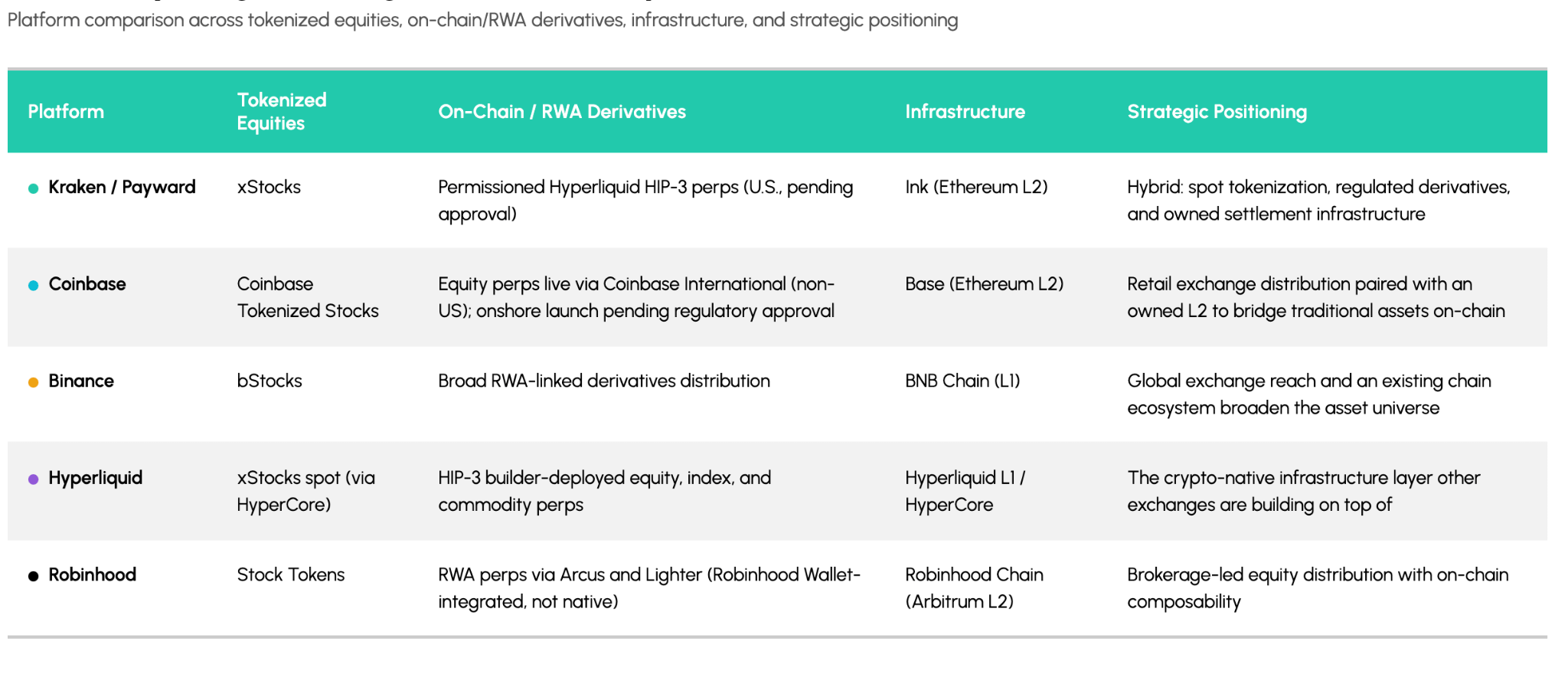
- Kraken/Payward spans xStocks for spot exposure, and a move into onshore derivatives via Hyperliquid’s HIP-3. xStocks are issued by Backed Finance, giving economic exposure to shares, with dividends delivered through rebasing. Kraken’s Nasdaq partnership moves it toward a rights-preserving model (NETs) that would sit alongside xStocks.
- Binance launched bStocks in June, reaching $500 million in assets under management within seven weeks. Like xStocks, bStocks are certificates representing financial rights to the underlying equity, with no voting rights and redemption limited to market hours.
- Coinbase issues tokenized stocks through B20, a standard purpose built for RWAs on Base. Coinbase describes each token as a direct claim on the underlying share, held via Alpaca under an ADGM-regulated SPV, though only KYC’d “Vested Holders” can redeem or vote. Dividend rights are live for all holders.
- Hyperliquid is an infrastructure and liquidity layer on which third parties can build. It has hosted select xStocks spot markets since August and enables external builders to deploy equity, index, and commodity perpetuals through HIP-3. Kraken’s plan to bring regulated US perpetuals to Hyperliquid via its CFTC-regulated Bitnomial subsidiary is the clearest example of this.
- Robinhood launched Stock Tokens on Robinhood Chain in July, structured as debt securities with a Jersey SPV. Dividends pass through via an onchain multiplier, with no voting or shareholder rights currently attached, though Robinhood said it is working toward in-kind share redemption and voting rights on its roadmap.
Other platforms are moving into this space too, including OKX with its “Unified Tokenized Stocks” on the OKX X Layer blockchain, and Backpack’s tokenized stocks on Solana, which use a US broker-dealer structure closer to traditional shareholder rights than most of the models above.
Tokenized Stocks & Perps: Adoption So Far
While crypto trading volumes have softened this year, we’re seeing meaningful growth in tokenized stock trading and RWA linked perpetual futures across exchanges.
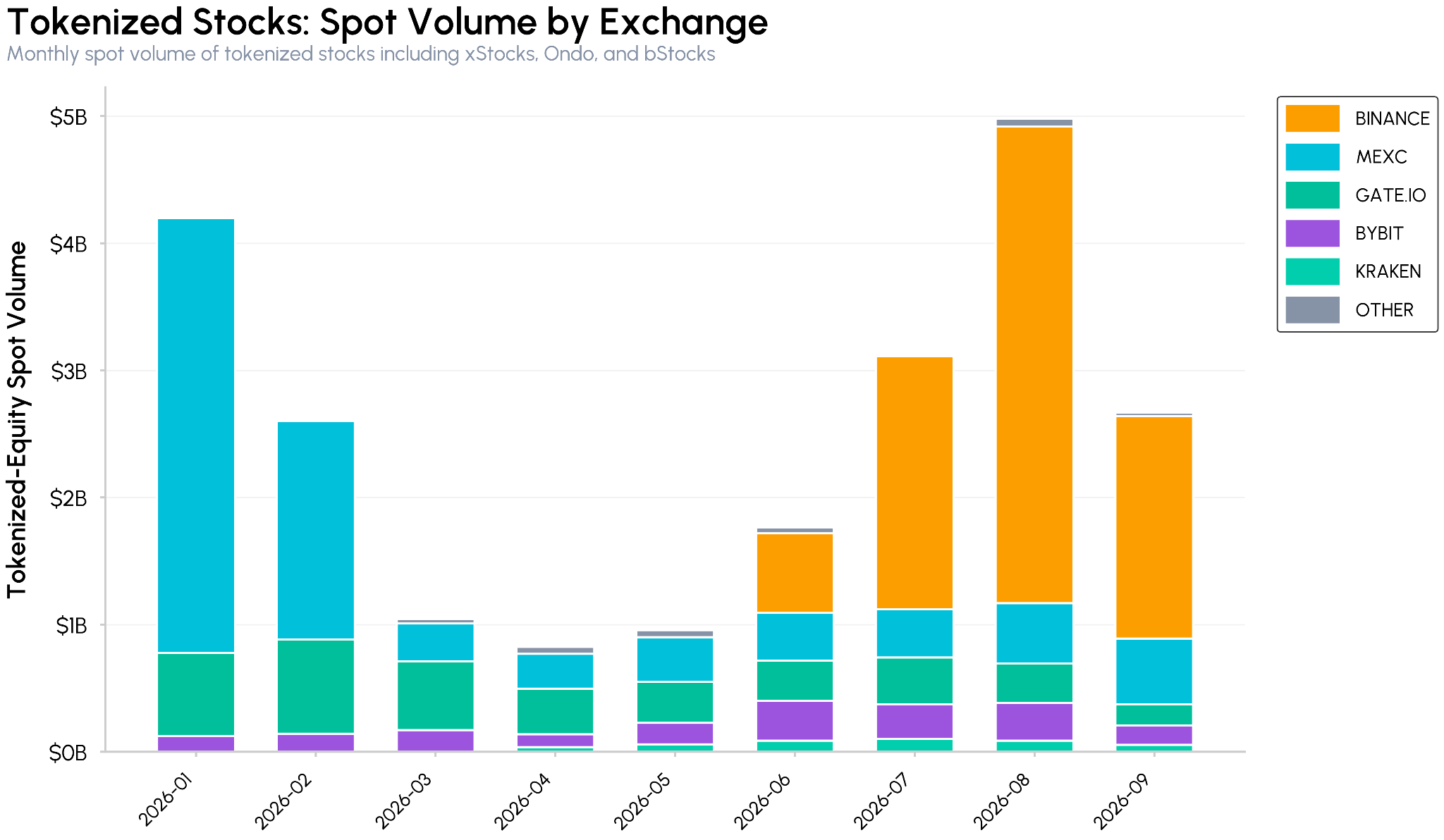
Spot tokenized stock volume across xStocks, Ondo, and bStocks has grown sharply this year, driven especially by Binance’s entry. Volume on Binance went from essentially zero to over $3.7 billion within a few months following the June launch of bStocks. The growth in issuance has also driven secondary market activity onto DEXs and AMMs, particularly Uniswap v4 on Robinhood Chain as activity continues to build around Stock Tokens.
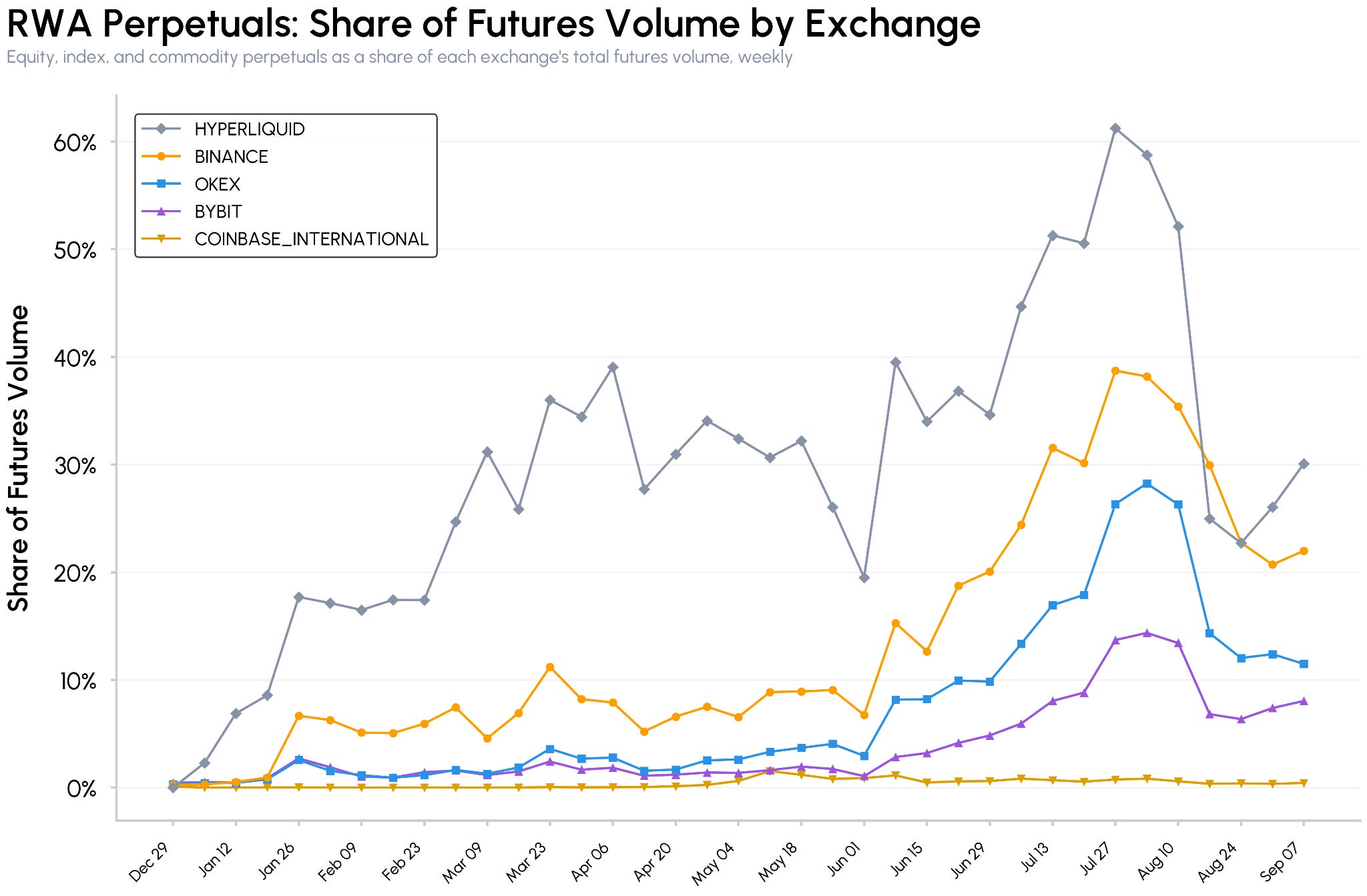
Perpetual futures markets show an even sharper shift. Equity and commodity perps now make up a growing share of futures volume, with Binance and Hyperliquid seeing its share of futures volume rise to over 20 and 40 percent respectively this year. Exchanges continue to diversify their revenue base and volume sources beyond pure crypto trading, which could mean less cyclicality going forward and a broader, more all weather engine for growth as markets increasingly move toward 24/7 trading.
Kraken’s xStocks alone have amassed over $3B in onchain market capitalization across Ethereum and Solana. Active addresses interacting with xStocks have also surged in September, as distribution and usage of these assets expands across both onchain and centralized venues for trading, as well as into vaults, lending, and borrowing.
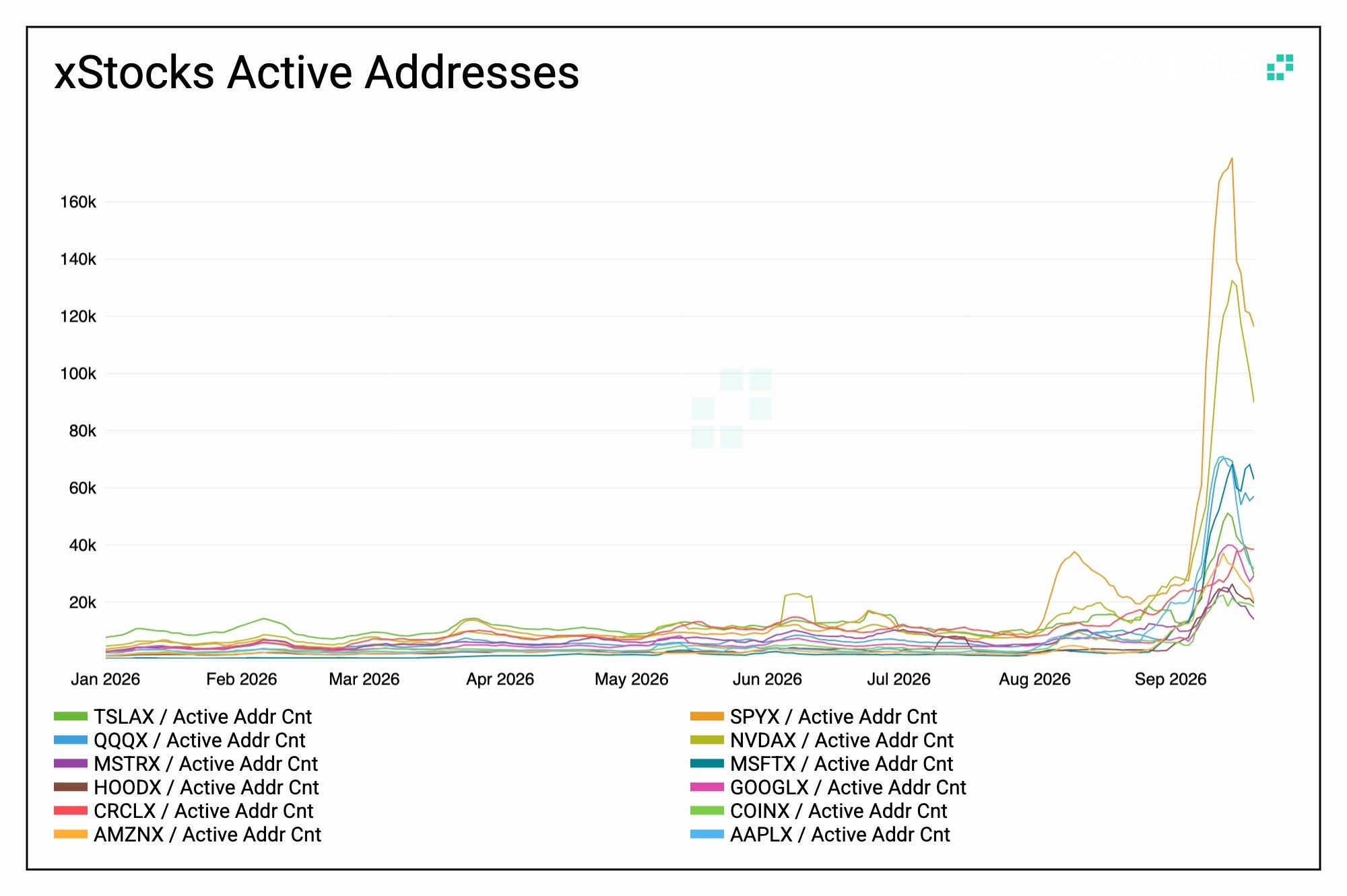
Source: Talos CM Network Data Pro
SEC Innovation Exemption & Who is Positioned to Benefit?
On September 17, 2026, the SEC introduced a five year “Innovation Exemption,” letting qualifying Tokenized Securities Venues (TSVs) trade tokenized stocks onchain through permissioned AMMs without registering as an exchange. To qualify, a token must carry conventional shareholder rights, including dividends and voting, and be issued by or on behalf of the company, or by an unaffiliated third party the issuer hasn’t objected to.
The infrastructure that maps more directly onto what the SEC described includes Securitize and Superstate’s issuer-native and transfer-agent models, Dinari’s custodial structure, and the DTCC’s own pilot to tokenize DTC-custodied securities. Uniswap v4’s whitelisted pools stand to benefit, while Kraken’s Nasdaq Equity Tokens (NETs) and Coinbase’s B20 point toward exchanges building rights-preserving models of their own. xStocks, bStocks, and Robinhood’s Stock Tokens, the products driving most of today’s volume, appear to sit outside the framework as currently structured.
The reception has been positive across the board, with tokens and equities tied to tokenized stock infrastructure broadly rallying, regardless of how directly their underlying model maps to the exemption’s requirements.
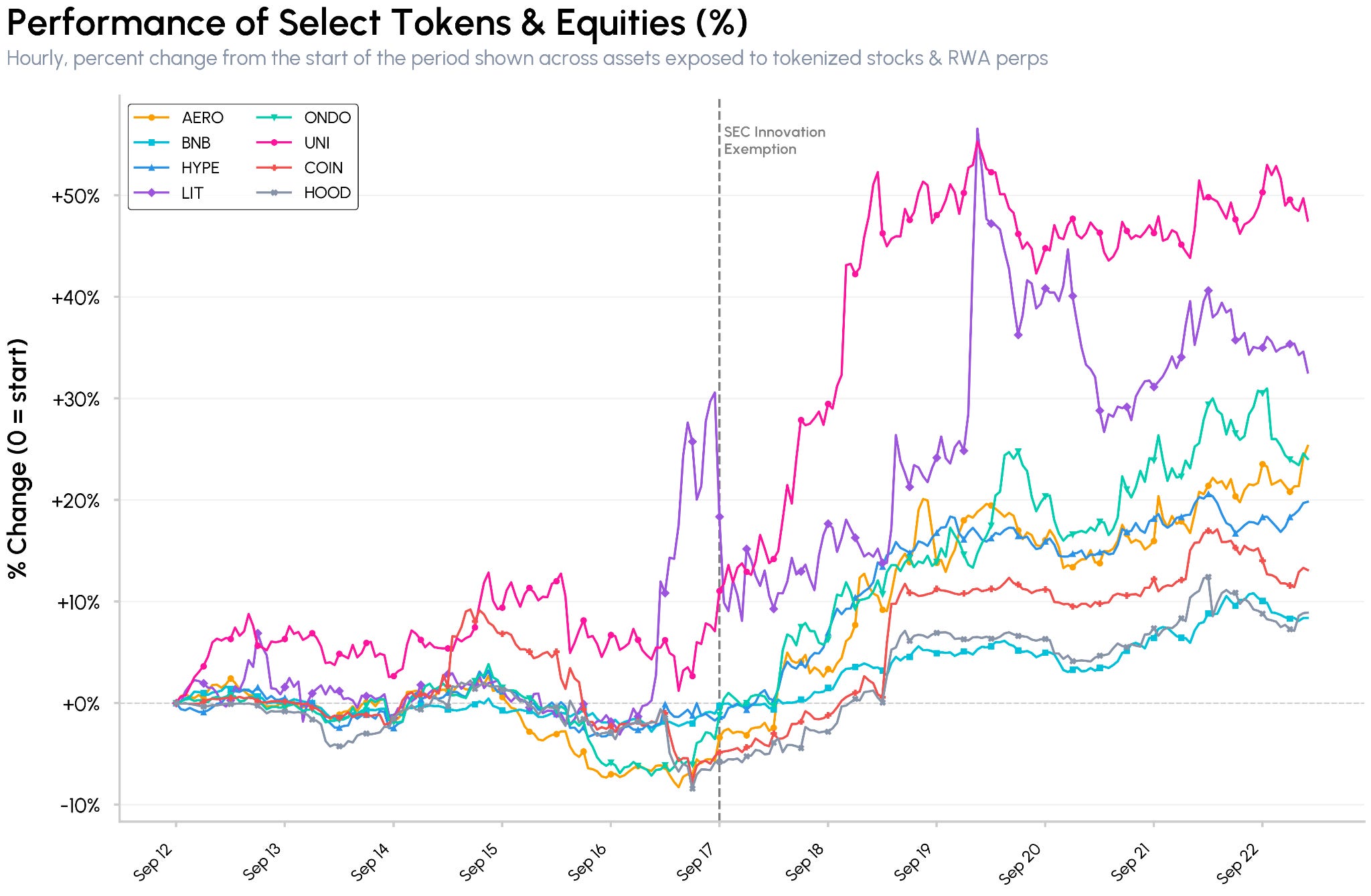
Source: Talos CM Reference Rates
Conclusion
Crypto venues are becoming multi-asset platforms, and traditional assets are adopting the 24/7, programmable structure crypto pioneered. The growth of xStocks, bStocks, Coinbase’s B20, Robinhood Stock Tokens, and RWA perpetuals shows that demand is emerging across both spot and derivative forms of equity exposure.
The models of tokenization sit across a spectrum, from issuer-native equity to custodial exposure to pure derivatives. Each trades ownership for accessibility. Which model wins out is yet to be seen, as we sit in the early innings of adoption. For exchanges, the opportunity is a more diversified revenue base and for the market, the line between crypto and traditional assets continues to blur.
Disclaimer: The information herein is provided for informational purposes only. Talos Trading, LLC and its affiliates (“Talos”) does not give any representations or warranties in relation to the accuracy, validity, or completeness of the information of this material, including without limitation the factual information obtained from publicly available sources considered by Talos to be reliable at the time. Talos accepts no liability for any consequences of using the information contained in this material. Any opinions or estimates expressed herein reflect a judgment made by the author(s) as of the date of publication and are subject to change without notice. Neither this material nor any copy thereof may be taken, reproduced, or redistributed, directly or indirectly, without Talos’s prior written permission. Any views or opinions expressed are those of the authors and do not necessarily reflect the views of Talos. This communication does not constitute an offer to buy or sell, or a promotion or recommendation of, any digital asset, security, derivative, commodity, financial instrument, or product or trading strategy. This document and information are not intended to constitute investment advice or a recommendation to make (or refrain from making) any kind of investment decision and may not be relied on as such.
Talos's State of the Network is an unbiased, weekly view of the crypto market informed by our own network (on-chain) and market data.
Subscribe
If you’d like to get State of the Network in your inbox, please subscribe below.
Latest insights and research


Request a demo
Find out how Talos can simplify the way you interact with the digital asset markets.