


Coin Metrics State of the Network is an unbiased, weekly view of the crypto market informed by our own network (on-chain) and market data.
Key Takeaways:
- Aave’s USDC pool experiences daily utilization rate spikes around midnight UTC due to $190m USDC liquidity pulled and redeposited within an hour. This affects all pool lender and borrower rates.
- Tracking flows beyond the wallet pulling USDC liquidity, we find this activity is most consistent with funds being pulled to pool assets and attest to investment holdings, taking snapshots before redepositing.
- The liquidity pull and redeposit time tightened around midnight UTC in July. This activity costs all USDC borrowers an additional $6 million per year versus if liquidity was not pulled.
Introduction
Variable-rate lending and borrowing has been a cornerstone of decentralized lending. Lending protocols use variable rates for markets to respond to changing economic conditions. One of the benefits of variable-rate decentralized lending and lending pool design is the ability to withdraw liquidity when available at any time. Lenders and borrowers have no maturity date. This provides capital flexibility at the cost of being exposed to third-party activity risk.
Fixed-rate lending markets are being built to solve the drawbacks of variable-rate markets including third-party activity risk. Because variable-rate lending pools different lending and borrowing positions, one participant’s activity can move the rate every other borrower and lender pays. While an individual borrow position may appear secure via overcollateralization, external factors such as the Kelp DAO exploit create sudden changes in liquidity which negatively impact users. Monitoring the utilization rate of a lending pool and interest minute-to-minute can reduce borrowing costs.
In this State of the Network, we explore Aave’s USDC market utilization spikes, tracking the address that incurs these spikes by pulling liquidity, and how the spikes in borrow rates affect borrowers.
How Does Aave’s Utilization Rate Work?
Aave’s dual-interest rate model incentivizes borrowing and lending based on a target utilization rate. Interest rates rise gradually when the utilization rate is below target and rise steeply when utilization rate is above the target. The utilization rate is calculated as (Total Borrowed / Total Supplied). For example, as more assets are borrowed, utilization rate approaches 1.0 or 100% of the supply is borrowed.
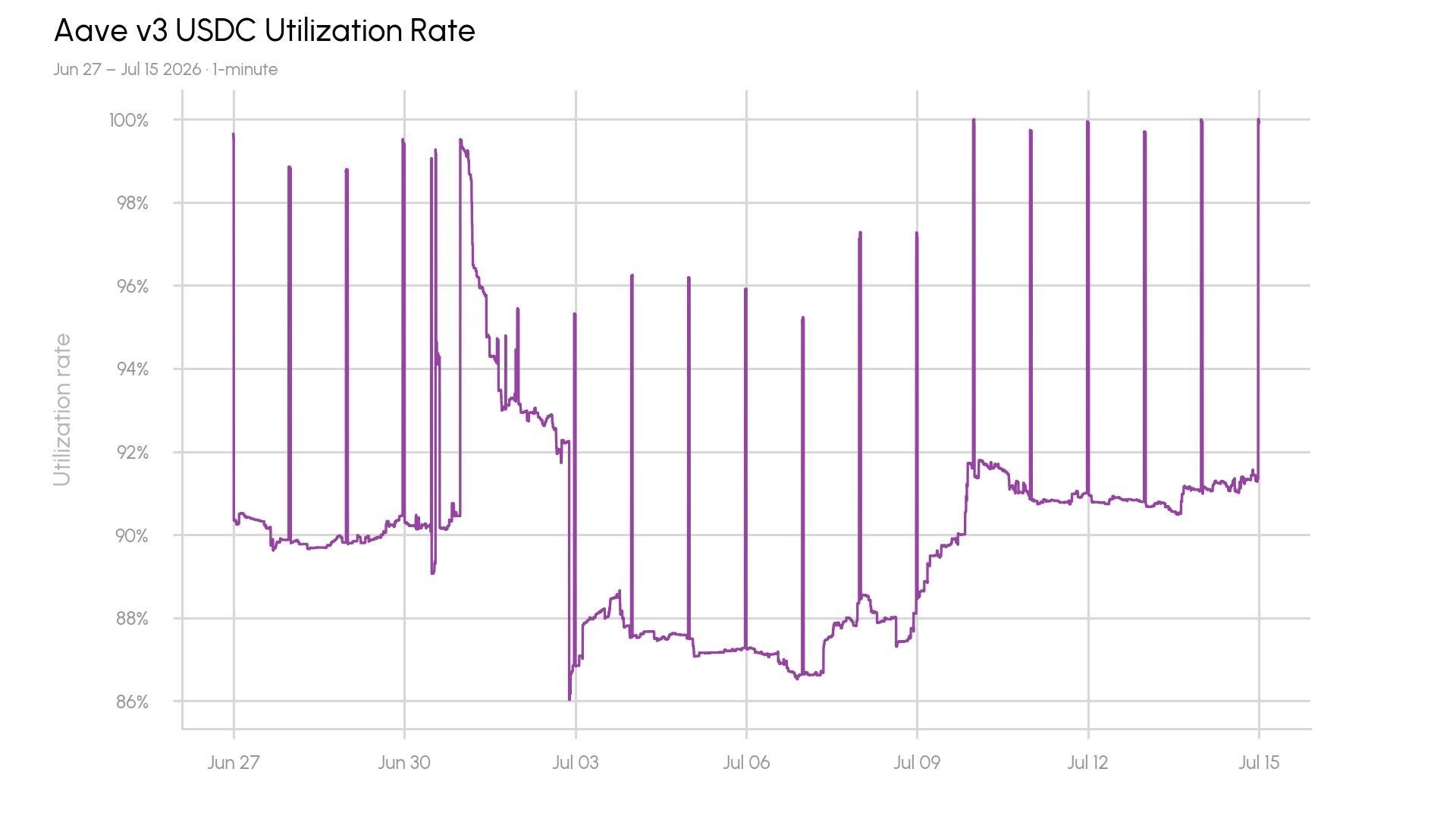
Source: Talos CM Protocol Metrics
Aave’s USDC market on its Core Instance on Ethereum has a target utilization rate of 92%. The slope of the interest rate when the utilization rate is beyond its target is steep – from 92% to 100% utilization rate, the borrow rate increases from 4% to 14%. This disincentivizes borrowing or suggests lending more USDC to satisfy demand.
The utilization rate of the Aave USDC market typically oscillates around 90%. However, since May, inspecting the minute frequency, the utilization rate shows recurring spikes.
Why are these Spikes Happening?
Barring governance adjustments or oracle manipulation, the amount of USDC lent and borrowed are the two variables impacting utilization rate.
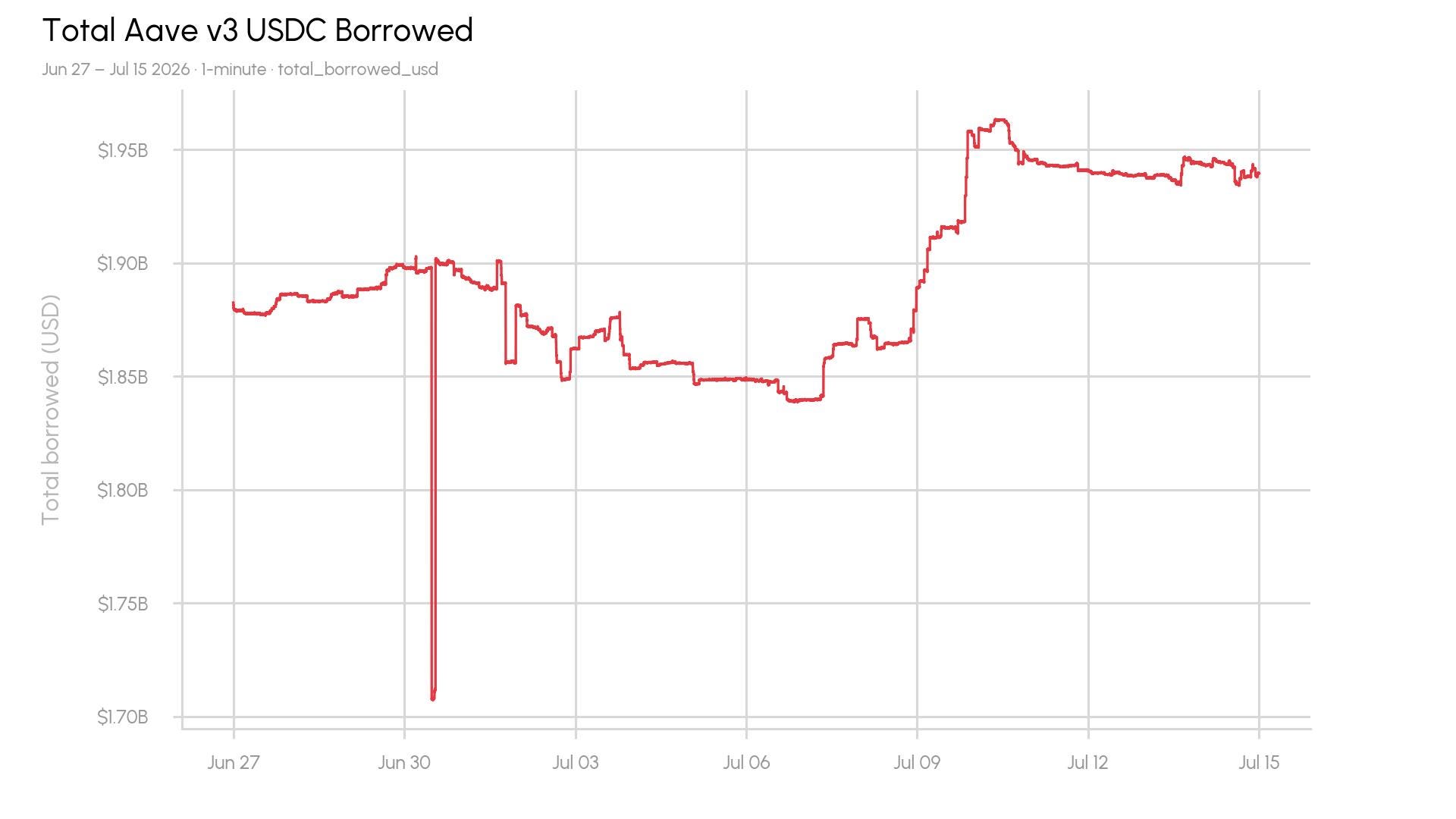
Source: Talos CM Protocol Metrics
Aside from one temporary drop in borrowings, the total borrowed is on average $1.89B since June 27. If borrowings are not consistently spiking upward – which would increase the utilization rate – the amount of USDC supplied must be spiking downward.
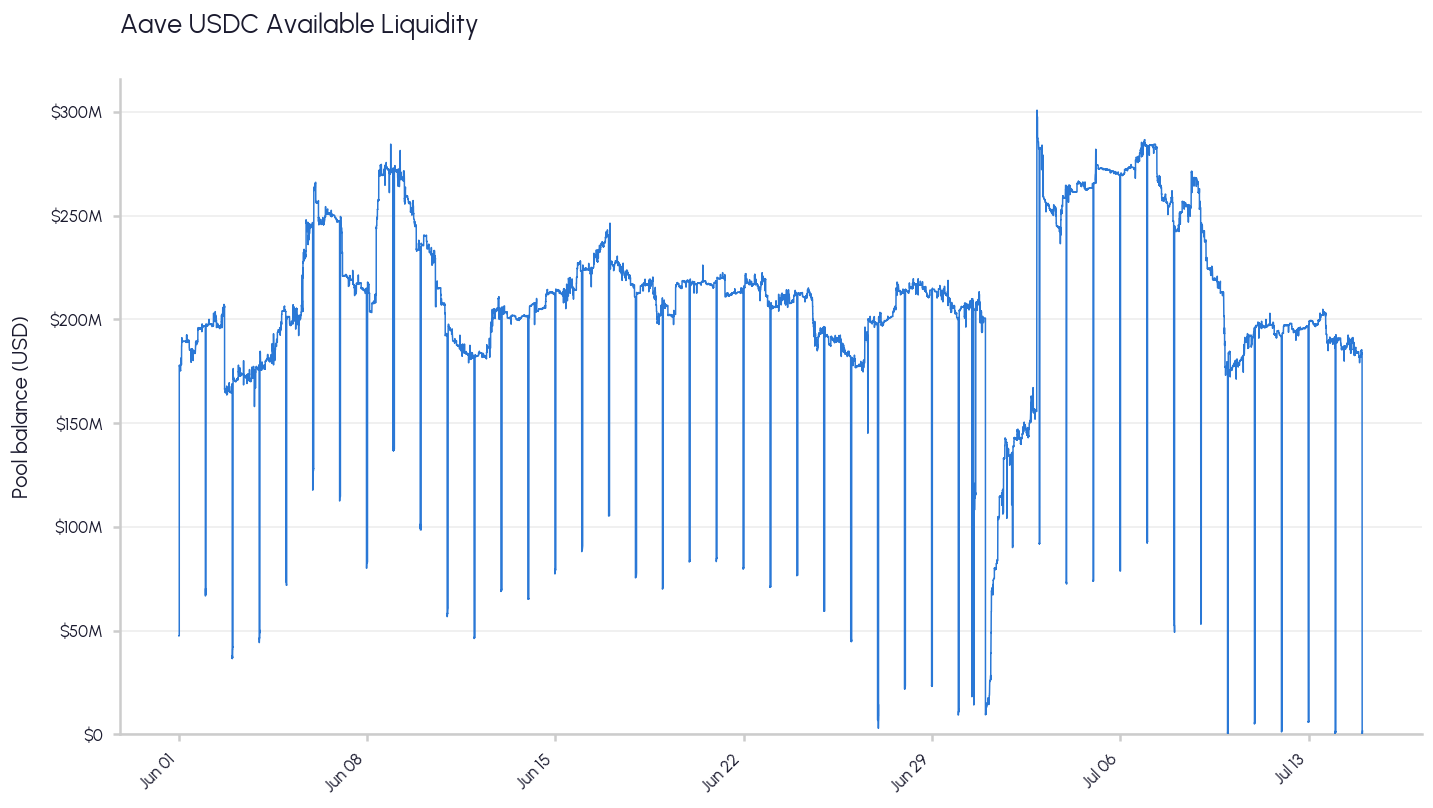
From 11:30 UTC to no later than 00:30 UTC, over 150m USDC supply is removed from the pool and added back. Available liquidity or additional supply that can be borrowed plummets from around $210m to as low as $33k.
Who is Causing these Spikes?
Ethereum’s pseudonymity allows us to publicly track the address and its transactions without revealing the user or intentions. We identified the address moving $190m every night: 0x56957E411Ea83a0B4A0689C1fB0D1e5eA0d20149.
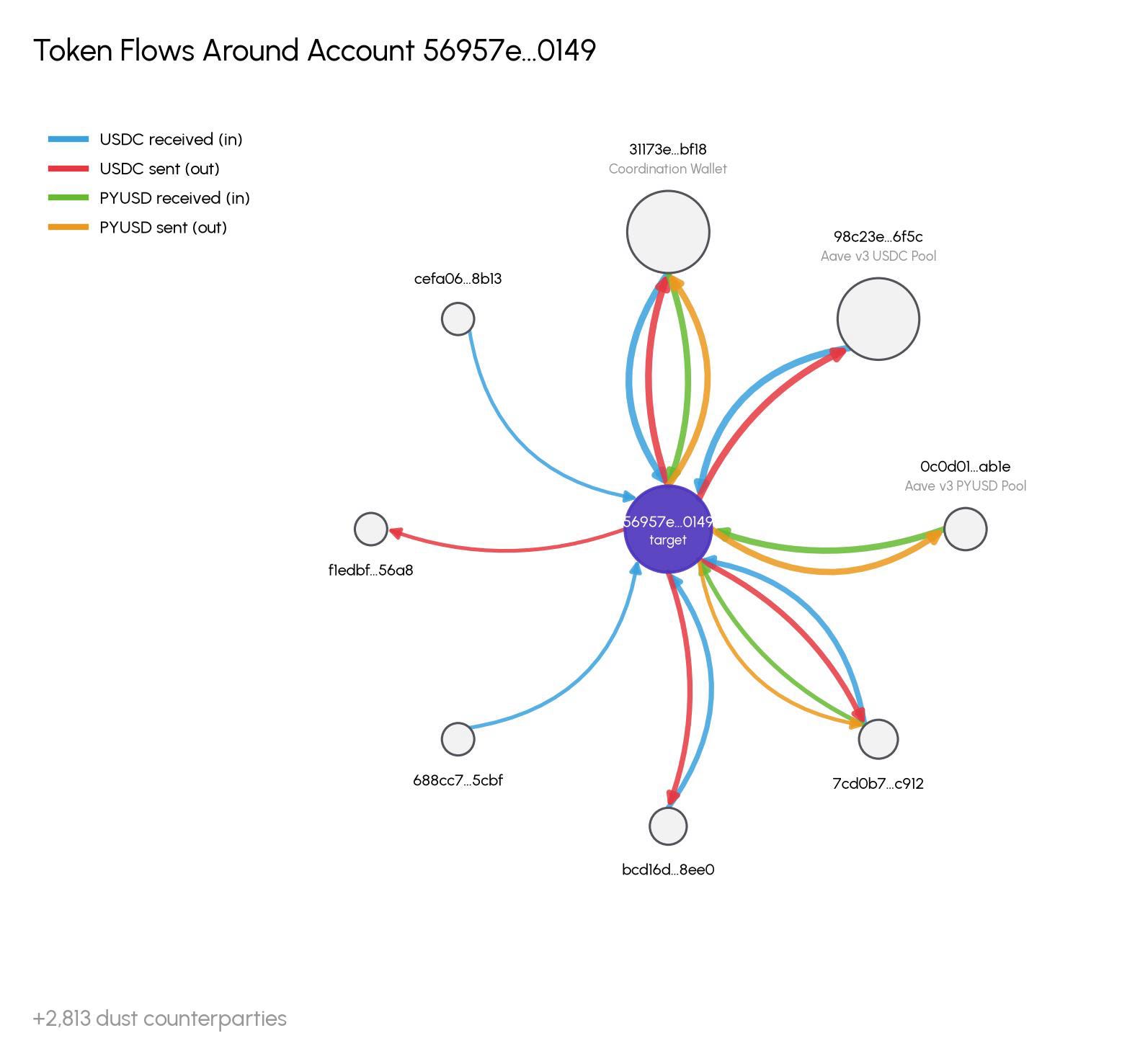
The account was funded on December 5, 2025. Looking at balance updates and flow of funds, we are able to trace that this target address conducted similar activity with Aave’s PYUSD pool in December and January. The target address receives USDC, deposits it to an Aave pool, withdraws around 23:30 UTC and sends to 0x31173Ed183e5a9450C3671018ec4d770c8A8bF18 minutes later. The USDC is then returned shortly after 00:00 UTC and deposited back into the Aave pool.
The ‘Coordination Wallet’ 31173e…bf18 receives funds from the target address and another address that earns yield by depositing USDC and holding sUSDS. The combination of these funds are sent to a third, overarching wallet every night 0xf1edbf98dda764ec51de3776371f0f7d6f6156a8.
This is potentially a process where the investor is required to attest to its holdings every day, removing liquidity from DeFi pools to take a snapshot.
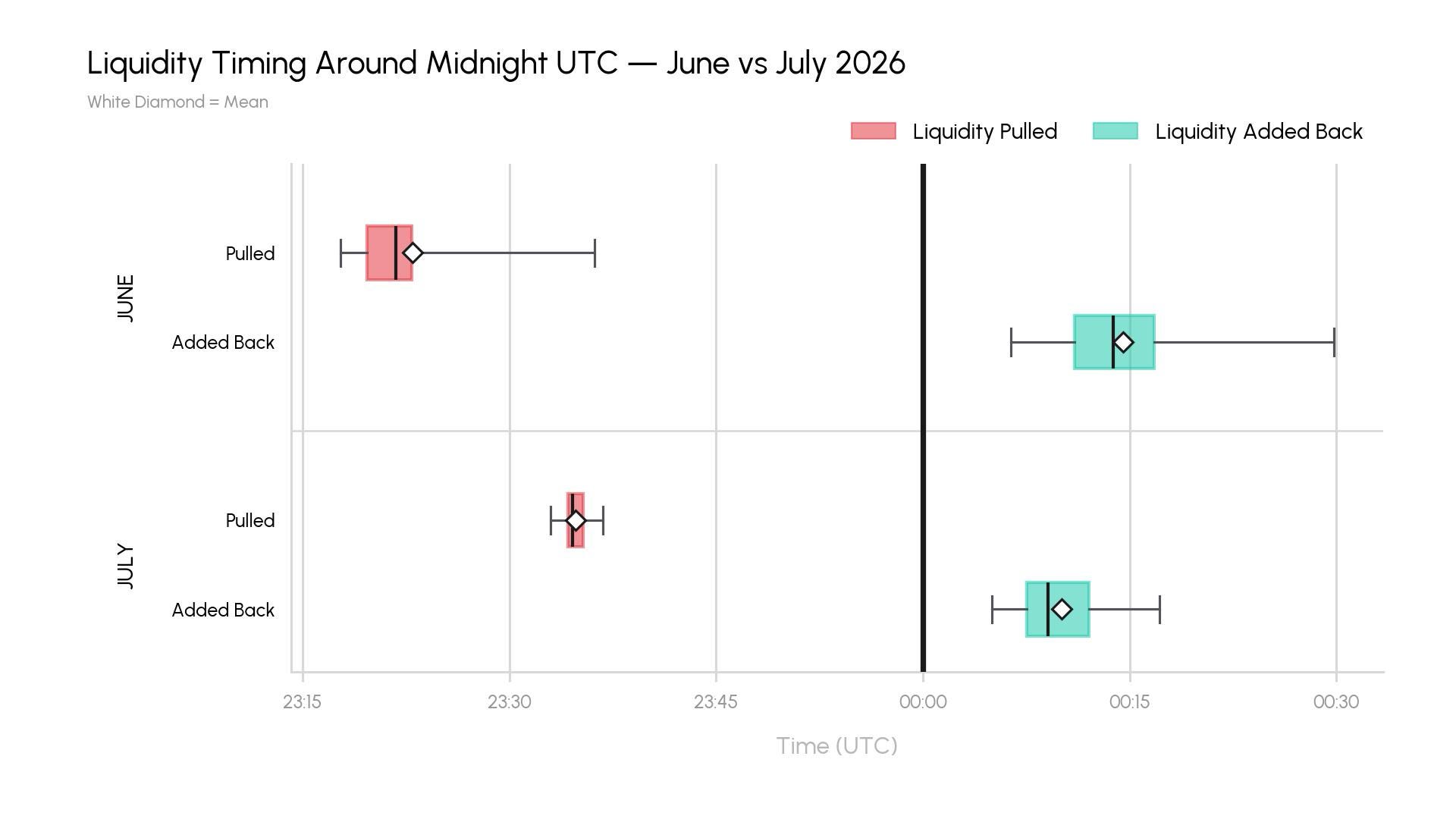
The average liquidity pulled and added back times has tightened from June to July. Liquidity pulls have shifted from 23:20 to 23:34 while add backs have shortened from 00:34 to 00:09. The time between liquidity activity in June was on average 259 blocks long whereas the spikes in July have been 177 blocks long.
How does this Affect Borrowers?
The utilization rate spiking due to liquidity being pulled is rewarding for suppliers but not for borrowers. When utilization rate spikes, the variable borrow rate spikes, leading to temporary larger payments on a block-by-block basis.
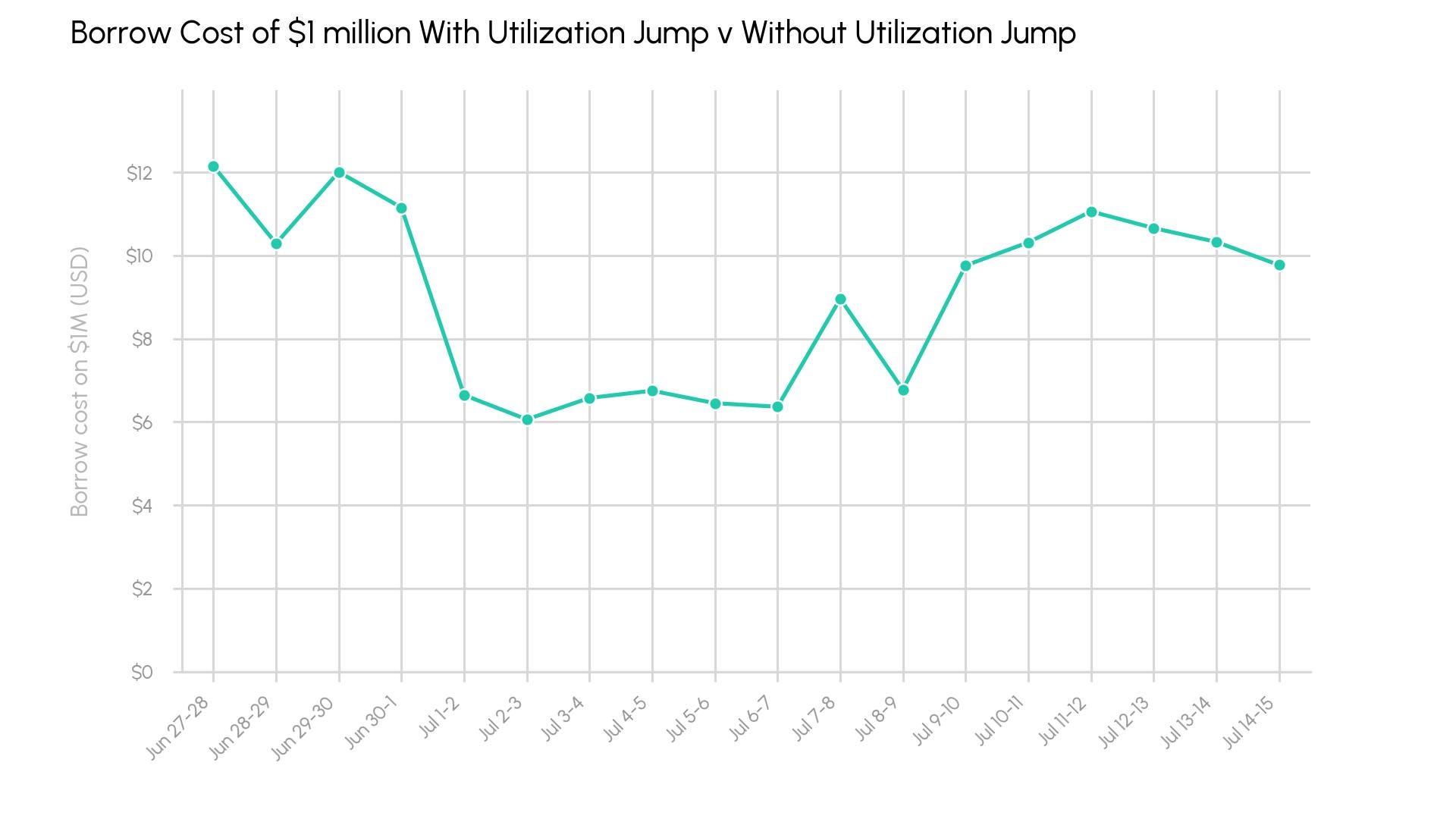
Yield or interest is streamed block-by-block on Aave. Ethereum’s average block time is 12 seconds, leading to around 5 blocks created per minute. We broke down the Variable Borrow APR and modeled how a $1m borrow position would be affected by the change in borrow rate per minute.
Source: Talos CM Atlas & Talos CM Protocol Metrics
Over 18 days, borrowers pay on average $9 more per day on a $1m borrow position when liquidity is pulled versus simulating when liquidity is not temporarily altered. This would cost around $3,280 per year. Across the total $1.89B borrowed from the USDC pool, this costs all borrowers $17,000 more per night or $6m per year. Borrowers are paying more because of activity unrelated to their own loans.
Why is this Important?
We suggest these consistent utilization spikes are most consistent with a fund attesting to its holdings. Building regulations and improving workflows around DeFi investment can help reduce these negative effects on lending pools. The transparency of the blockchain helps track funds through blockchain protocols without having to send to designated addresses to prove the funds exist and are in control of the approved parties.
Today, lenders and borrowers must not only monitor the health of their own positions but positions across the pool as well. Tracking funds and deciphering their intentions can help assess new risks, anticipating shifts in liquidity and interest rates.
Subscribe and Past Issues
Coin Metrics State of the Network is an unbiased, weekly view of the crypto market informed by our own network (on-chain) and market data.
If you’d like to get State of the Network in your inbox, please subscribe here. You can see previous issues of State of the Network here.
Disclaimer: The information herein is provided for informational purposes only. Talos Trading, LLC and its affiliates (“Talos”) does not give any representations or warranties in relation to the accuracy, validity, or completeness of the information of this material, including without limitation the factual information obtained from publicly available sources considered by Talos to be reliable at the time. Talos accepts no liability for any consequences of using the information contained in this material. Any opinions or estimates expressed herein reflect a judgment made by the author(s) as of the date of publication and are subject to change without notice. Neither this material nor any copy thereof may be taken, reproduced, or redistributed, directly or indirectly, without Talos’s prior written permission. Any views or opinions expressed are those of the authors and do not necessarily reflect the views of Talos. This communication does not constitute an offer to buy or sell, or a promotion or recommendation of, any digital asset, security, derivative, commodity, financial instrument, or product or trading strategy. This document and information are not intended to constitute investment advice or a recommendation to make (or refrain from making) any kind of investment decision and may not be relied on as such.
Subscribe
If you’d like to get State of the Network in your inbox, please subscribe below.
Latest insights and research
.jpg)


Request a demo
Find out how Talos can simplify the way you interact with the digital asset markets.