

Following the Funding: The Shift Towards the Equity Basis Trade
State of the Network #390
Following the Funding: The Shift Towards the Equity Basis Trade

Introduction
State of the Network #390
Key Takeaways
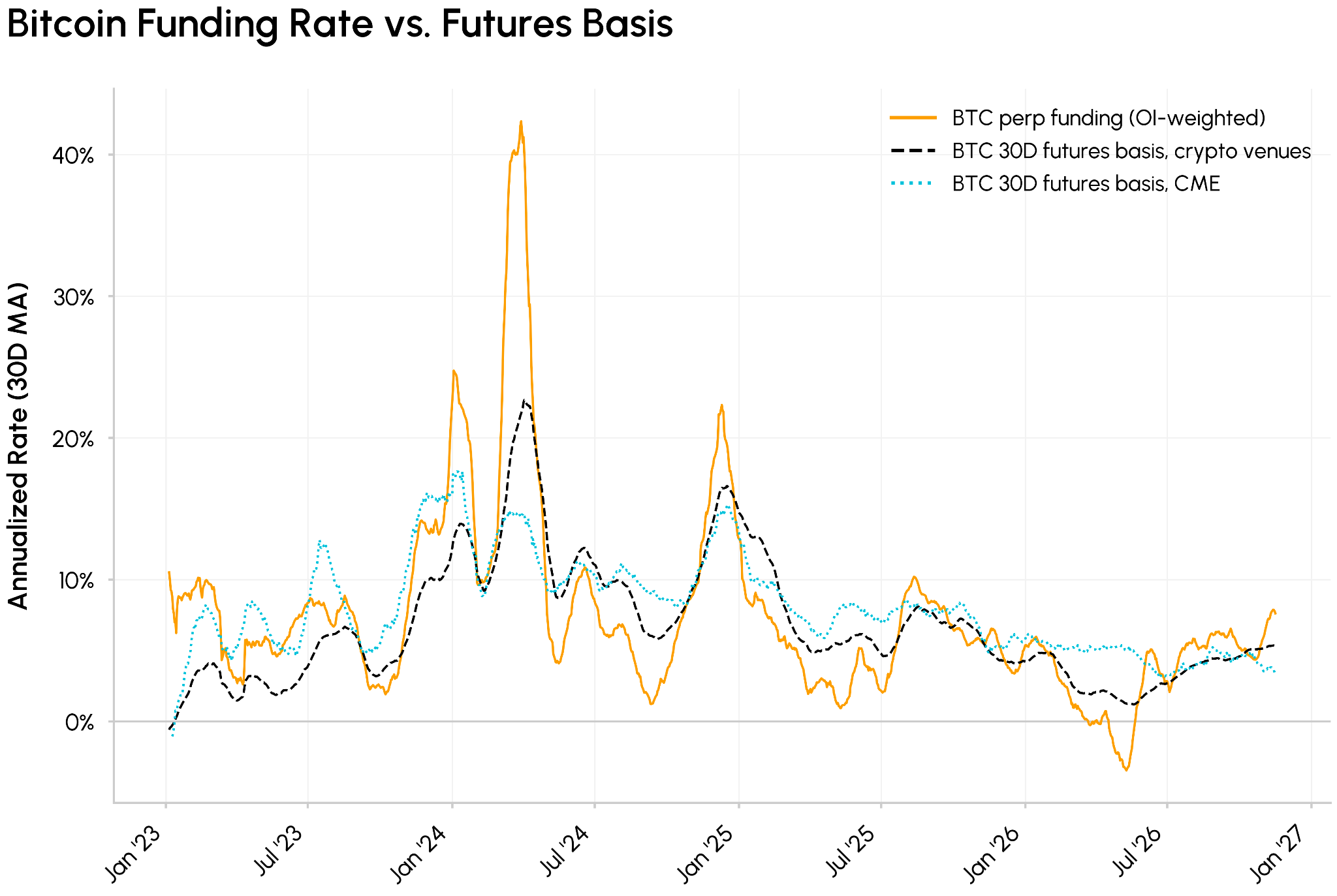
- The crypto basis trade has compressed in 2026. BTC perp funding and the 30-day futures basis peaked at 20–40% annualized in early 2024 and have fallen to ~3–5% in 2026, near or below Treasury yields.
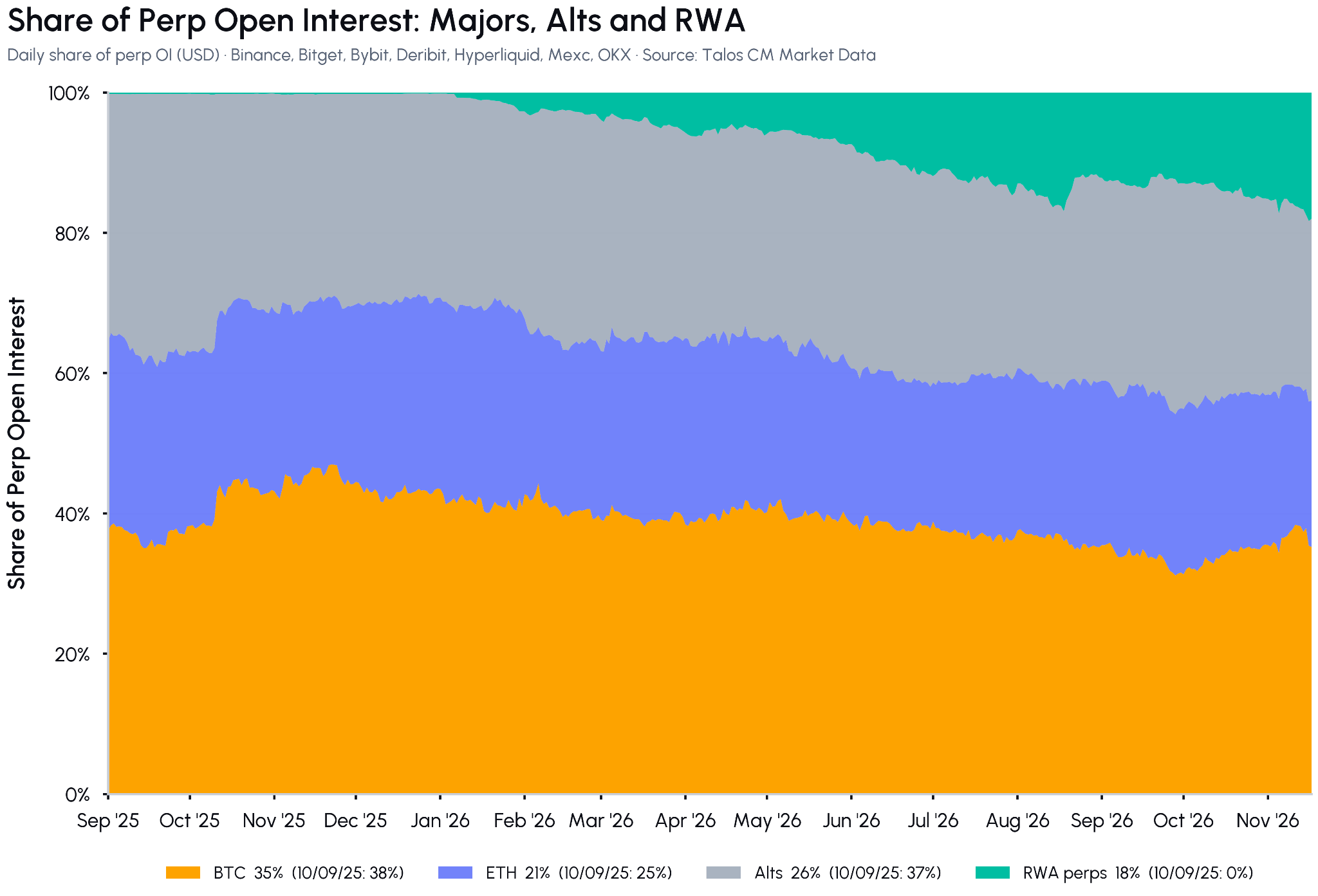
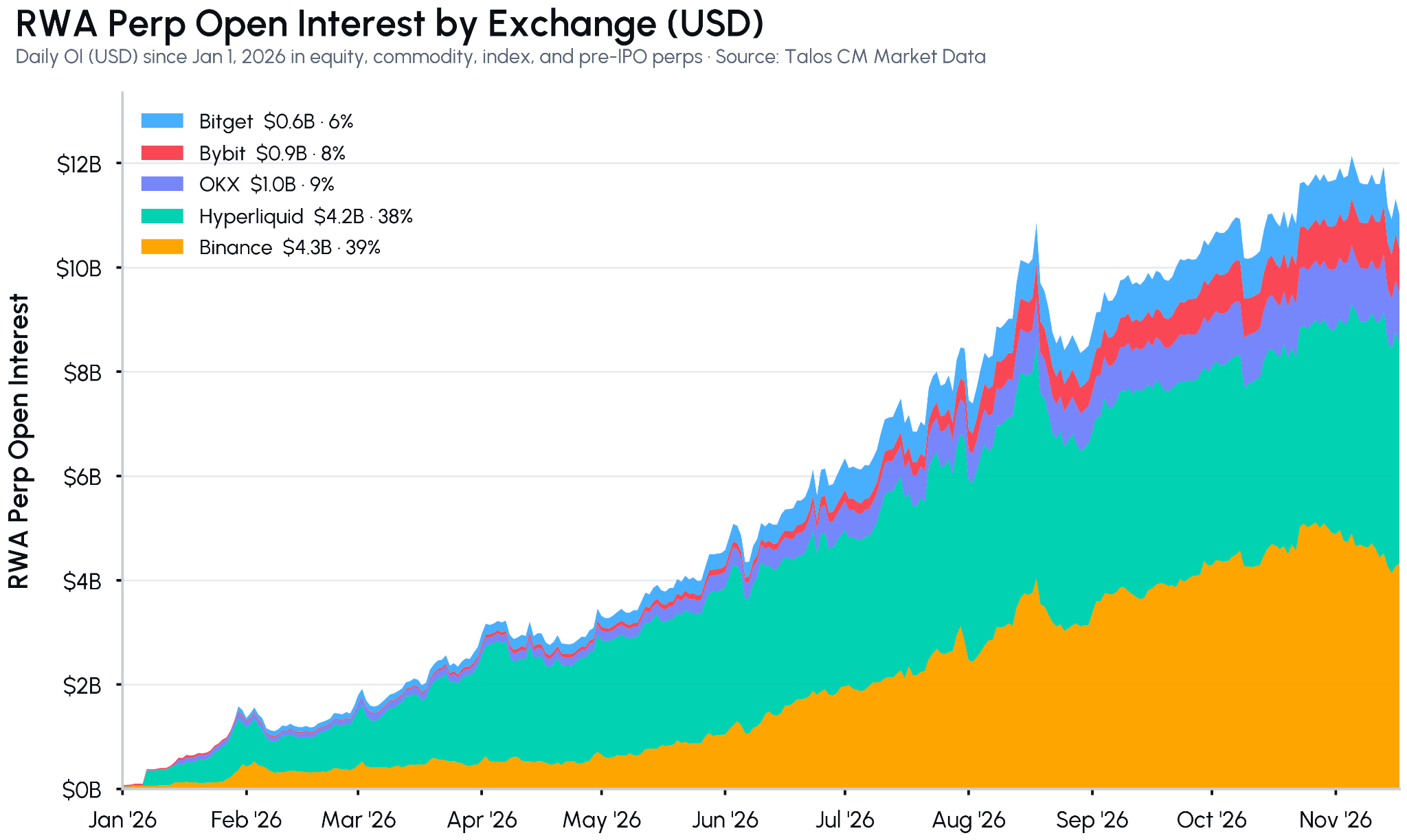
- RWA perps have grown from ~0% to ~18% of perp open interest across major venues since October 2025, to over $11B. Binance (39%) and Hyperliquid (38%) hold most of it.
- Equity perps pay a larger premium, with the top 10 equity perps by OI averaging ~11% annualized funding in 2026 vs ~3% for the top 10 crypto perps. The gap has narrowed since August, leaving returns dependent on venue and asset selection.
- With the CFTC confirming that single-stock perps can trade on regulated U.S. exchanges, and Kalshi passing $3B in volume within weeks, equity perps could reach a much broader base of traders, creating new opportunities for both directional exposure and basis trades.
Introduction
The basis trade, or “cash and carry,” became a popular strategy with the launch of spot Bitcoin ETFs in 2024. It involves buying spot Bitcoin (or a spot Bitcoin ETF) while shorting an equivalent futures position to offset directional price exposure, collecting the “basis yield.” By 2025–2026, that yield compressed significantly as institutional participation matured, at times dipping below U.S. Treasury yields.
Meanwhile, perpetuals linked to real world assets (RWAs) such as equities, indices and commodities have grown rapidly, opening the same trade in an entirely new asset class. On November 3rd, the CFTC confirmed that perpetual futures on individual stocks can trade on regulated U.S. exchanges for the first time. As U.S. venues join existing markets like Binance and Hyperliquid, equity perps could attract a broader base of traders and institutional capital.
In this issue, we examine how the crypto basis trade has compressed and why equity perps are emerging as an alternative asset class for delta neutral strategies. We compare funding across the largest crypto and equity perps, look at how fragmentation across exchanges shapes where the trade can be executed, and test whether the premium is capturable using tokenized stocks on Binance.
Compression of the Crypto Carry Trade
Perpetual futures have no expiry date and instead use periodic funding payments between longs and shorts to keep their prices aligned with the underlying asset. When funding is positive, longs pay shorts, allowing a hedged investor to collect the payments.
The BTC perpetual funding rate and the 30-day futures basis, which peaked at 20–40% annualized in early 2024, has settled around 3–5% in 2026. Funding briefly turned negative in Q2 2026. At par or below Treasury yields, this leaves little reward for a hedged crypto position.
Source: Talos CM Market Data Pro
Ethena “tokenized” this delta-neutral strategy, and made it accessible onchain with the launch of USDe in February 2024. Its structure paired crypto holdings with offsetting short futures positions, and its staked form, sUSDe, accrued funding payments and staking rewards. Ethena’s crypto basis allocation reached a peak of over $8B, however, the October 10th collapse in open interest brought the basis premium to historical lows. Since then, the market cap of USDe dropped from a peak of over $14B to $4.5B today.
Growth in Equity Perps
Perpetuals tied to real world assets (RWAs) have gone from virtually nothing to ~18% of perp open interest across major venues since October 2025, reaching over ~$11B in November 2026. Global retail and institutional interest is rising for 24/7 products to speculate or hedge exposure in traditional finance investments including equities, indices, and commodities.
Source: Talos CM Market Data Pro
Through mid-2026, Hyperliquid held the majority of RWA perpetuals open interest, but centralized exchanges have surged in the second half of the year to take a larger share. Binance now accounts for 39%, or $4.3B in open interest across the top five exchanges, with regulated U.S. entrants like Kalshi also joining the market on the back of CFTC guidance for single stock perps.
Source: Talos CM Market Data Pro
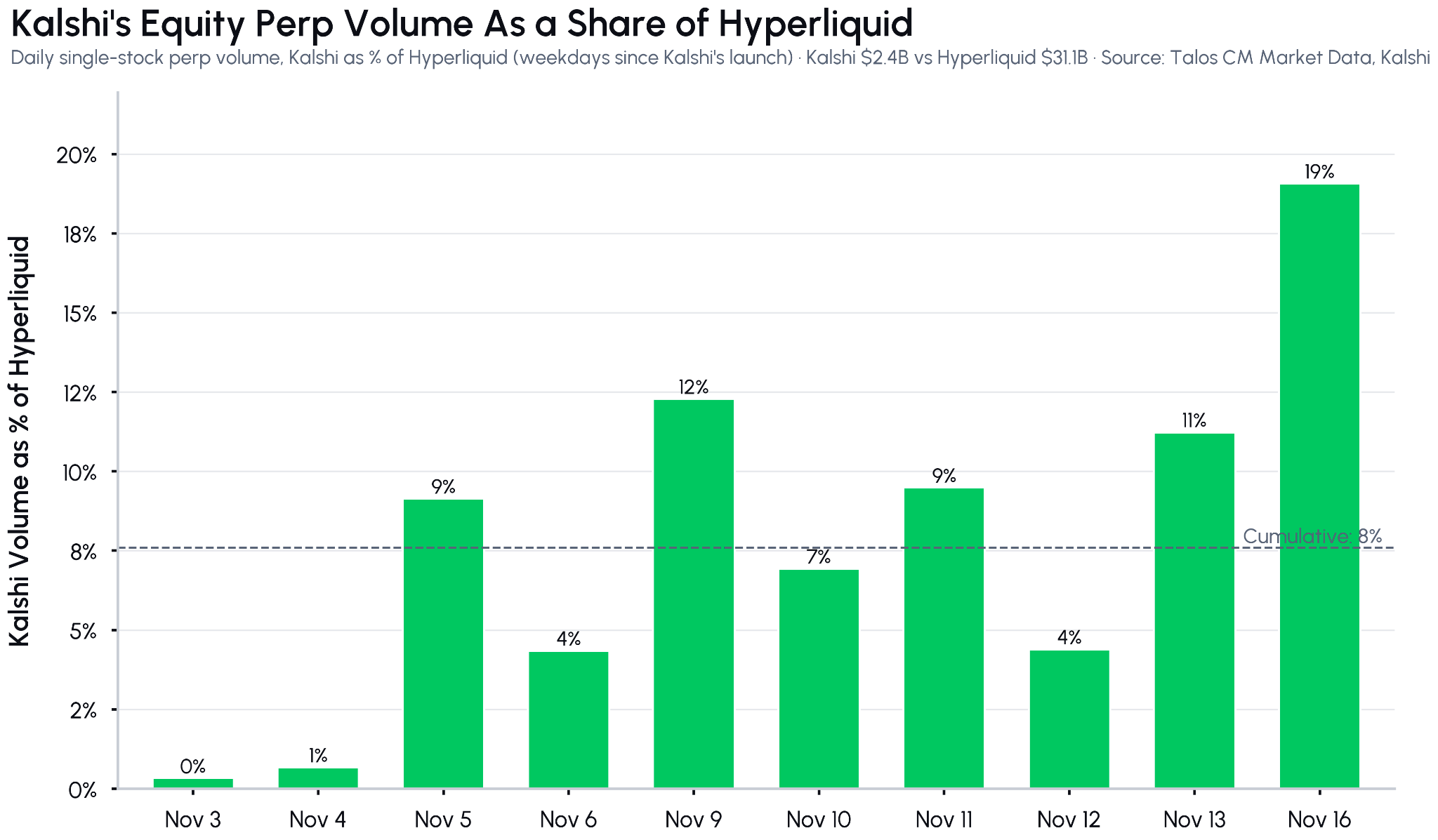
Since launching its equity perpetual contracts in early November, Kalshi has already seen $3B in cumulative volume across 58 single name stocks vs. ~118 stocks listed on Hyperliquid. On weekdays since launch, it has traded roughly $2.4B in single stock perps vs $31B on Hyperliquid, about 8% of the onchain leader’s volume, peaking at 19% on November 16th.
That’s an impressive start for a 2-week old venue and the first regulated U.S. market for single stock perps. It also reflects a broader push toward the “everything exchange,” where platforms that started in stocks, crypto or prediction markets increasingly offer all three, plus perps, in one account.
Source: Talos CM Market Data Pro, Kalshi
Comparing Funding Rates Across Crypto & Equity Perpetuals
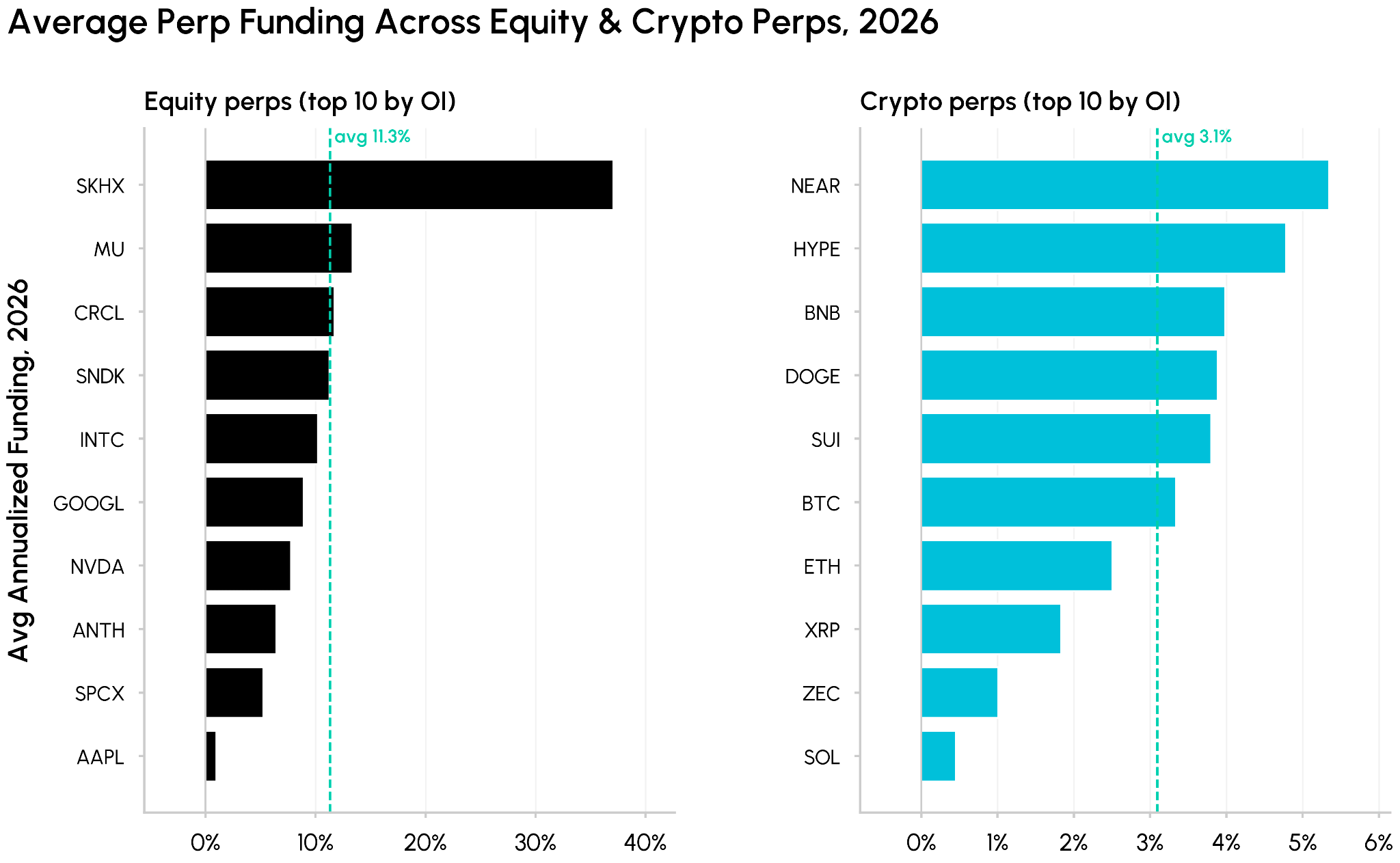
The top 10 equity perps by OI averaged ~11% annualized funding in 2026 vs ~3% for the top 10 crypto perps. The premium was led by memory names like SK Hynix, Micron and SanDisk, where demand for leveraged, around-the-clock exposure has been strongest, including Korean listings that are harder for global investors to access directly. Even excluding SK Hynix, equity perps averaged roughly 8%, more than double crypto. Pre-IPO perps such as Anthropic now also rank among the largest equity perps, offering exposure before public listing.
Source: Talos CM Market Data Pro
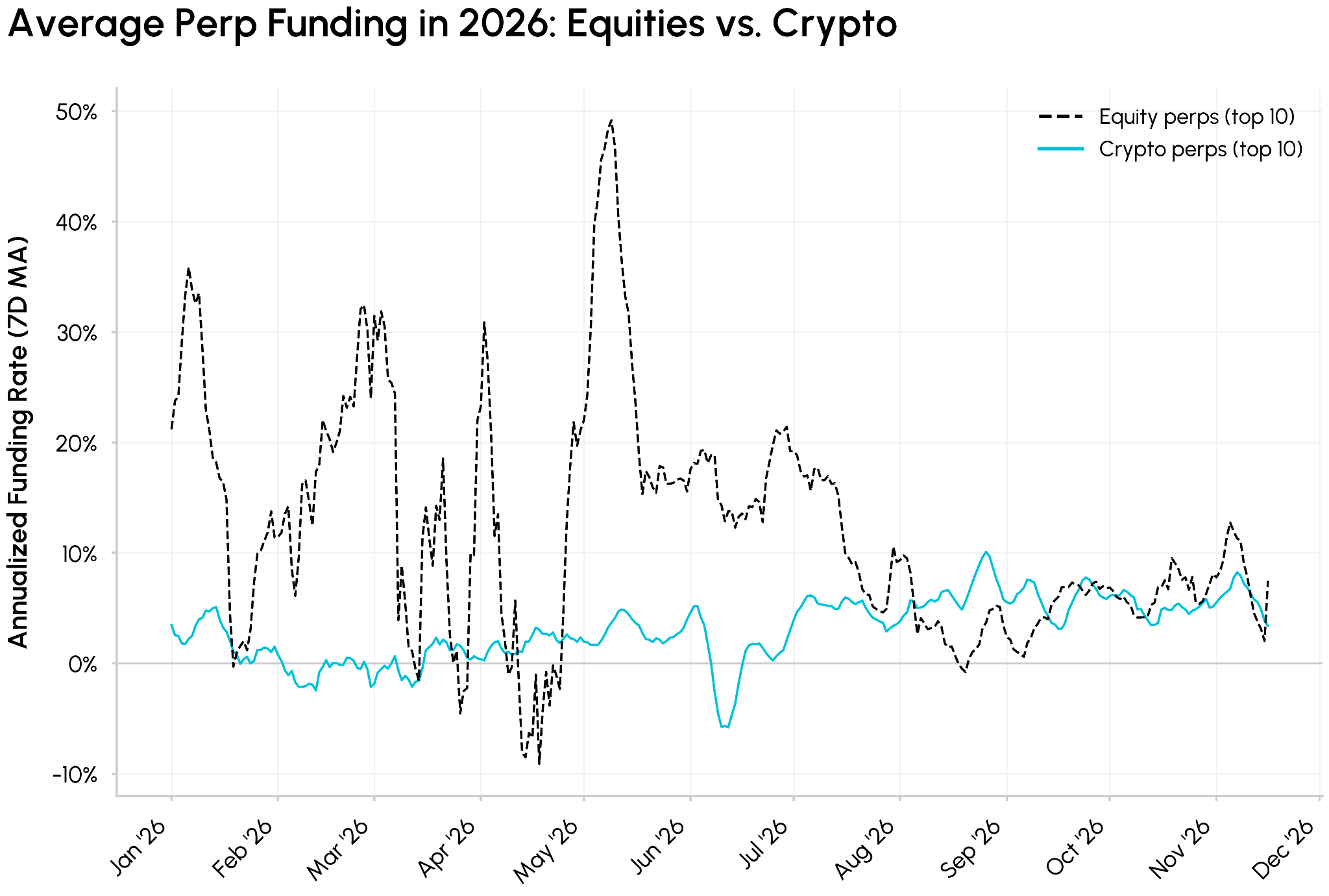
The premium was largest and most volatile in the first half of 2026, when equity funding frequently exceeded 20% while crypto hovered near zero. Since August, the two have converged as equity funding cooled and crypto funding recovered. Equity funding has also moved largely independently of crypto, making it a source of diversification for delta neutral strategies and exchange volumes.
Source: Talos CM Market Data Pro
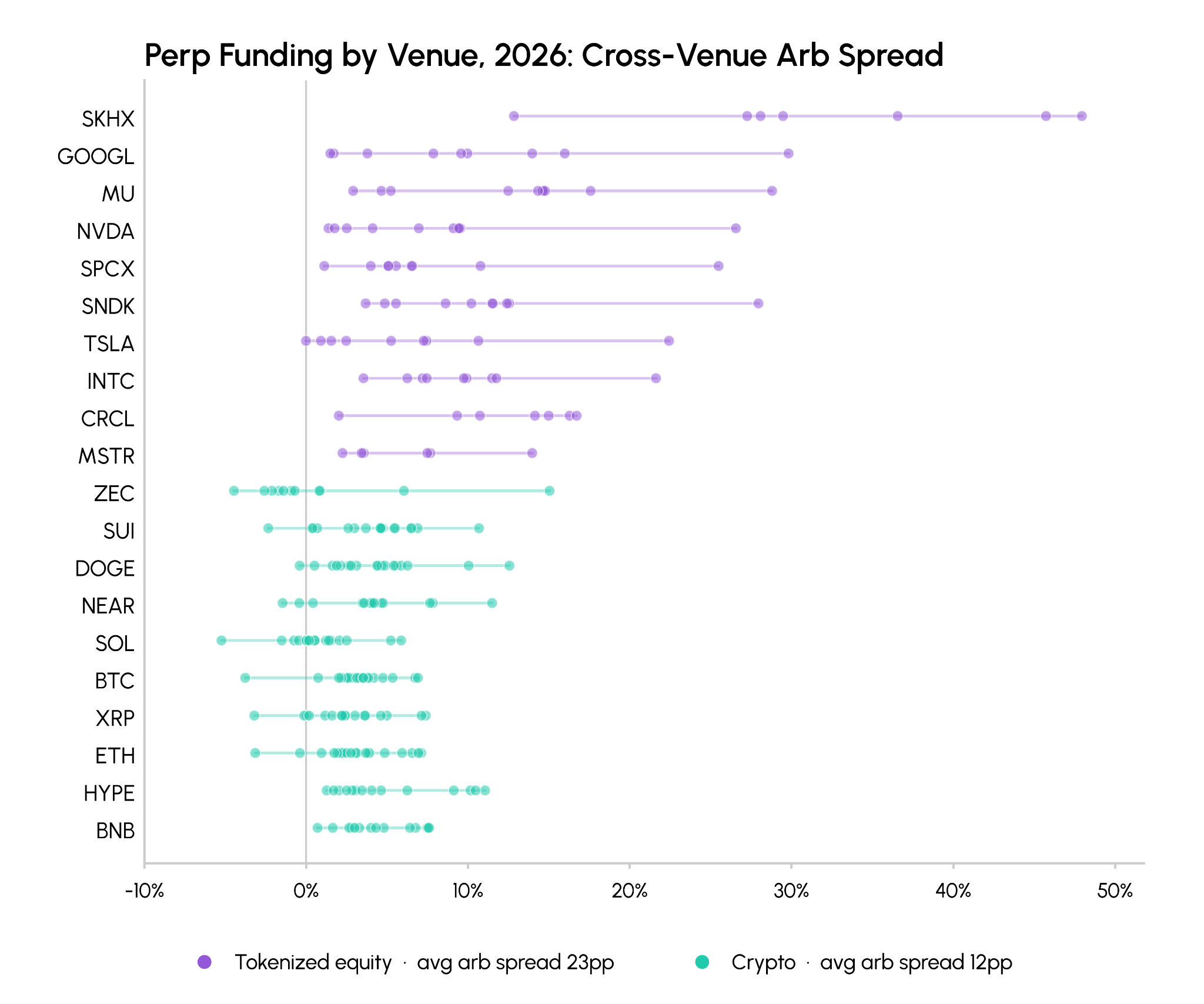
Funding spread between venues for the same equity perp are nearly 2x crypto perps. The average spread for the top 10 equity perps by OI is 23% while the average spread for the Top 10 crypto perps is 12%. This wider spread means the funding earned on the same equity perp can differ significantly depending on the venue, opening the door to cross-venue arbitrage.
Source: Talos CM Market Data Pro
The Tokenized Stock Basis Trade on Binance
With exchanges now offering spot tokenized stocks alongside perps (as we covered in “The Race for Tokenized Stocks & The Path Ahead”), the basis trade is also becoming a viable opportunity for equities on a single venue.
Binance’s tokenized stocks (bStocks), which have traded over $13B in spot volume over the past three months, provide a tangible example. Binance’s tokenized bStocks matched with its equity perp market offer both legs of the equity basis trade. Users can hold long exposure to the tokenized stock, while going short the perpetual future to collect the funding rate, all housed under the same exchange.
As we found in Stock Market that Never Sleeps, Binance’s NVDAb offered the lowest slippage among tokenized NVDA variants in 96% of observations, though liquidity across tokenized equity markets thins out when U.S. markets are closed.
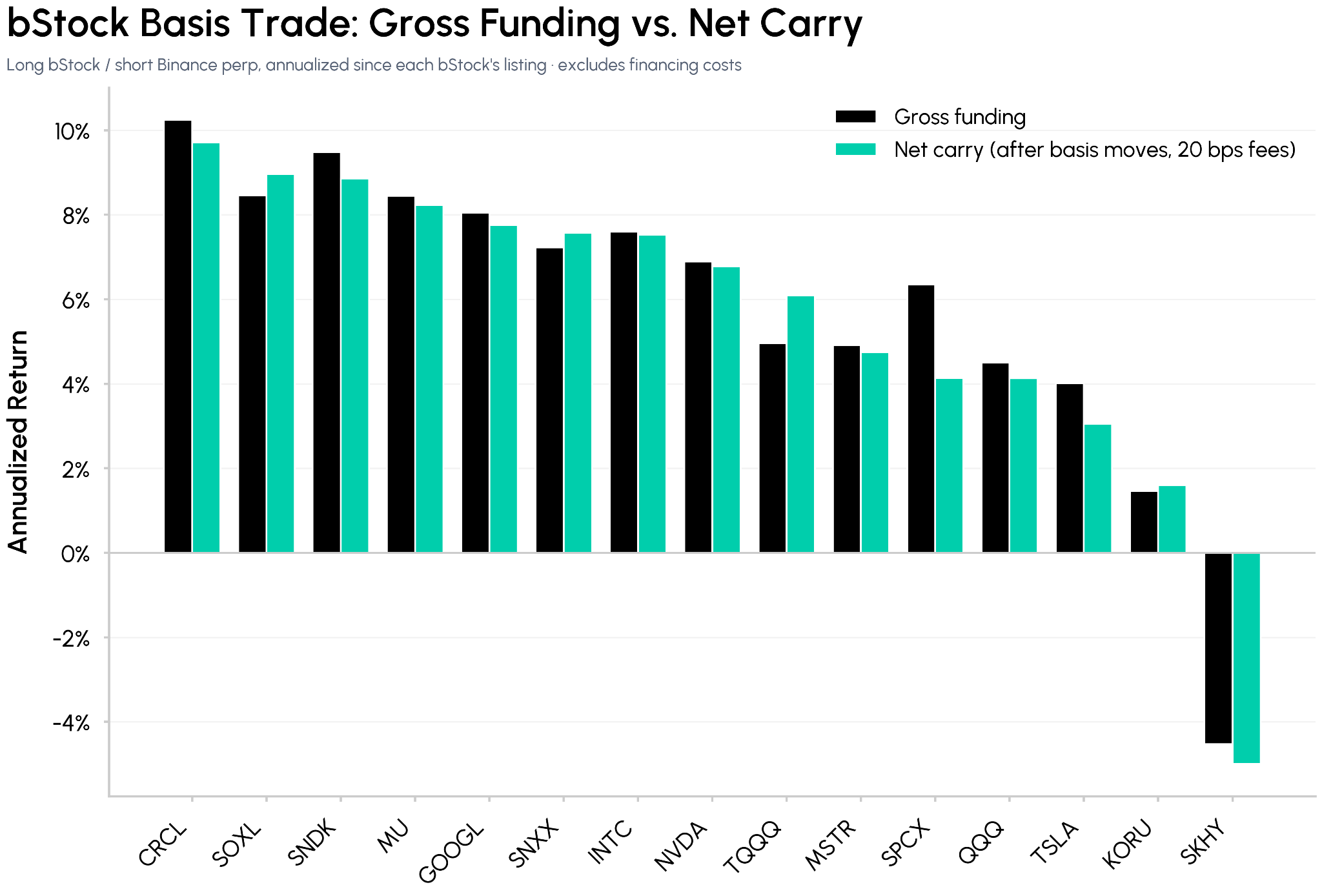
Source: Talos CM Market Data Pro (Gross funding is the annualized funding collected on the short perp. Net carry adjusts for changes in the price gap between the bStock and the perp, and an assumed 20 bps round-trip trading cost. Financing costs are excluded)
Across Binance’s largest bStocks, net carry closely tracked gross funding. Single names such as CRCL, SNDK, MU and NVDA would have earned roughly 7–10% annualized, while SK Hynix turned negative as funding turned.
What This Means for Delta Neutral Strategies
Our analysis shows the basis trade hasn’t disappeared, but has broadened into a new asset class. Over 2026, the top equity perps paid roughly 11% annualized in funding vs ~3% for crypto, and cross-venue spreads ran about twice as wide. The basis trade on the same venue with Binance bStocks and perps would have netted roughly 7–10% on most single names. The premium reflects structural frictions, fragmented liquidity and strong demand for 24/7, leveraged stock exposure.
Equity funding has started to converge toward crypto levels since August as more capital has moved in. The returns that remain depend on venue and asset selection, and on managing the risks such as prices drifting when U.S. markets are closed, funding rates that can turn quickly, and financing costs that can eat into headline yields.
As regulated U.S. venues begin listing single-stock perps, equity perp liquidity is likely to spread across more venues. That makes a consolidated view of funding, basis, open interest and liquidity across venues important to gauge where opportunities emerge.
Disclaimer: The information herein is provided for informational purposes only. Talos Trading, LLC and its affiliates (“Talos”) does not give any representations or warranties in relation to the accuracy, validity, or completeness of the information of this material, including without limitation the factual information obtained from publicly available sources considered by Talos to be reliable at the time. Talos accepts no liability for any consequences of using the information contained in this material. Any opinions or estimates expressed herein reflect a judgment made by the author(s) as of the date of publication and are subject to change without notice. Neither this material nor any copy thereof may be taken, reproduced, or redistributed, directly or indirectly, without Talos’s prior written permission. Any views or opinions expressed are those of the authors and do not necessarily reflect the views of Talos. This communication does not constitute an offer to buy or sell, or a promotion or recommendation of, any digital asset, security, derivative, commodity, financial instrument, or product or trading strategy. This document and information are not intended to constitute investment advice or a recommendation to make (or refrain from making) any kind of investment decision and may not be relied on as such.
Latest insights and research


Request a demo
Find out how Talos can simplify the way you interact with the digital asset markets.